Break-Even Analysis: Formula & Examples
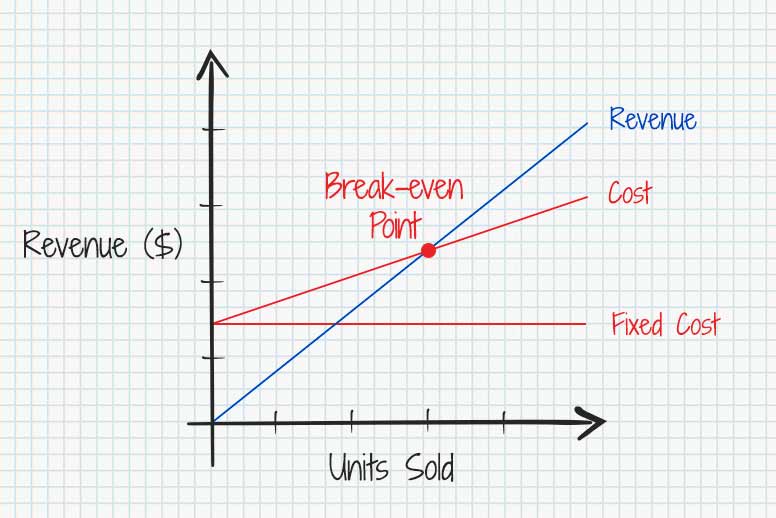
Table of Contents
Calculating your break-even point is important for making smart business decisions. This metric shows exactly when your revenue will cover all of the costs of running your business. When you’ve done your break-even analysis and you know your break-even point, it helps you set prices and manage expenses. With this information, you can plan for profitability.
In this guide, you’ll learn how to calculate the break-even point, understand the formula, and use it to improve your financial planning. You can also use our free break-even point calculator to do most of the work.
How to Calculate the Break-Even Point?
Calculating your break-even point is easy once you know your fixed costs, variable costs, and selling price. By following a few simple steps, you can determine how many sales you need to cover your expenses and start making a profit.
To calculate the Break-Even Point in Units, you have to use the following formula.
Break-Even Point (Units) =
Fixed Costs / (Selling Price per Unit − Variable Cost per Unit)
If you need to calculate the Break-Even Point in Sales, you need to use the following formula:
Break-Even Point (Sales) =
Fixed Costs / Contribution Profit Margin
What is the Break-Even Point?
The Break-Even Point is a formula that allows companies and accounting departments to know when they will start becoming profitable.
The break-even point is the point where your total revenue equals your total costs, so your business is not making a profit or a loss. In cost accounting, calculating the break-even point helps you understand how many products or services you need to sell to cover your fixed and variable costs before you start earning a profit.
- Shows when your business starts becoming profitable.
- Helps set sales and pricing goals.
- Supports budgeting and cost accounting decisions.
- Makes it easier to plan for growth and manage expenses.
Break-Even Point definition
To be more precise, the Break-Even Point is that moment when the company’s income equals the expenses, so there is neither benefit nor loss.
There are several ways to calculate the Break-Even Point: by units, by sales, by target, by tax consideration, etc.
In this article, we will analyze and share some examples of the best way to calculate it.
How to Calculate it in Units?
Break-Even Point (Units) = Fixed Costs / (Sales Price per Unit – Variable Costs per Unit)
At the Break-Even Point (BEP), your business isn’t losing money, but it’s not making a profit either.
Once you pass this point, every sale starts to add to your profit.
For business owners, especially when starting their business, one of the most important questions is: “When will my business reach the break-even point?”
All businesses aim to become profitable to keep running long-term.
Here’s a simple formula to help contractors figure out their break-even point:Let’s break it down:
- Fixed Costs: These are expenses that stay pretty much the same each month, like rent or utility bills. Whether you’re doing a lot of jobs or just a few, these costs don’t change much.
- Sales Price per Unit: This is the price you charge for one job or service. For example, if you charge $500 for a carpentry job, that’s your sales price per unit.
- Variable Costs per Unit: These are the costs that go up or down depending on how much work you’re doing. Think of things like materials and labor costs. These expenses change with each job and usually make up the biggest part of your budget.
Here’s how to calculate your variable cost per unit:
Cost per Unit = Total Variable Costs / Total Units Produced
This formula will give you a clear idea of how much you need to charge or sell to cover your costs and start making a profit.
Calculate Your Break-Even Point
Instead of calculating your BEP with the formulas above, you can just our free online break-even point calculator to quickly find out how many sales you need to cover your costs. Simply enter your fixed costs, variable costs, and price per unit to calculate your break-even point and use it to plan your business finances.
Break-Even Point (BEP) Calculator
Salaries, Insurance, Rent, Loan Payments, Utilities, etc.
Raw materials, piece-rate labor, production supplies, commissions, credit card fees, etc

Total Summary
The hidden cost of invisible admin work tops $25,000 a year per professional. InvoiceFly centralizes quotes, invoicing, and payments to recover up to 400 hours a year. (Source: InvoiceFly Salary & Time Gap Report 2026; wages: BLS OEWS 2023.)
Create and Send Invoices with Invoice Fly
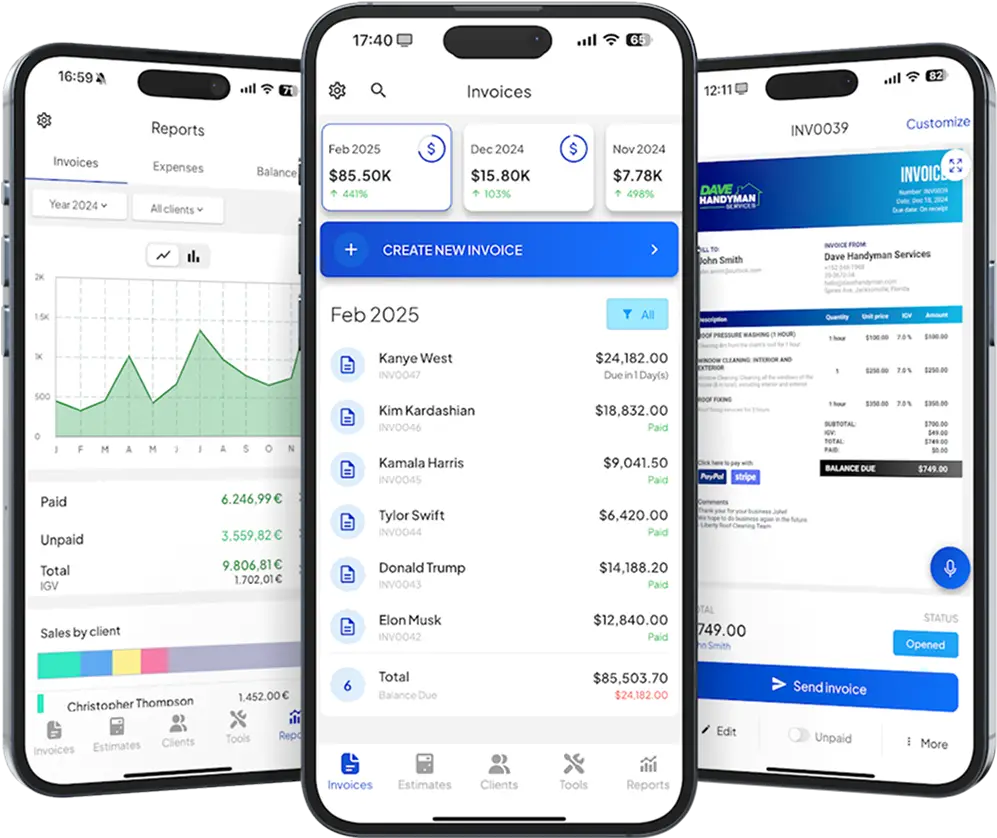
Whether you’re billing clients weekly, monthly, or per project, Invoice Fly helps you create professional invoices, track payments, and stay organized from anywhere.
Invoice Fly’s on our platforms:
★ 4.8/5.0 · +180,000 reviews
★ 4.8/5.0 on Trustpilot, Capterra, GetApp, and Software Advice.
★ App Store (+88.000 positive reviews) and Google Play (+90.000 positive reviews)
★ Over 125,000 businesses trust us.
“It’s easy to use there is an option to remember all previous items in material lines so everything
is memorized. I am able to go ahead and turn a estimate right into an invoice. It keeps track of
everything for me and keeps it very organized and it’s perfect. It’s cost efficient. I can pay by the
month by the week or by the year I choose to pay weekly is very convenient and easy to use. I
love it very much”
— Justin S. · Capterra · ★★★★★
Break-Even Point Example in Units
Imagine your business has $10,000 fixed costs per month (like rent and utilities). You sell a product or service for $100 each, and it costs you $20 to produce each unit (materials, labor, etc.).
This means you’re left with an $80 contribution margin per unit (the amount that goes toward covering your fixed costs).
- Fixed Costs per Month: $20,000
- Selling Price (ASP): $200
- Variable Cost per Unit: $40
- Contribution Margin: $160
Now, divide your $20,000 in fixed costs by the $160 contribution margin, and you get a break-even point of 125 units. So, if you sell 125 units, you’ll break even—meaning no profit, but no loss either.
- Break-Even Point (BEP): 125 units
You can also use Excel’s Goal Seek function to make this calculation easier. Just set the target (net profit of $0), and Excel will tell you how many units you need to sell to hit that break-even point.
RELATED ARTICLE: Gross Profit vs. Net Profit: Formula, Analysis & Examples
How to Conduct Break-Even Point Analysis
When a company hits its break-even point, it’s not losing money, but it’s not making a profit yet either—it has “broken even”. From this point forward, any extra revenue goes straight toward increasing profit.
Doing a break-even analysis is key to setting the right prices, creating realistic sales goals, and spotting areas where the business could improve—like tweaking sales tactics or marketing strategies.
For established companies with multiple services or products, you can also calculate the break-even point for each offering. This helps decide whether adding a new service or product makes financial sense.
Overall, break-even analysis gives you valuable insights to make good business decisions, set your pricing and clear sales goals with an actual number to aim for, making it easier to plan for growth and profitability ratios.
RELATED ARTICLE: What Is A Ledger Balance? Definition, Formula & Examples
Other Break-Even Point Calculation Examples:
1. Sales Revenue
If you need to calculate the break-even point in terms of sales revenue (dollars), rather than units, you should use the following formula:
BEP in Sales = Fixed Costs / Contribution Margin Ratio
Where:
CMR = (Selling Price per Unit – Variable Cost per Unit) / Selling Price per Unit
Imagine you run a business with $2,000 in fixed costs per month (for rent, utilities, etc.). You sell a product for $50 each, and it costs you $20 to make one product (for materials and production).
Step 1: Calculate the Contribution Margin
- Contribution Margin = Selling Price per Product – Variable Cost per Product
- Contribution Margin = $50 – $20 = $30
So, every time you sell one product, you make $30 to help cover your fixed costs.
Step 2: Calculate the Contribution Margin Ratio
- Contribution Margin Ratio = Contribution Margin / Selling Price per Product = 30 / 50 = 0.6 or 60%
Step 3: Calculate the Break-Even Point in Sales Revenue
To figure out how much total revenue you need to cover your costs, divide your fixed costs by the Contribution Margin Ratio:
Break-Even Point (Sales Revenue) = Fixed Costs ÷ Contribution Margin Ratio = 2,000 ÷ 0.6 = 3,333.33
Conclusion
You need to sell $3,333.33 worth of products each month to break even. This means selling enough units of your product to cover both fixed and variable costs before making any profit.
RELATED ARTICLES:
Create and Send Invoices with Invoice Fly
Whether you’re billing clients weekly, monthly, or per project, Invoice Fly helps you create professional invoices, track payments, and stay organized from anywhere.
2. Desired Profit (Target Profit)
You can also calculate the break-even point in terms of target profit, rather than units or sales, if you have a profit target in mind for your business.
You should use the following formula:
- Target Profit (Units):
Target Profit =
(Fixed Costs + Target Profit) / (Selling Price per Unit – Variable Cost per Unit)
- Target Profit (Sales):
Target Profit = (Fixed Costs + Target Profit) / Contribution Margin Ratio
3. Multiple Products (Weighted Average)
For businesses that sell multiple products, the break-even point must account for the different profit margins across products. In those situations, a weighted average contribution margin is used.
Let’s break it down in the following example:
BEP (Sales) = Fixed Costs / Weighted Average Contribution Margin Ratio
Where Weighted Average Contribution Margin Ratio:
∑ (Sales Mix Percentage x Contribution Margin Ratio for each product) / 100
4. Variable and Fixed Costs Mixed
If costs are mixed (both variable and fixed), you can calculate the break-even point by identifying the total contribution margin, with the following formula:
BEP (Units) = Fixed Costs / (Average Selling Price – Average Variable Cost per Unit)
5. Cash Break-Even Point (Units)
This version of the break-even point considers only cash-related expenses, ignoring non-cash expenses like depreciation. It helps in understanding how much cash sales are needed to cover cash outflows.
You should use the following formula:
CBEP = Fixed Cash Costs / (Selling Price per Unit – Variable Cost per Unit)
Fixed Cash Costs: Excludes non-cash expenses like depreciation or amortization.
6. Tax Consideration
If your business wants to include the effect of taxes in its break-even calculation (for after-tax profit), it adjusts for taxes.
Formula for Target Profit After Tax (Units):
BEP with Tax = (Fixed Costs + (Target Profit / (1 – Tax Rate)) / (Selling Price per Unit – Variable Cost per Unit)
Key Considerations:
- Fixed Costs remain the same regardless of the production or sales volume.
- Variable Costs change directly in proportion to the number of units produced or sold.
- Contribution Margin helps understand how much of each sale contributes toward covering fixed costs and generating profit.
Try our free Break-Even Point calculator
Do you need help calculating your Break-Even Point? Try our BEP Calculator for free. Add your monthly fixed costs, your selling price per unit, and your production cost per unit to figure out when you will start making a profit.
Final Thoughts
Understanding and calculating your business’s break-even point is more than just a mathematical exercise—it’s a strategic move that empowers you to make informed financial decisions.
Mastering the BEP formula gives you a clear roadmap to profitability. From pricing strategies to cost management, break-even analysis illuminates areas where you can optimize for growth, ensuring your hard work translates into tangible financial results.
If you run a service business, it’s important to understand the documents you use from the first customer inquiry to the final payment. Start with our guides on what is an estimate and what is quotation to learn how to price jobs and create professional quotes for your customers.
Once the work is complete, our guide on what is an invoice explains how to request payment correctly. If you work with repeat customers, you should also understand what is billing and how recurring billing works. Finally, after you receive payment, our guide on what is a receipt explains why you should provide proof of payment for every completed transaction.
Ready to take control of your business finances? Download Invoice Fly today!
Create and Send Invoices with Invoice Fly
Whether you’re billing clients weekly, monthly, or per project, Invoice Fly helps you create professional invoices, track payments, and stay organized from anywhere.
What Invoice Fly users say:
“Awesome!! I really don’t have as much time to sit at a computer and keep up with documents as I was on the go. This app really helps me to keep up and stay on track with payments and customers info.”
— Oscar · Software Advice · ★★★★★ · February 2
FAQs
Calculate your BEP in units using this formula:
Break-Even Point (Units) = Fixed Costs ÷ (Revenue per Unit – Variable Cost per Unit)
Calculating your break even point helps you determine your minimum sales targets, quantifies financial risk, and guides pricing and cost-cutting strategies.
In general, you should calculate your break-even point monthly or quarterly. When launching new products or in the case of a startup you should calculate it more frequently so you can quickly adjust pricing or control overhead.
Calculating break-even is a way businesses can determine how many units or dollars of sales cover the variable and fixed costs of production.
A positive ROI signals a profitable investment. It is short for Return on Investment. The Break-Even point, meanwhile, will help you understand how long it will take to recover your initial expenditure.
 English
 Español