
Gross Receipts Explained: Definition, Examples, and Calculation
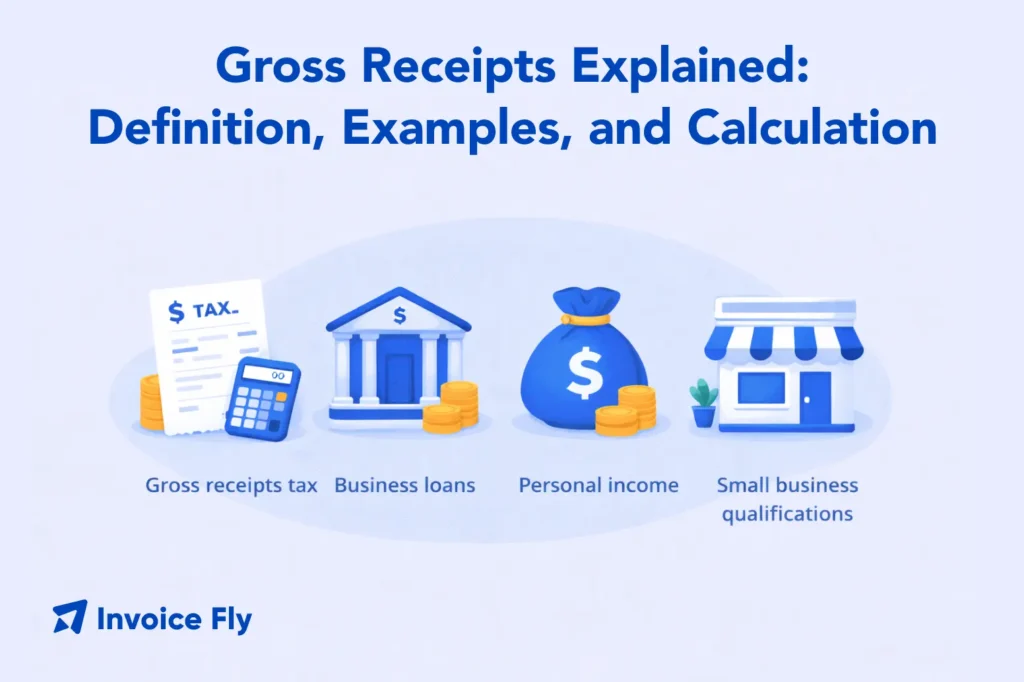
Table of Contents
Gross receipts are the total amount of money a business receives from all sources during a specific period before subtracting any expenses. This includes sales, service income, fees, commissions, rent, and other incoming payments.
In simple terms, gross receipts show how much money came into a business—not how much it kept.
This guide will cover everything you need to understand how this number helps with taxes, loans, and day-to-day financial decisions.
What are gross receipts?

Gross receipts represent the full amount of revenue a business collects before deducting any costs. This includes all payment methods—cash, credit cards, bank transfers, and online payments.
It’s important not to confuse gross receipts with profit. Profit is what remains after expenses. This come before expenses. If you want a deeper breakdown of how revenue fits into broader tax structures, see this guide on types of taxes.
For example, a small online store might generate $120,000 in gross receipts in a year. But after paying for inventory, shipping, ads, and software, the owner may only keep $25,000 as profit.
Gross receipts can also include more than just sales. A business might earn:
- Service fees
- Interest from business accounts
- Rental income
- Commissions
A freelance web designer, for example, might earn $60,000 from client work and another $2,000 from referral commissions. Both count toward gross receipts. In some regions, these earnings may fall under systems like goods and services tax depending on how revenue is classified.
The exact definition can vary slightly depending on tax rules or applications, but the core idea stays the same: total incoming revenue before deductions.
Gross receipts example
Let’s look at a simple monthly example.
A small café earns:
- $30,000 from food and drinks
- $4,000 from catering orders
- $200 in interest
Total gross receipts = $34,200
Even if the café spends:
- $12,000 on ingredients
- $8,000 on staff
- $3,000 on rent
Those costs do not reduce gross receipts. They only affect profit.
Another example: a freelance photographer completes 5 shoots at $1,500 each and sells $500 in prints.
Gross receipts = $8,000
Even if she spends $2,000 on travel and editing tools, her gross receipts remain $8,000. Understanding eligible expenses later ties into strategies like tax deductions for small businesses.
These examples show that gross receipts reflect activity, not profitability.
What can you use gross receipts for?

Gross receipts are used in many business situations. They provide a quick snapshot of how much money flows into a business.
Common uses include:
- Tax reporting
- Loan applications
- Business performance tracking
- Program eligibility
For example, a retail store might compare monthly gross receipts to identify busy seasons. If December brings in $80,000 but February only $30,000, that pattern helps with staffing and inventory planning. This becomes even more important when dealing with rules like sales tax nexus across different locations.
A contractor might track quarterly gross receipts to decide when to hire extra workers.
Because gross receipts are easy to measure and hard to manipulate, they are often the first number banks, agencies, and analysts review.
Gross receipts tax
Gross receipts tax is based on total revenue, not profit. This means businesses may owe tax even if they have high expenses.
For example:
- A delivery company earns $300,000
- Expenses total $270,000
- Profit = $30,000
If a 5% GRT applies, the tax is based on $300,000—not $30,000.
Tax owed = $15,000
That’s half the company’s profit, which can be challenging for low-margin businesses.
Some businesses adjust pricing to account for this tax. For instance, a service provider might slightly increase rates to cover the added cost. You can explore this in more detail in this guide on gross receipts tax.
In some cases, additional rules like reverse charge VAT or withholding tax may also affect how revenue is reported or taxed.
For official guidance, tax authorities like the IRS explain how revenue is reported and classified.
Business loans

Lenders use gross receipts to evaluate whether a business generates enough revenue to repay a loan.
For example, a landscaping business applying for a $50,000 loan might report:
- Annual gross receipts: $250,000
This tells the lender the business has steady activity. Combined with bank statements and credit history, it helps assess risk.
Even if profits vary, consistent gross receipts can show stability. A seasonal business, like a holiday décor company, may earn most of its income in a few months.
A freelancer earning $80,000 annually in gross receipts may qualify for financing if income is consistent. Lenders may also evaluate total obligations, which ties into understanding your tax liability.
Organizations like the U.S. Small Business Administration (SBA) also use revenue metrics when supporting loan programs.
Personal income
For self-employed individuals, gross receipts are closely tied to personal income—but they are not the same.
Example:
- Gross receipts: $70,000
- Expenses: $20,000
- Net income: $50,000
The owner does not take home $70,000. Expenses reduce what they actually earn.
This distinction is important for budgeting. A consultant might see $6,000 come in during a month, but real income is lower after costs.
Tracking gross receipts still helps. It shows growth trends. For example:
- Year 1: $50,000
- Year 2: $75,000
This also connects to how income is reported, including concepts like adjusted gross income and planning for quarterly estimated taxes.
For contractors specifically, it’s useful to review estimated taxes for contractors and tax deductions for contractors.
Small business determination and qualifications
Many programs use gross receipts to determine if a business qualifies as “small.”
For example:
- A grant program may require under $1 million in annual gross receipts
- A tax rule may apply only to businesses under a certain threshold
If a company grows beyond that limit, it may lose access to benefits.
A construction company averaging $3 million in gross receipts over three years might qualify for certain programs. If it grows to $5 million, eligibility may change.
This matters because crossing thresholds can affect:
- Tax obligations
- Reporting requirements
- Access to funding
For businesses operating across regions, this may also involve rules like multi-state income tax.
Other factors like deductions—such as home office deduction rules or even family employment tax benefits—can influence overall financial positioning.
How to calculate gross receipts
Calculating gross receipts is straightforward. Add all incoming revenue during a specific period.
Steps:
- Add product sales
- Add service income
- Add fees and commissions
- Add other business-related income
Example:
A marketing agency earns:
- $100,000 from retainers
- $30,000 from projects
- $5,000 in commissions
Gross receipts = $135,000
No expenses are subtracted.
Accuracy is key. Businesses should pull data from:
- Bank deposits
- Payment processors
- Invoicing systems
- Point-of-sale tools
For example, a retail store might have:
- In-store sales
- Online orders
- Marketplace payouts
All must be included.
Using tools like an invoice generator or estimate system helps keep records consistent, especially when tracking items like mileage using guides such as how to track business mileage.
To better understand how gross receipts fit into the bigger picture of taxation, review our complete guide on types of taxes.
Manage Your Business Finances More Accurately
Tracking gross receipts is one of the simplest ways to understand how money flows through your business—but doing it manually can lead to missed income, messy records, and reporting errors.
Using a tool like Invoice Fly’s free invoice generator makes it easier to stay organized. You can create invoices, track payments, and keep all your income records in one place. This helps ensure you are always accurate when it’s time to file taxes, apply for loans, or review performance.
Instead of piecing together numbers from different platforms, you can rely on a single system that reflects your real revenue in real time.