
E-Invoicing: Complete Guide for Small Businesses and Contractors
Table of Contents
E-invoicing makes it easy to send and receive invoices online without dealing with paper files or manual data entry. Instead of typing invoice details into your accounting or ERP system by hand, structured e-invoices transfer the information automatically—saving time, reducing errors, and helping you get paid faster. For small businesses, freelancers, and contractors, this also means less admin work and fewer compliance headaches as more countries introduce digital invoicing requirements.
In this guide, we’ll explain what e-invoicing is, how it works, and how to choose the right solution for your business.

What Is E-Invoicing?
E-invoicing, short for electronic invoicing, is the process of sending invoice data between a supplier and a buyer in a structured digital format that accounting or ERP systems can read automatically.
The key word here is structured. A PDF invoice sent by email is digital—but it isn’t a true e-invoice. Real e-invoices use formats like XML, JSON, or UBL, which allow software to capture totals, tax details, and customer information instantly, without manual data entry.
E-invoicing is commonly used across three main channels:
- Business-to-business (B2B) — invoices exchanged directly between companies via a shared network or platform
- Business-to-government (B2G) — invoices submitted to government agencies, often through regulated portals
- Business-to-consumer (B2C) — digital invoices sent to individual customers, typically via email or an online portal
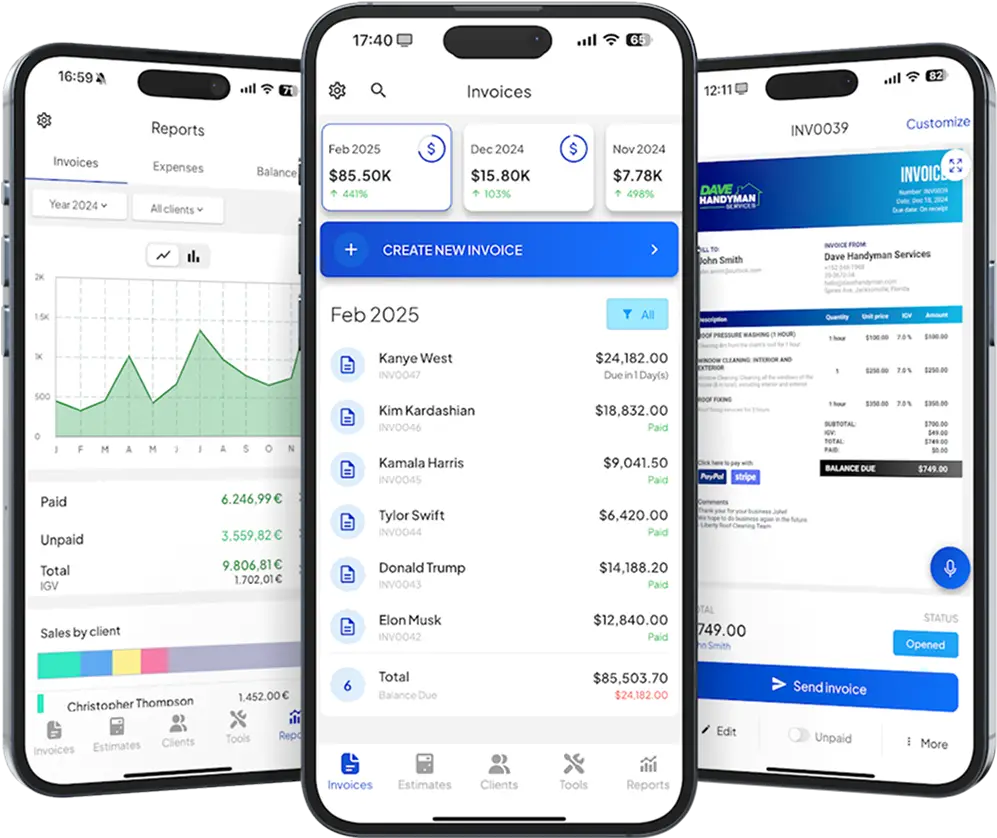
For most small businesses and contractors, e-invoicing simply means using software that creates, sends, and tracks invoices automatically—replacing paper invoices, PDF attachments, and manual follow-ups with a faster, more reliable system.
To see how e-invoices fit into your overall billing workflow, check out our guide on what is an invoice.
Benefits of E-Invoicing
Switching to e-invoicing isn’t just about going paperless. The operational and financial advantages are significant, especially for small businesses managing invoicing without a dedicated finance team.
1. Faster payments E-invoices arrive instantly and can be processed automatically on the buyer’s end. There’s no postal delay, no lost paperwork, and no waiting for someone to manually key in data. Faster processing means faster approvals and faster payment.
2. Fewer errors Manual data entry is where invoice mistakes happen — wrong amounts, missing line items, incorrect payment terms. E-invoicing eliminates most of that by transferring data directly between systems. Fewer errors means fewer disputes and fewer delays.
3. Lower costs Paper invoices carry real costs: printing, postage, storage, and staff time. E-invoicing cuts most of those costs out entirely. For high-volume invoicers, the savings add up quickly.
4. Better cash flow visibility E-invoicing platforms give you a real-time view of which invoices have been sent, opened, approved, and paid. That visibility makes it much easier to forecast cash flow and follow up on overdue payments at the right time.
5. Easier compliance As more governments introduce mandatory e-invoicing requirements, having an e-invoicing system in place keeps you ahead of the curve rather than scrambling to catch up. The US government’s e-invoice portal (known as Delphi) is already in place for federal suppliers — a sign of where the broader market is heading.

Challenges of E-Invoicing
E-invoicing offers clear advantages, but it’s not without friction — especially for smaller businesses making the switch for the first time.
- Setup and integration: Connecting e-invoicing software to your existing accounting system takes time and sometimes technical help. The more complex your current setup, the more involved the transition.
- Client adoption: E-invoicing only works smoothly when both sides are using compatible systems. If your clients are still using paper-based processes, you may need to maintain multiple invoicing methods during the transition.
- Format differences: Different countries and industries use different e-invoicing standards. If you work across borders or with government clients, you may need to support more than one format.
- Upfront cost: While e-invoicing saves money long-term, quality software comes with subscription fees. For very small operations, the cost-benefit calculation depends on your invoice volume.
The good news: for most small businesses and contractors, modern e-invoicing tools are designed to handle these complexities in the background, so you don’t need to understand every technical standard to benefit from the system.
Types of E-Invoicing
Not all e-invoicing works the same way. The main types differ in how invoice data is transmitted and who’s involved:
- Direct e-invoicing: Supplier and buyer exchange invoices directly through a shared platform or integrated software. Common in B2B relationships where both parties use the same system.
- Network-based e-invoicing: Invoices are sent via a third-party network — like PEPPOL, which is widely used in Europe and parts of Asia — that connects different systems using a common standard.
- Government-mandated e-invoicing: In some countries, all invoices must be submitted to a tax authority portal in real time before they’re sent to the buyer. This model is growing globally and is already in place across much of Europe and Latin America.
- PDF/email invoicing: Often described as a stepping stone to true e-invoicing. It’s digital, but not structured — the recipient still needs to manually process the data.
For most small businesses in the US, direct e-invoicing through a platform like InvoiceFly is the most practical starting point. For those selling to federal government clients, the US e-invoice portal sets out the specific requirements for compliant submissions.
Common E-Invoice Formats
The format determines how invoice data is structured and transmitted. The most common formats include:
- XML (Extensible Markup Language): The most widely used format for structured e-invoices globally. Readable by both machines and humans with the right tools.
- UBL (Universal Business Language): A standardized XML format used widely in government and cross-border invoicing, particularly in Europe.
- JSON: A lightweight data format increasingly used in API-based e-invoicing integrations.
- PEPPOL BIS: A specific implementation of UBL used across the PEPPOL network, which connects businesses and government buyers in dozens of countries.
- PDF/A-3: A PDF format that embeds structured XML data, allowing it to function as both a human-readable document and a machine-readable e-invoice. Common in hybrid workflows.
For most small businesses, the format question is handled by your software — you create the invoice, the platform handles the technical formatting and transmission.

E-Invoicing and Regulatory Compliance
E-invoicing rules vary by country—and they’re changing quickly. Across much of Europe, electronic invoicing is already required for businesses that work with government agencies, and several countries are now extending those rules to business-to-business (B2B) transactions as part of broader tax-reporting reforms.
In the United States, e-invoicing is currently required only for companies billing federal government agencies, typically through structured systems supported by the U.S. General Services Administration (GSA). For most private-sector businesses, adoption is still voluntary and driven by efficiency rather than regulation—for now.
Still, as more countries introduce digital reporting requirements, moving to structured e-invoicing early can make it easier to work with international clients and stay ahead of compliance changes.
Key compliance considerations for small businesses:
- Invoice content requirements: Most tax authorities specify what information must appear on a valid invoice, including business details, tax identifiers, issue dates, and line-item totals. Good invoicing software usually includes these automatically. Our guide on professional invoice elements covers the standard components.
- Record Retention rules: Many jurisdictions require invoices to be stored for several years for audit purposes. For example, the IRS generally recommends keeping supporting tax records for at least three years. E-invoicing platforms typically handle storage automatically.
- Clear Payment terms: Clearly stated invoice payment terms are a compliance requirement in many regions and a practical necessity for getting paid on time.
Best Practices for E-Invoicing
Whether you’re just getting started or optimizing an existing process, these practices will help you get the most out of e-invoicing.
- Standardize your invoice format: Stick to the same structure, line items, and payment terms across every invoice you send. Consistency helps clients review invoices more quickly, reduces back-and-forth questions, and makes your records easier to track at tax time. If you want a simple structure to follow, our guide on how to write an invoice walks through best practices for invoice structure.
- Automate follow-up: Most e-invoicing tools can send reminders for you—take advantage of that. A friendly, automatic nudge often gets better results than chasing payments manually and saves you time each week.
- Keep client details up-to-date:
E-invoicing only works smoothly when billing information is accurate. Make it a habit to confirm contact emails and billing details, especially with repeat clients or larger organizations. - Reconcile invoices regularly: Check your sent invoices against payments received at least once a week. Catching missing or late payments early helps protect your cash flow and avoids surprises at the end of the month.
- Know which document to send (and when): E-invoices, proforma invoices, credit notes, and receipts all serve different purposes. Our guides on proforma invoices and invoice vs. receipt clarify when to use which document.

Conclusion
E-invoicing is one of the most practical upgrades a small business or contractor can make to their billing process. It reduces errors, speeds up payments, cuts admin time, and keeps your records organized all without requiring a finance team or an accounting degree.
The best place to start is with a tool that fits how you already work. InvoiceFly’s invoice maker lets you create, send, and track professional digital invoices from any device. For one-off jobs, the free invoice generator gets you a clean, professional invoice in minutes.
For a deeper look at how invoicing fits into your overall business finances, revisit our complete guide on what is an invoice.