
Sales Invoice: Complete Guide for Contractors and Small Businesses
Table of Contents
A sales invoice is the document you send a client after you’ve finished a job or delivered products to request payment and confirm what was provided. It includes your business details, the customer’s information, a clear breakdown of services or items, prices, taxes, and payment terms so everyone knows exactly what’s owed and when. For contractors and small businesses, a clear, professional sales invoice helps keep cash flow steady, records organized, and expectations clear if questions ever come up later.
In this guide, we’ll explain what a sales invoice is, what to include in one, the most common types to use, and how templates and software can help you create invoices faster and with fewer mistakes.

What Is a Sales Invoice?
A sales invoice is a formal document issued by a seller to a buyer that records a transaction and requests payment. It confirms what was sold, how much is owed, and when payment is due — making it the official record of the sale for both parties.
The terms “sales invoice” and “invoice” are often used interchangeably, and for most small businesses they mean the same thing: a payment request sent after goods are delivered or services are completed. The word “sales” simply emphasizes that the document relates to a completed sale rather than an estimate, quote, or purchase order.
A sales invoice is more than just a bill. According to the IRS, businesses are required to keep records that support income and expense claims — and sales invoices are one of the primary documents used to satisfy that requirement. They’re used in accounting, tax filing, and financial reporting, which means accuracy and consistency matter every time you create one.
For a complete overview of how invoices work across different business contexts, see our guide on what is an invoice.
The Key Components of a Sales Invoice
A well-structured sales invoice includes everything a client needs to process payment and everything you need to keep accurate records. Use this checklist to make sure your invoice covers the essentials:
| Section | What to Include |
| Business and client details | Your business name, address, phone number, and email, plus your client’s name, billing address, and contact information |
| Invoice identification | A unique invoice number, invoice date, and payment due date |
| Itemized products or services | Clear descriptions, quantities, unit prices, and line totals for each item or service |
| Financial summary | Subtotal before tax, applicable taxes (sales tax, VAT, or GST), discounts if any, and the total amount due |
| Payment terms and methods | Accepted payment options (bank transfer, check, credit card, online payment) and terms such as Net 30 or due on receipt |
For a deeper look at what makes an invoice professional and complete, see our guide on professional invoice elements.
Some states have specific requirements about what must appear on an invoice. For example, Washington State’s Department of Revenue outlines rules around sales tax disclosure on invoices — worth checking if you operate across state lines or in a state with specific invoicing regulations.
Why Sales Invoices Are Important
A professional sales invoice does more than request payment. It protects your business, supports your accounting, and keeps client relationships clear and professional.
Cash flow management: Invoices with clear due dates and payment terms create a predictable payment schedule. Businesses that invoice promptly and consistently get paid faster than those that don’t. Our guide on invoice payment terms covers how to set terms that work for your business model.
Legal protection: A signed or acknowledged sales invoice creates a documented record of what was agreed, delivered, and billed. If a payment dispute arises, the invoice is your first line of evidence.
Tax and accounting records: Every sales invoice feeds into your revenue records. Clean, consistent invoicing makes bookkeeping easier, reduces errors during tax filing, and gives your accountant what they need without extra back-and-forth.
Professionalism: A well-formatted invoice signals to clients that you run a serious operation. It builds trust and reduces the likelihood of payment delays caused by confusion over amounts or terms.

Common Types of Sales Invoices
Not every sales situation calls for the same type of invoice. Here are five of the most common formats contractors and small businesses use:
- Standard sales invoice: The most common type — issued after work is completed or goods are delivered, requesting payment by a specified due date. This is what most people mean when they say “invoice.”
- Proforma invoice: Sent before work begins or goods are shipped, outlining the expected cost. It’s not a payment request. It’s a preliminary document used for planning, customs declarations, or client approval. See our guide on what is a proforma invoice for more detail.
- Recurring invoice: Used for clients on retainer or subscription arrangements where the same amount is billed on a regular schedule — weekly, monthly, or quarterly.
- Credit invoice: Also called a credit memo, this document reduces or cancels an amount previously billed. Used when a client is overcharged, returns goods, or a discount is applied after the original invoice was sent.
- Interim invoice: Issued at project milestones for long-term contracts rather than at the end. Common in construction, consulting, and large service projects where it’s impractical to wait until full completion to bill.
For a full breakdown of invoice formats by use case, see our guide on types of invoices.

How Do Sales Invoices Work?
Understanding the flow of a sales invoice from creation to payment helps you build a consistent process that reduces delays and keeps your records clean.
Step 1 — Deliver first, invoice second A sales invoice is issued after the product is delivered or the service is completed — not before. This is what separates it from a quote, estimate, or proforma invoice. The moment the work is done, the invoice should go out. Delays in invoicing directly translate to delays in payment.
Step 2 — Send it promptly and professionally Email is the standard delivery method for most small businesses. Your invoice should be attached as a PDF or sent through invoicing software that lets the client view and pay online. A professional format — with your logo, clear line items, and explicit payment instructions — reduces the back-and-forth that slows payment down.
Step 3 — Set clear payment terms Common payment terms include:
- Due on receipt — payment expected immediately upon receiving the invoice
- Net 30 — payment due within 30 days of the invoice date
- 2/10 Net 30 — a 2% discount applies if paid within 10 days; full amount due in 30
Choose terms that reflect your cash flow needs and your client relationship. For new clients, shorter terms are generally safer.
Step 4 — Follow up on overdue invoices A polite payment reminder sent a few days before the due date — and again shortly after — is standard practice and significantly improves on-time payment rates. Most invoicing software can automate this so you don’t have to chase clients manually.
Step 5 — Record and reconcile Once payment is received, mark the invoice as paid in your records and reconcile it against your bank statement. Keeping your invoice records current means your financial reports are always accurate and tax time is far less painful.
For a step-by-step guide to the full invoicing process, see our guide on how to write an invoice.

Conclusion
A sales invoice is one of the most important documents your business sends. It’s how you request payment, confirm what was delivered, and keep your records accurate and organized. For contractors and small businesses, using clear templates or invoicing software makes the process faster, more consistent, and much easier to manage as your workload grows.
A good sales invoice should be simple for your client to understand, easy for you to track, and reliable enough to support your bookkeeping and tax reporting whenever you need it. Getting this right from the start helps you get paid faster and keeps your business running smoothly.
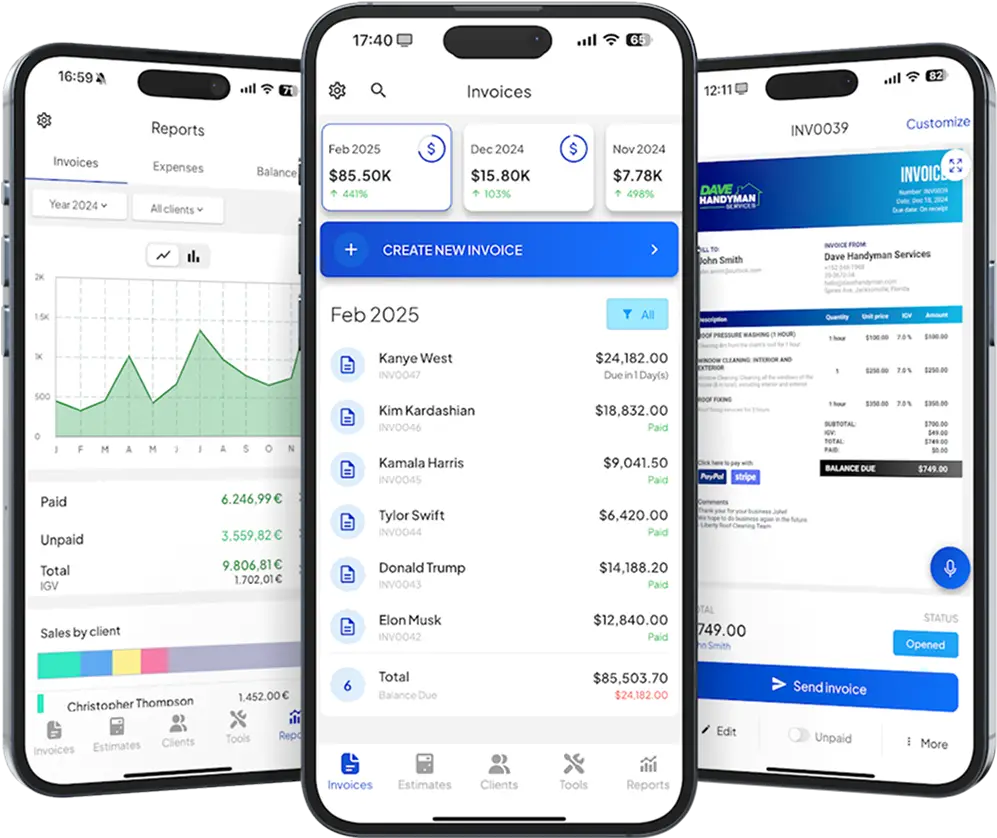
InvoiceFly’s invoice maker lets you create, send, and track professional sales invoices from any device, with your branding, line items, and payment terms built in. For quick one-off jobs, the free invoice generator gets you a clean, accurate invoice in minutes. And when it comes to winning the job before you bill for it, our estimates app helps you send professional estimates that convert leads into paying clients.
For a deeper look at how sales invoices connect to your overall billing workflow, revisit our guide on what is an invoice and explore the differences between an invoice vs. receipt and a quote vs. invoice to make sure you’re using the right document at every stage of the client relationship.