
What Is an Estimate? Complete Guide for Small Business & Contractors

Table of Contents
An estimate is a document that gives your client a clear idea of how much a project is likely to cost before any work begins. It usually includes expected labor, materials, and timelines, helping both sides stay on the same page from the start. Because project details can change, estimates are flexible by design—they set expectations without locking you into a final price too early. If you run a small business or work as a contractor, understanding how estimates work (and how they differ from quotes and invoices) can help you price jobs with confidence and avoid confusion with clients.
In this guide, we’ll explain what an estimate is, what to include in one, and how to create and send professional estimates using simple online tools.

What Is an Estimate?
An estimate is a formal document a business or contractor provides to a potential client that outlines the projected cost of a job or project. It’s not a final price — it’s an informed approximation based on what the scope of work appears to be at the time of assessment.
Estimates are common across industries where project costs can vary: construction, landscaping, plumbing, electrical work, auto repair, consulting, freelance services, and more. When a client asks “how much will this cost?”, the estimate is your professional, documented answer.
A well-prepared estimate typically includes:
- A description of the work — what services or deliverables are included
- Labor costs — the hours or rate involved in completing the work
- Material costs — any supplies, parts, or products required
- An estimated timeline — how long the project is expected to take
- Terms and conditions — payment expectations, validity period, and any caveats
Because an estimate is not a binding contract, the final invoice may differ from the original figure — particularly if the scope changes, unexpected issues arise, or materials cost more than anticipated.
What Does Estimate Mean?
The word estimate comes from the Latin aestimare, which means “to value” or “to appraise.” Today, it simply refers to a careful approximation, an informed best guess based on the details you have at the time.
In business, though, an estimate is more than just a rough number. It’s a professional way to show your client you’ve reviewed their project, considered the scope of work, and used your experience to arrive at a realistic expected cost. A clear, thoughtful estimate helps set expectations early and builds trust before the job even begins.
In construction and project management, estimation is a structured process. Federal project cost guidelines define cost estimates as structured projections that account for labor, materials, overhead, and contingency costs. While these standards are often used on large government projects, the same approach works just as well for small businesses and contractors who want to price jobs accurately and professionally.
What an Estimate Is For
Estimates serve a specific purpose at a specific moment in the client relationship — before work begins and before a binding agreement is in place. They help both sides understand what the job involves and what it’s likely to cost.
The Purpose of an Estimate
For clients, an estimate answers the most important early question: can I afford this? It gives them enough information to decide whether to move forward, compare options, or adjust the scope to fit their budget.
For contractors and small business owners, an estimate serves several important functions:
- It sets expectations — clients who understand the projected cost upfront are far less likely to dispute the final invoice
- It demonstrates professionalism — a detailed, clearly formatted estimate signals that you run a serious operation
- It protects you — a written estimate creates a paper trail showing what was agreed in principle before work started
- It helps you win jobs — a fast, accurate estimate often beats out slower competitors even when the price is similar
Getting estimates right is closely connected to your overall pricing strategy. Whether you charge by the hour or use flat-rate pricing affects how you structure your estimates — our guide on hourly vs. flat rate pricing breaks down which approach works best in different situations.

How Do Businesses Give Estimates?
The process of giving an estimate varies by industry, but the core steps are consistent regardless of what type of work you do.
1. Assess the scope of work
Before you can estimate costs, you need to understand what the job actually involves. This usually means a site visit, a discovery call, a review of project specifications, or some combination of the three. The more clearly you understand the scope, the more accurate your estimate will be.
2. Calculate your costs
Break the job into its component parts and assign a cost to each:
- Labor: How many hours will this take, and at what rate? If you have employees or subcontractors, factor in their time too.
- Materials: What supplies, parts, or products are needed? Get real quotes from suppliers rather than guessing.
- Overhead: Factor in the portion of your fixed business costs — insurance, vehicle expenses, software, tools — that apply to this job.
- Markup: Your markup is what turns cost recovery into profit. Most contractors apply a standard markup percentage on top of their total costs.
3. Account for contingency
Unexpected issues happen — especially in construction, renovation, and outdoor work. Building a small contingency buffer (typically 10–15%) into your estimate protects your margin if things don’t go exactly to plan.
4. Document and send it
A verbal estimate is almost no estimate at all. Put it in writing, include all the key details, and send it promptly. Clients who receive a fast, professional estimate are more likely to say yes before reaching out to competitors.
For a detailed walkthrough of each step, see our guide on how to write an estimate.
Do Estimates Cost Money?
In most industries, estimates are provided free of charge. It’s a standard part of the sales process. Clients expect to receive a cost projection before committing to work, and charging for it upfront can be a barrier to winning the job.
That said, there are situations where charging for an estimate is both reasonable and common:
- Complex projects that require significant time to assess, measure, or plan
- Consulting or specialist services where the assessment itself has professional value
- Clients with a history of collecting estimates without committing
When a paid estimate is appropriate, many businesses apply the fee as a credit toward the project cost if the client moves forward. This approach makes the charge feel fair and reduces friction.
For straightforward jobs — lawn care, cleaning, basic repair work, tutoring, and similar services — a free estimate is almost always expected. See our tutoring rates guide for an example of how service-based businesses can approach pricing and estimates in a people-first industry.

Estimate vs. Quote vs. Invoice
Estimates, quotes, and invoices are often confused—but each document serves a different purpose at a different stage of a job. Using the right one at the right time helps set expectations, avoid disputes, and keep your records organized.
Here’s a simple way to tell them apart:
| When It’s Used | Price Flexibility | Purpose | |
| Estimate | Before work begins | Flexible | Gives an approximate project cost |
| Quote | Before work begins | Fixed | Commits to a specific price |
| Invoice | After work begins or ends | Final | Requests payment for completed work |
Estimates
An estimate is an approximation. It’s provided before work begins, based on the information available at the time. The final cost may differ — and a good estimate makes that clear with language like “estimated total” or “subject to change based on final scope.”
Estimates are best used when:
- The full scope of work isn’t yet confirmed
- Material costs are variable or dependent on supplier pricing
- The project involves unknowns that could affect the timeline or labor required
Estimates vs. Quotes
A quote — sometimes called a quotation — is a fixed price offer. When you give a client a quote, you’re committing to complete the work for that specific amount, regardless of how long it takes or what it costs you. Quotes are binding in a way that estimates are not.
Use a quote when:
- The scope is clearly defined and unlikely to change
- You’ve done similar jobs enough times to know exactly what’s involved
- The client needs a firm number to get budget approval or compare bids
The key difference: an estimate can change; a quote cannot.
Estimates vs. Invoices
An invoice is sent after work begins—or once it’s finished—to request payment for the actual services delivered. Unlike estimates, invoices reflect real costs, not projections.
Most projects follow this natural workflow:
Estimate → Quote (sometimes) → Invoice
If your final invoice ends up much higher than the original estimate, it’s always smart to discuss the changes with your client first. Unexpected totals are one of the most common causes of payment delays and disputes. Our invoice maker makes it easy to convert accepted estimates directly into professional invoices, keeping everything consistent and reducing the chance of confusion.

Send Estimates With InvoiceFly
Sending estimates by email or on paper works — but it creates extra steps, increases the chance of errors, and makes it harder to track which estimates have been accepted, declined, or left without a response.
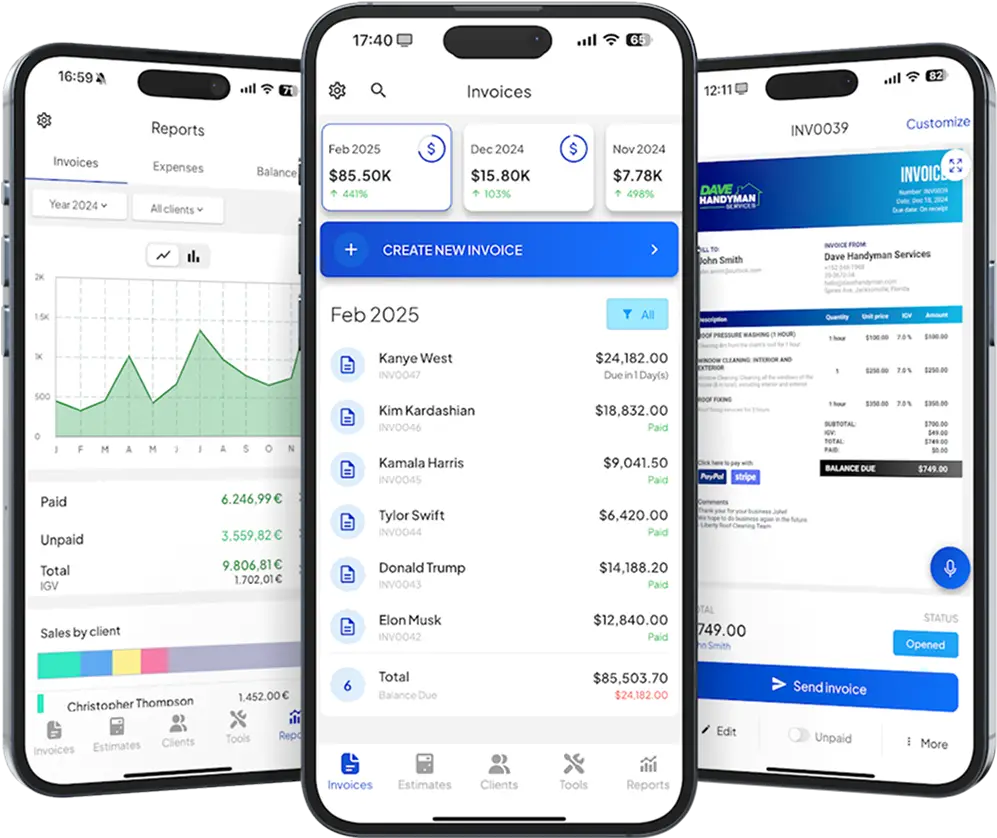
InvoiceFly’s estimates app lets you build, send, and manage professional estimates from your phone or desktop. You can add your logo, line items, labor and material costs, and notes — then send directly to clients for review and approval. When a client accepts, you can convert the estimate to an invoice in a few taps.
For quick one-off jobs, the free estimate generator lets you create a clean, professional estimate without setting up an account. And when it’s time to get paid, the free invoice generator has you covered.
First impressions matter — and a polished estimate often makes the difference between winning and losing a job.