Appliance Repair Website: Essential Features for Your Online Presence
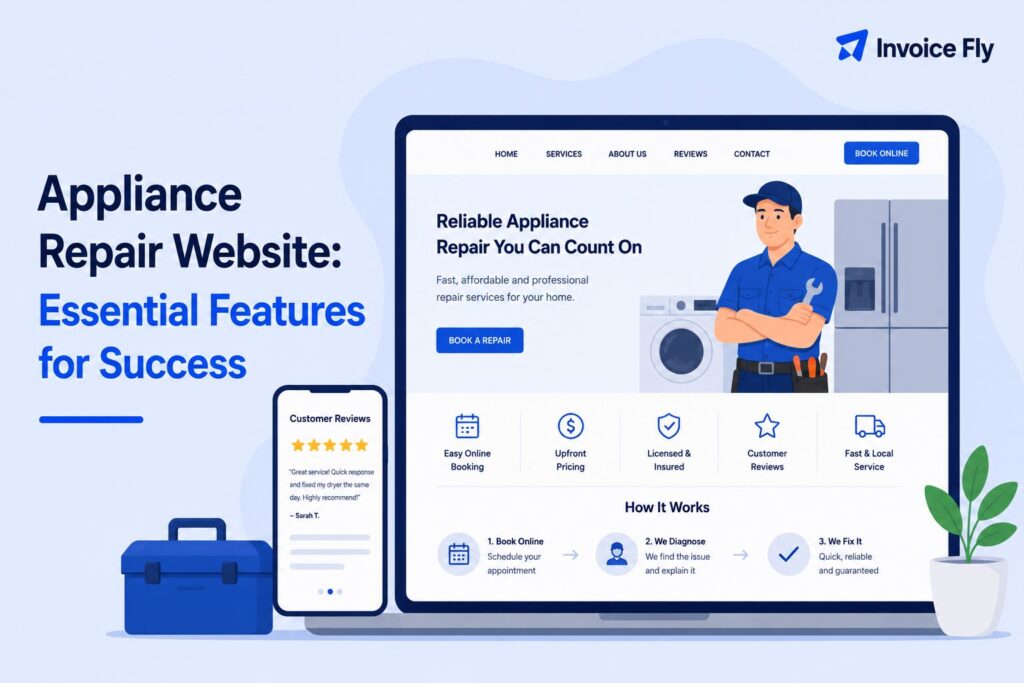
Table of Contents
- Why your appliance repair business needs a website
- How to describe your appliance repair services on your website
- How to create an appliance repair website
- Essential website pages for an appliance repair business
- What to include on an appliance repair website
- Examples of the best appliance repair websites for inspiration
- After you create your appliance repair website
- Build a website that keeps generating service calls
- FAQs
An appliance repair website helps your business get found online, attract local customers, and turn website visits into booked service calls. It acts as your digital storefront, where homeowners can learn about your services, check your service area, read reviews, and request repairs at any time. A strong website also builds trust by showing your technicians, qualifications, warranties, and previous work.
This guide will cover:
- Why your appliance repair business needs a website
- How to describe your repair services
- How to create an appliance repair website
- The essential pages your website needs
- Features that increase trust and bookings
- Examples of effective appliance repair websites
- How to promote your website after launch
Why your appliance repair business needs a website

Most customers search online when a refrigerator stops cooling, a washing machine starts leaking, or a dryer stops working. Without a professional website, your business may not appear when local homeowners are ready to book a repair.
A website gives your appliance repair business a central online presence. It helps you:
- Appear in local Google searches
- Explain which appliances and brands you repair
- Generate service requests outside business hours
- Build trust through reviews and technician profiles
- Answer common questions before customers call
- Promote emergency or same-day appointments
- Track which marketing channels generate bookings
Your website also supports your other marketing activities. Your Google Business Profile, online ads, local directories, social pages, and email campaigns can all direct potential customers to one clear place where they can book.
According to the NAICS, appliance repair businesses fall within the appliance repair and maintenance industry. A credible online presence helps your business compete with both large repair companies and independent technicians.
If you are still planning your services, pricing, or business structure, read our guide on how to start an appliance repair business.
How to describe your appliance repair services on your website

Avoid describing your business with a vague statement such as “We repair home appliances.” Customers want to know immediately whether you can fix their specific appliance.
List the appliances you repair, such as:
- Refrigerators and freezers
- Washing machines
- Dryers
- Dishwashers
- Ovens and cooktops
- Microwaves
- Garbage disposals
- Other kitchen appliances
You should also list the brands you service and explain whether you work on gas, electric, domestic, or commercial appliances.
For each service, describe common problems customers may notice. For example, a washing machine repair page could cover leaks, drainage problems, unusual noises, or a drum that will not spin.
Include your expected response time, diagnostic process, warranties, and the steps customers should take to book. You can also link to a wider guide to your appliance repair services for customers who are unsure what type of appointment they need.
How to create an appliance repair website
Building a website for an appliance repair business does not require advanced coding skills. You can create one in a few practical steps.
1. Choose a website builder
Choose a platform that matches your technical ability and growth plans.
- Wix offers simple drag-and-drop tools.
- Squarespace is useful for clean, modern designs.
- WordPress provides more control, integrations, and long-term scalability.
A basic appliance repair website template may work for a new one-person business. A growing company with several technicians, multiple locations, or advanced scheduling requirements may need professional appliance repair website design services for scalability.
2. Register a domain name
Your domain name is your website address. Keep it short, clear, and easy to remember.
A domain such as cityappliancerepair.com immediately tells customers what you do and where you operate. Avoid long names, unnecessary hyphens, or unusual spellings.
3. Choose reliable hosting
Your hosting affects website speed and security. Look for:
- An SSL certificate
- Automatic backups
- Responsive support
- Strong uptime
- Fast loading speeds
- Security monitoring
4. Select a mobile-friendly design
Many customers will search for a repair technician from their phone while standing beside a broken appliance. Your website must work properly on smaller screens.
Buttons should be easy to tap, phone numbers should be clickable, and forms should be quick to complete. The best landing page optimization for appliance repair websites usually focuses on reducing the number of steps between arriving on the page and requesting service.
Essential website pages for an appliance repair business

A well-structured website helps customers quickly find the information they need and book a repair with confidence.
- Home page: Clearly explains what you repair, where you operate, and makes booking easy with visible contact details, a “Book Service” button, service overview, reviews, and trust signals.
- Services pages (by appliance type): Separate pages for each appliance to improve SEO, list common faults, brands serviced, repair process, availability, warranty, and include a booking button.
- Pricing and service call fees: Be transparent with service call fees, diagnostics, repair deductions, emergency rates, labor minimums, payment methods, and link to a pricing guide.
- About your technicians: Use real photos and short bios highlighting experience, training, expertise, background checks, and professionalism to build trust.
- Booking or request service page: Keep it simple with no account required, collect only essential details (contact info, appliance type, issue, timing), and allow photo uploads to help diagnosis.
What to include on an appliance repair website
Include only the essentials that help customers trust you and book quickly.
Service areas
Clearly list every city, town, or neighborhood you serve. Feature your main service area on the homepage and create location pages where needed.
How many location pages should an appliance repair website have?
Only create pages for areas you genuinely serve—avoid duplicate “city swap” pages. Each page should be unique and useful, including:
- Services in that area
- Typical response times
- Local reviews
- Nearby neighborhoods
- Contact details
Reviews and customer testimonials
Show reviews on your homepage, service pages, and booking pages to build trust. Pull them from Google, Birdeye, Podium, Housecall Pro, or Jobber, and sync automatically where possible. Always use real feedback and get permission for names or photos.
Before and after repair photos
Show real repair work like diagnostics, part replacements, and completed jobs. Add short captions and remove any customer-identifying details.
AI chatbot for instant troubleshooting and booking
A chatbot can answer basic questions, check availability, or start bookings after hours. It must never give unsafe repair advice and should direct users to a technician for gas, wiring, leaks, smoke, or burning smells.
Call booking form
Keep it short:
- Name
- Phone number
- Preferred call time
- Appliance type
- Brief issue description
Why people don’t submit forms on appliance repair websites
Forms fail when they’re too long, slow, or unclear. Common issues include too many fields, slow load times, no privacy info, unclear response times, forced accounts, and data loss. Always set expectations clearly (e.g. “We’ll call you within 15 minutes during business hours”).
Certifications, licenses, and warranties
Show licenses, training, insurance, certifications, and memberships to build trust. You can link to appliance repair certification and explain your appliance repair business insurance.
Clearly state what you offer:
- Labor warranties
- Parts warranties
- Satisfaction guarantees
- Follow-up visits
- Manufacturer-backed repairs
Examples of the best appliance repair websites for inspiration
The best appliance repair websites make the next step obvious. They do not overwhelm visitors with complicated menus, animations, or large blocks of text.
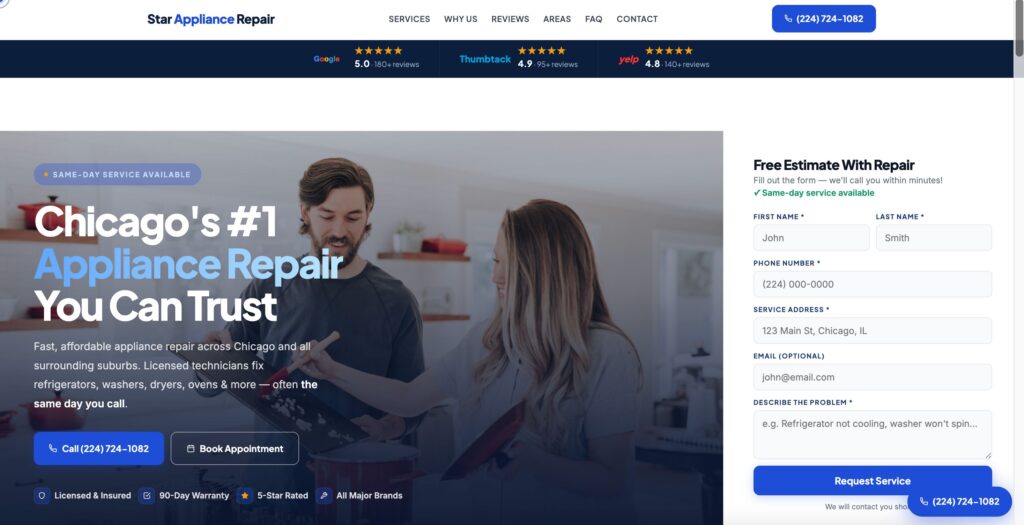
For example, a strong appliance repair website might look like this:
- A homepage headline such as “Same-Day Appliance Repair in Chicago” with a large “Call Now” button at the top of the page
- A service page like “Refrigerator Repair” that lists common issues such as cooling problems, leaks, or strange noises, along with a booking form on the same page
- A contact section that shows a clickable phone number, business hours, and a map of the service area
- A reviews section displaying real Google reviews like “Fixed my washing machine the same day—very professional and fast service”
- A technician page with photos and short bios, such as “John has 12 years of experience repairing Samsung and LG appliances”
After you create your appliance repair website
Publishing your website is only the first step. You must continue promoting and improving it to generate consistent service calls.
Start by creating and verifying a Google Business Profile. Keep your business name, address, phone number, opening hours, and website details accurate.
Your ongoing strategy should include:
- Local SEO
- Location-specific content
- Google Business Profile updates
- Customer review collection
- Local directory listings
- Link building
- Website speed improvements
- Booking-form testing
- Regular service-page updates
Build links from reputable local organizations, suppliers, trade associations, and community websites. Avoid buying large volumes of low-quality backlinks.
Use Google Search Console and analytics to track which pages generate impressions, calls, and form submissions, then improve pages that get traffic but don’t convert.
For more guidance on building the wider business around your website, return to our complete guide on how to start an appliance repair business.
Build a website that keeps generating service calls
Start with clear service pages, transparent information, real reviews, and a simple booking process. Once the website is live, continue improving it through local SEO, Google Business Profile updates, link building, and conversion tracking.
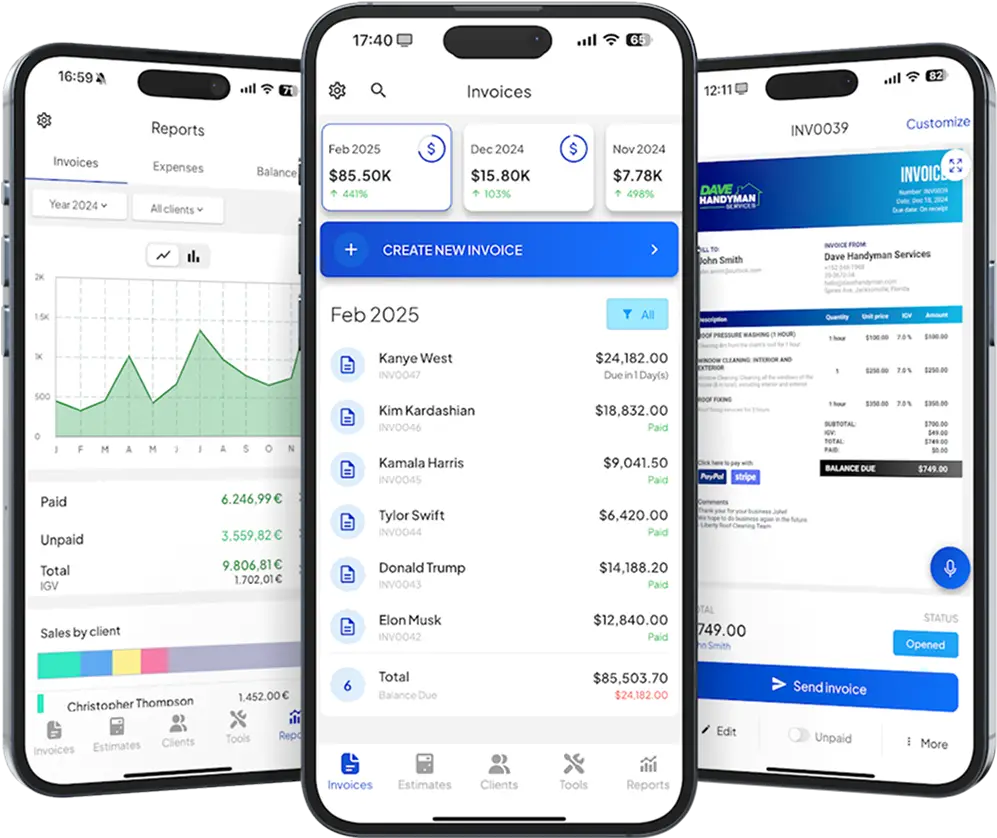
Connect your website with tools that help manage operations. Dedicated software for appliance repair businesses can help you schedule jobs, create estimates, send invoices, collect payments, and maintain customer records. An invoice maker lets you send professional invoices after completing a repair, while a free invoice generator is useful for occasional jobs.