- Home
- »
- Free Resources for Small Businesses
- »
- Free Business Calculators
- »
- Loan Calculator
Loan Calculator
Calculate your monthly loan payments, compare interest rates, and understand the total cost of borrowing. Use Invoice Fly’s free loan calculator to explore repayment options, plan your budget, and move forward with greater financial confidence.
Loan Calculator: Estimate Your Repayment
Your loan estimate
| Payment date | Principal | Interest | Monthly total | Principal balance |
|---|
How to use Invoice Fly’s loan calculator
Use Invoice Fly’s free loan calculator to compare repayment options, estimate your monthly payments, and understand the total cost of borrowing. Enter your loan details to see how the amount, interest rate, and repayment term affect your budget.
-
1
Enter your loan amount
Start with the amount you plan to borrow. Try different amounts to see how borrowing more or less affects your monthly payment. This can help you set a realistic budget before buying a car, financing a personal expense, or taking out another loan.
-
2
Choose your loan term
Enter your repayment period in months. A shorter loan term generally means higher monthly payments but less interest paid overall. A longer term can lower your monthly payments, although you may pay more interest over time. Compare different terms to find a balance that works for your budget.
-
3
Add your annual interest rate
Enter the interest rate offered by your lender. Your rate affects both your monthly payment and the total interest you’ll pay. Compare realistic rates based on your loan offer and credit profile to get a more useful estimate.
-
4
Select your loan start date
Choose the month your loan begins. This helps the calculator estimate your payoff date based on the repayment term you entered.
-
5
Include any origination fee
If your lender charges an origination fee, expand the fee section and enter the applicable amount. Including this cost helps you get a more complete picture of your borrowing expenses.
-
6
Review your loan estimate
Check your results to understand the full cost of your loan:
- Monthly payment: The amount you’ll pay each month.
- Total principal: The original amount borrowed.
- Total interest payments: The interest you’ll pay over the loan term.
- Total loan payments: The combined principal and interest payments.
- Payoff date: When you’re expected to finish repaying the loan.
Use these figures to compare different loan amounts and terms before committing to a repayment plan.
-
7
View your amortization schedule
Open the amortization schedule to see how your loan balance changes with each payment. It breaks down how much goes toward principal and interest over time, helping you understand your repayment progress and how long it will take to pay off the loan.
Make your next financial decision with confidence. Use Invoice Fly’s free loan calculator to compare repayment scenarios, plan your monthly budget, and understand your borrowing costs before you commit.
Benefits of using a loan calculator
Use your loan estimate to compare repayment options, plan your budget, and make more confident borrowing decisions.
Compare loan options without the sales pressure
Run the numbers before speaking to a lender or dealership. Estimate monthly loan payments, compare interest rates, and decide what fits your budget before committing to a car, home, or personal loan.
Find the right loan amount
Compare different loan amounts to see how much borrowing more or less affects your monthly payment and total interest. This helps you set a realistic budget and avoid taking on more debt than you need.
Choose a repayment term that fits your budget
Explore different loan terms to balance affordable monthly payments with the total cost of borrowing. A shorter term generally means higher monthly payments but less interest overall, while a longer term can lower payments but increase total interest.
Understand your total repayment costs
Look beyond your monthly payment to see the total principal and interest you’ll pay over the life of the loan. Use the amortization schedule to understand how your balance changes over time and when you’re expected to finish repaying.


How to make the most of Invoice Fly’s loan calculator
Use a loan calculator to compare repayment terms, understand interest costs, and find a monthly payment that fits your budget. Small changes to your loan term or amount can make a significant difference in what you pay over time.
Compare loan repayment scenarios
Here are a few examples of how changing your loan term affects monthly payments and total interest. These estimates assume a fixed interest rate and regular monthly payments, excluding additional fees.
| Loan scenario | Monthly payment | Total interest |
|---|---|---|
| Mortgage: $350,000 at 6.5% | ||
| 20-year term | $2,609.51 | $276,281.43 |
| 30-year term | $2,212.24 | $446,405.71 |
| Car loan: $35,000 at 5% | ||
| 3-year term | $1,048.98 | $2,763.33 |
| 5-year term | $660.49 | $4,629.59 |
| Personal loan: $10,000 at 12.5% | ||
| 3-year term | $334.54 | $2,043.31 |
| 5-year term | $224.98 | $3,498.76 |

How to improve your credit score before applying for a loan
A good credit score can help you qualify for lower interest rates and better loan terms. Before applying for a personal loan, car loan, or mortgage, take these steps to strengthen your credit profile.
- Pay bills on time: Your payment history plays an important role in your credit score. Make payments by their due dates to build a positive record.
- Lower your credit utilization: Keep your credit card balances low compared with your available credit.
- Check your credit report: Review your reports for errors and dispute any inaccurate information.
- Limit new credit applications: Applying for several loans or credit cards in a short period can temporarily affect your score.
- Pay down existing debt: Reducing outstanding balances can improve your credit profile and help lenders assess your ability to repay.
- Compare loan interest rates: A stronger credit profile may help you qualify for better rates, but always compare fees and repayment terms too.
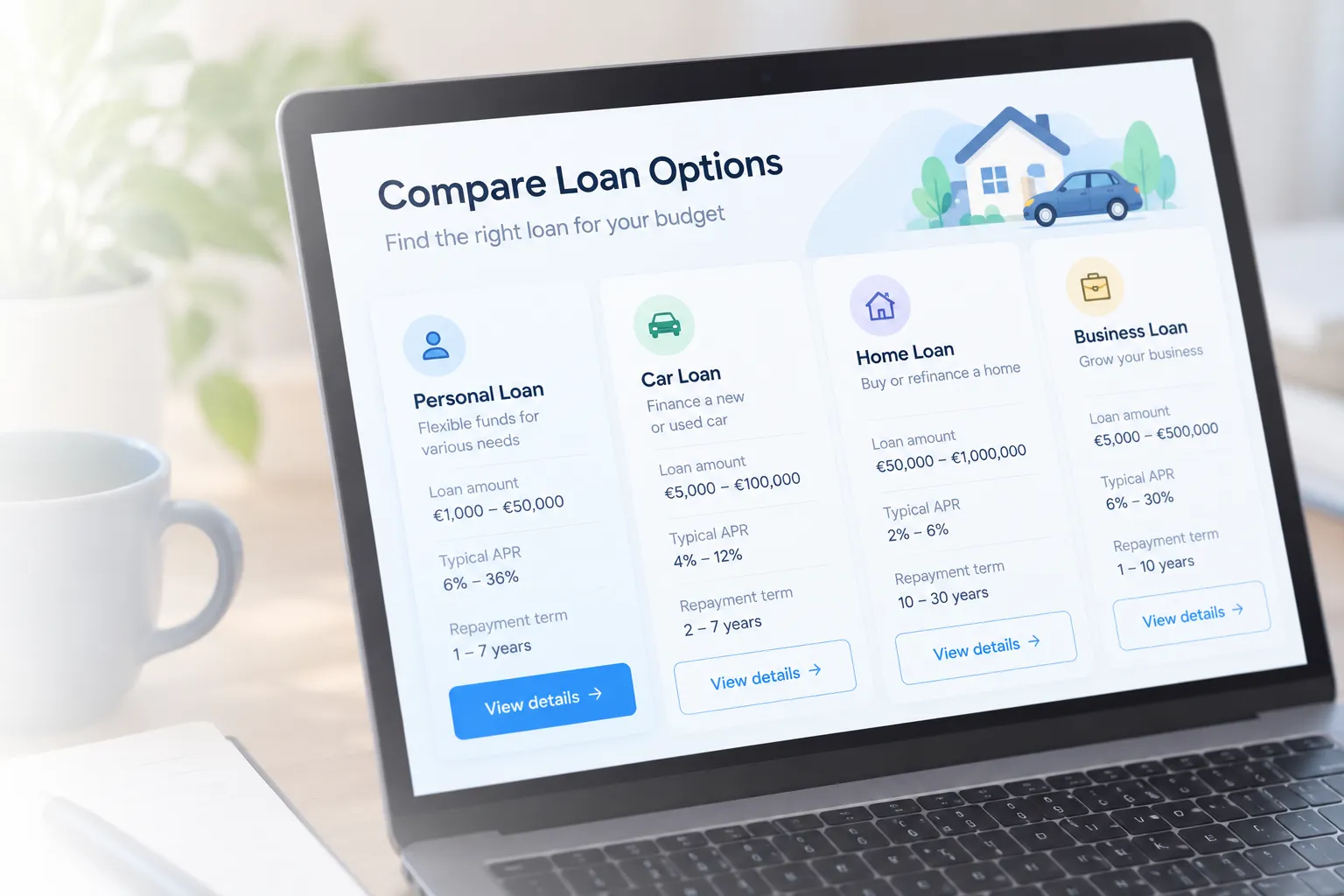
Next steps: Find the right loan for your budget
Once you’ve checked your credit and calculated your potential monthly payments, take these steps before choosing a loan.
- Explore personal loan options: Compare available loan types, eligibility requirements, and borrowing limits.
- Build your credit profile: Give yourself time to improve your credit history before applying if your score needs work.
- Compare lenders and interest rates: Review APRs, fees, repayment periods, and monthly payments to understand the full cost of borrowing.
- Calculate your loan payments: Use Invoice Fly’s free loan calculator to compare loan amounts and repayment terms before committing.

Explore more free business calculators
Take control of your business finances with Invoice Fly’s free business calculators. Estimate costs, plan your budget, and make informed decisions with simple tools designed to support your day-to-day business needs.
- Profit margin calculatorRevenue€200Costs€80Profit margin60%
Find your profit, markup, and profit margin from your costs and selling price.
- Sales tax calculatorPrice$100Tax rate8%Total with tax$108
Calculate the sales tax on a purchase and the total price including tax.
- Markup calculatorCost€30Price€45Markup50%
Work out the markup percentage between your cost and your selling price.
- All calculatorsInvoicingFreeTaxes & VATFreePricing & profitFreeExploreView all
Browse every free Invoice Fly calculator for taxes, pricing, payroll, and more in one place.
FAQs
A loan calculator helps you estimate how much you’ll repay based on your loan amount, interest rate, and repayment term. It can show your estimated monthly payment, total interest, and overall repayment cost, helping you compare borrowing options before applying for a loan.
An adjustable-rate mortgage (ARM) has an interest rate that can change after an initial fixed-rate period. Your monthly payment may increase or decrease depending on market rates and your loan terms. Invoice Fly’s loan calculator estimates repayments based on the interest rate you enter, so it cannot predict future payment changes. To assess an adjustable-rate mortgage, compare the initial rate with the possible rates and payments after the introductory period ends.
Enter your loan amount, annual interest rate, and repayment term in months into the calculator. Add any applicable origination fee if the calculator supports it. The calculator uses these details to estimate your monthly payment and total borrowing cost. Your lender’s final figures may differ depending on fees, loan conditions, and the interest calculation method.
The interest rate determines how much you pay to borrow money. For the same loan amount and repayment term, a higher rate generally means higher monthly payments and more interest paid over the life of the loan. Compare rates using the same loan amount and term to understand how even a small rate difference can affect your total cost.
It depends on your budget and financial goals. A shorter loan term generally means higher monthly payments but less interest overall. A longer term usually reduces your monthly payment, but you may pay substantially more interest over time. Use the loan calculator to compare terms and find a balance between manageable payments and the total cost of borrowing.
An amortization schedule breaks down your loan repayments over time, showing how much of each payment goes toward the principal and how much covers interest. It also shows how your outstanding balance decreases as you repay the loan. Reviewing this schedule helps you understand your repayment progress and how much interest you’ll pay throughout the loan term.
A secured loan is backed by collateral, such as a car or property, which the lender may repossess or claim if you default, subject to the applicable loan agreement and law. An unsecured loan does not require collateral; lenders instead assess factors such as your credit history, income, and existing debts. Secured loans may offer lower interest rates, while unsecured loans can have higher rates because the lender takes on more risk.
Yes. You can use a loan calculator to estimate repayments for many installment loans, including car loans, personal loans, student loans, and mortgages. Enter the loan amount, interest rate, and repayment term to compare monthly payments and total interest. For a more accurate estimate, account for additional costs such as mortgage insurance, property taxes, car insurance, or lender fees separately if they are not included in the calculator.
Look beyond the monthly payment and compare the annual percentage rate (APR), interest rate, fees, repayment term, and total amount you’ll repay. A lower monthly payment may come with a longer term and higher overall interest costs. Check the eligibility requirements and whether the rate is fixed or adjustable, then choose an option that fits your budget and financial goals.
Learn with the Invoice Fly Academy
From estimating your taxes to setting your prices, Invoice Fly’s free calculators help you manage everyday business finances.