- Home
- »
- Free Resources for Small Businesses
- »
- Free Business Calculators
- »
- Depreciation calculator
Depreciation Calculator
Calculate depreciation for your fixed assets using the straight line or diminishing balance method. Enter the asset cost, salvage value, useful life, and in-service date to see your depreciation schedule and book value.
Asset Depreciation Calculator

Depreciation schedule
Fix the highlighted fields to see the schedule.
| Year | Starting book value | Rate | Depreciation | Accumulated | Ending book value |
|---|
How to Use the Depreciation Calculator
Enter your asset details, choose a depreciation method, and get a depreciation schedule based on your numbers.
1
Enter Your Asset Cost
Add the original cost of the asset you want to depreciate. This is the starting value used in the depreciation calculation.
2
Add the Salvage Value
Enter the expected salvage value of the asset at the end of its useful life. This field is optional.
3
Enter the Useful Life
Add how many years you expect the asset to be in use. The calculator uses this to determine the depreciation period.
4
Choose a Depreciation Method
Select the method you want to use, such as straight line depreciation or the diminishing balance method.
5
Select the In-Service Starting Month
Choose the month the asset was placed into service. This helps determine when depreciation begins.
6
Review Your Depreciation Schedule
See your total depreciation, first-year depreciation, final book value, accumulated depreciation, and ending book value in one place.
Make Depreciation Easier to Track
Calculate asset depreciation, compare methods, and see how an asset’s value changes over its useful life, all in one place.
Calculate Depreciation Quickly
Enter your asset details and get your depreciation calculation without working through the depreciation formula manually.
Compare Depreciation Methods
Choose between straight line depreciation and the diminishing balance method to see how different methods affect your asset’s value over time.
See Your Depreciation Schedule
Review annual depreciation, accumulated depreciation, and ending book value in a clear schedule.
Keep Your Asset Records Organized
Use the results to support accounting and keep track of depreciation for your fixed assets.
Understanding Depreciation Calculations
Depreciation spreads the cost of an asset over its useful life. The method you choose determines how much depreciation is recorded each year and how quickly the asset’s book value decreases.
Straight Line Depreciation Formula
The straight line depreciation method spreads the depreciable cost evenly across the asset’s useful life.
Depreciation per Year = (Asset Cost − Salvage Value) ÷ Useful Life
Depreciation Calculation Example
For a $10,000 asset with a $1,000 salvage value and a 5-year useful life, the annual depreciation is $1,800. The same amount is recorded each year using the straight line method.
Diminishing Balance Method
The diminishing balance method applies depreciation to the asset’s remaining book value, so the depreciation expense is higher in earlier years and decreases over time.
Avoid Common Depreciation Errors
Use the correct asset cost, salvage value, useful life, and in-service date. Choosing the wrong depreciation method or entering incorrect figures can affect your depreciation schedule and accounting records.
Calculate Depreciation on the Go
Need to check an asset’s depreciation or book value while you’re away from your desk? Use Invoice Fly to calculate depreciation wherever you are, without building an Excel formula or doing the calculations manually.
More Free Calculators from Invoice Fly
Explore more free Invoice Fly calculators to help with taxes, payroll, pricing, and other business numbers.
 Open calculator
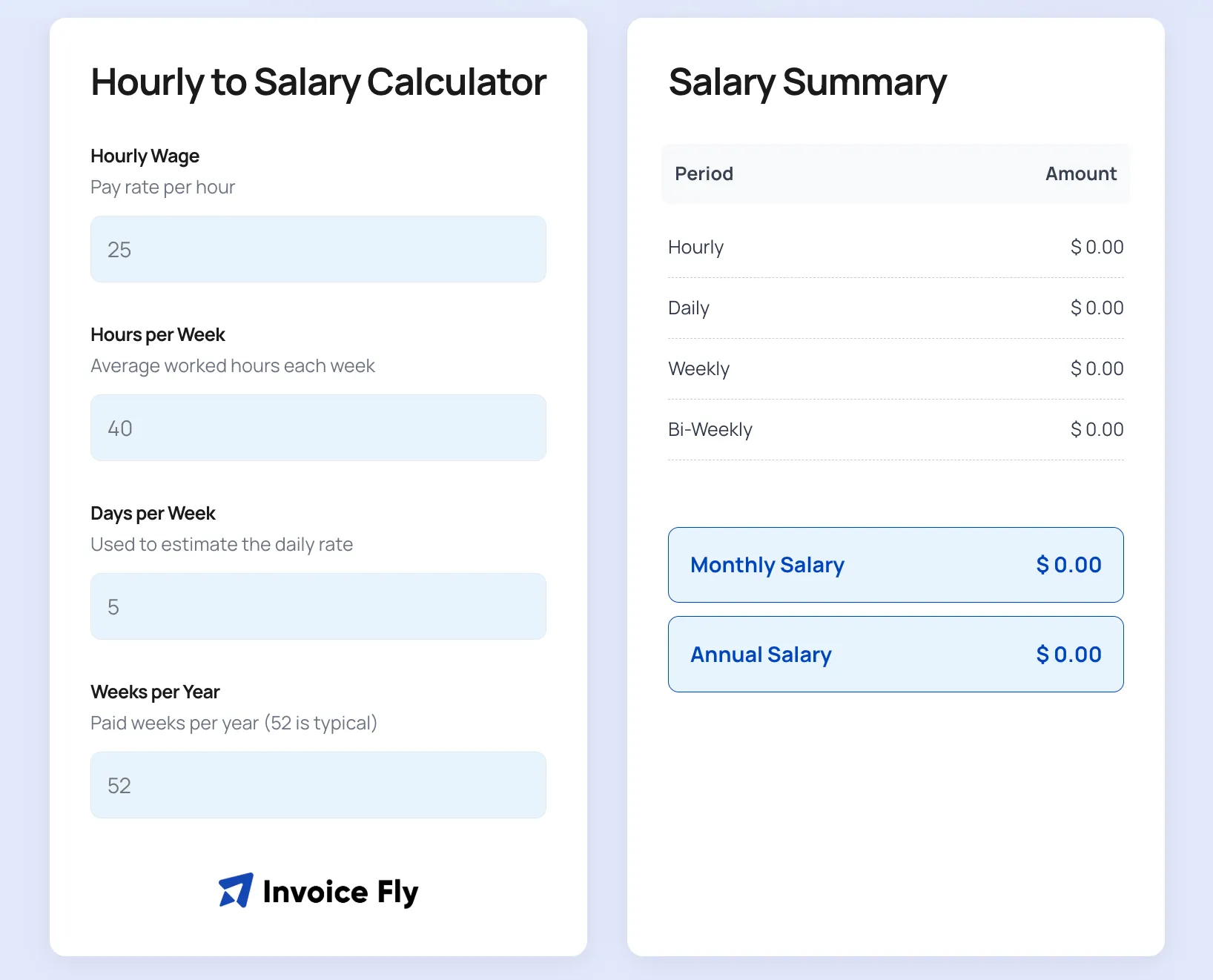
Hourly to Salary Calculator
Convert your hourly rate into weekly, monthly, and annual earnings.
 Open calculator
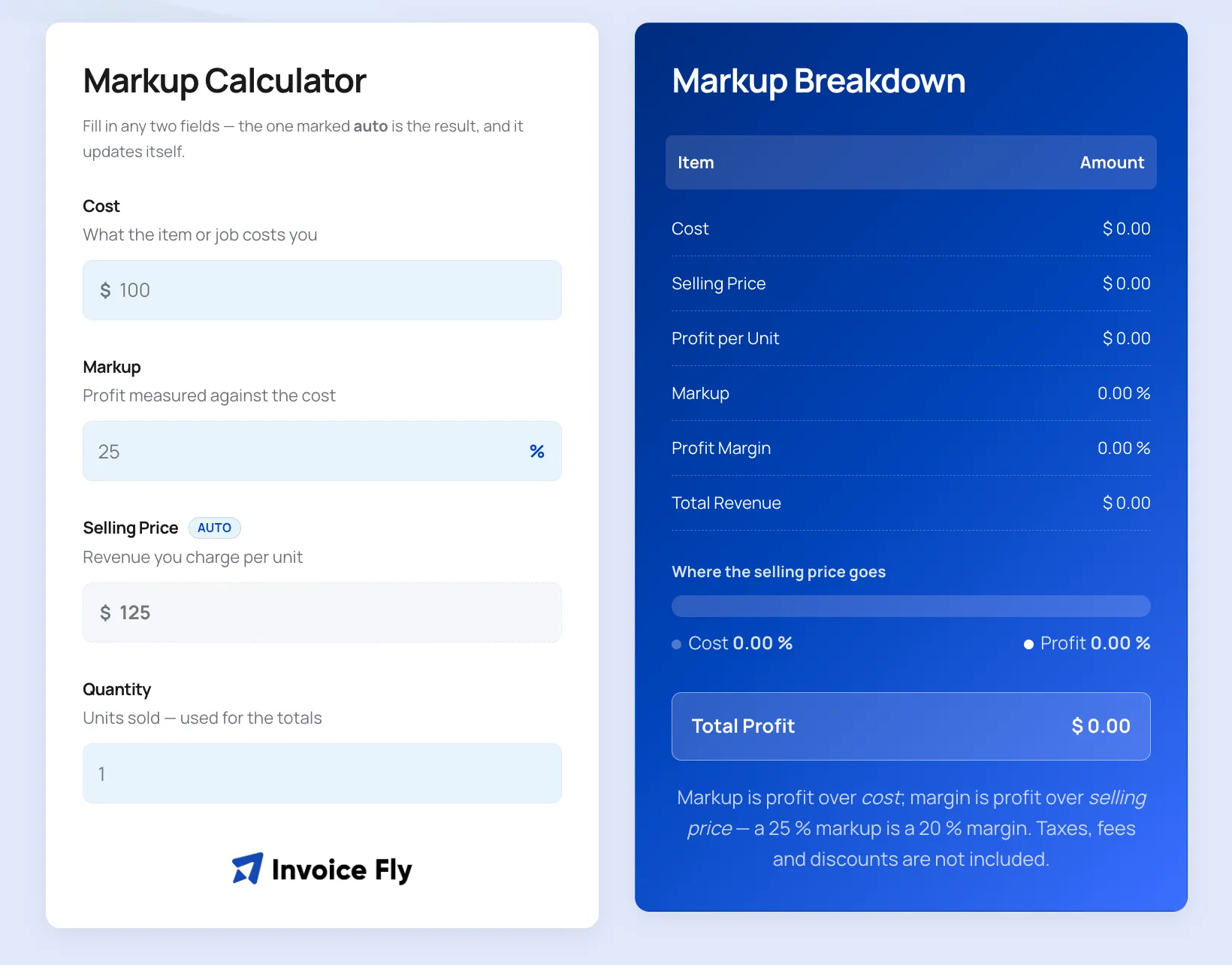
Markup Calculator
Calculate your markup, selling price, and profit.
 Open calculator
Tax Calculator 1099
Estimate taxes based on your 1099 income.
 Open calculator
IRS Estimated Taxes Payment
Estimate your federal estimated tax payments.
 Open calculator
Calculating Timesheet
Calculate your work hours and total time for a pay period.
 Open calculator
Federal Reimbursement for Mileage
Calculate mileage reimbursement for business travel.
Depreciation Calculator FAQs
The calculation depends on the method you use. With straight line depreciation, subtract the salvage value from the asset cost and divide the result by its useful life.
The depreciation formula depends on the method. For the straight line method, the formula is: (Asset Cost − Salvage Value) ÷ Useful Life.
A 20% depreciation rate means an asset depreciates by 20% of its applicable value during the period. The actual amount depends on the depreciation method and the asset’s current book value.
A 40% depreciation rate means 40% of the applicable asset value is recorded as depreciation for the period. With an accelerated method such as double declining balance, the depreciation amount can be higher in the earlier years.
Straight line depreciation spreads an asset’s depreciable cost evenly across its useful life. It is one of the simplest methods used for accounting and fixed asset records.
The diminishing balance method calculates depreciation based on the asset’s remaining book value. This results in higher depreciation earlier in the asset’s life and lower depreciation as the asset becomes older.
Double declining balance is an accelerated depreciation method that records more depreciation in the earlier years of an asset’s useful life. It uses twice the straight line depreciation rate.
Salvage value is the estimated value of an asset at the end of its useful life. For straight line depreciation, it is subtracted from the asset cost before calculating the annual depreciation expense.
Yes. You can use an Excel formula to calculate depreciation, with the formula depending on the method you choose. A depreciation calculator is a quicker way to calculate the amount and generate a depreciation schedule.
The straight line method records the same depreciation amount each year. Accelerated depreciation methods, such as diminishing balance and double declining balance, record more depreciation in the earlier years and less later.
Learn more with Invoice Fly Academy.
Learn how depreciation works, how different methods affect asset value, and how to handle depreciation in your accounting.