Invoice Fly vs Contractor+: Which Is Better for Contractors?
Table of Contents
The Invoice Fly vs Contractor Plus (Contractor+) choice comes down to how much of your business you want a single app to run. Both can take over the paperwork waiting for you after a long day, but they go about it differently. Invoice Fly sticks to the money side, while Contractor+ goes wider with a CRM, scheduling, contracts, and job costing.
Either one beats handwritten estimates. In this article, we compare features, plan limits, pricing, and everyday workflows so you can pick the one that fits your business.
Invoice Fly vs Contractor+ at a Glance
| Invoice Fly | Contractor+ | |
|---|---|---|
| Best for | Solo contractors who want focused billing and expense tools | Contractors who also need a CRM, scheduling, and job management |
| Estimates and invoices | Unlimited on either paid billing option | 5 per month on Freedom; unlimited on paid plans |
| Estimating help | Saved items and custom estimates | Live local cost data and Estimatic AI on paid plans |
| Scheduling | No scheduling calendar | Scheduling and calendar sync on Pro |
| CRM | Client and billing records | Leads, clients, and job history |
| Time and expenses | Timer, receipt scanning, expense tracking, and reports | Time and expense tracking; job costing on Pro Team |
| Contracts | Estimate signatures and deposits | Automated contracts and e-signatures on Pro |
| Team features | Built mainly for individuals | Team and client chat, collaboration on Pro Team |
| Integrations | Payment providers such as Strip and Paypall | QuickBooks Online, Zapier, and API on Pro Team |
| Starting paid price | $8.99/week or $98.99/year | Pro: $49/month or $348/year |
| Free option | Free online tools for single documents, no account needed; the full app requires a subscription | Freedom plan: 5 estimates or invoices per month |
In short, Invoice Fly makes sense when billing and cost tracking are your main headaches. Contractor+ offers more depth when leads, schedules, crews, and job margins also need a home.
What Is Invoice Fly?
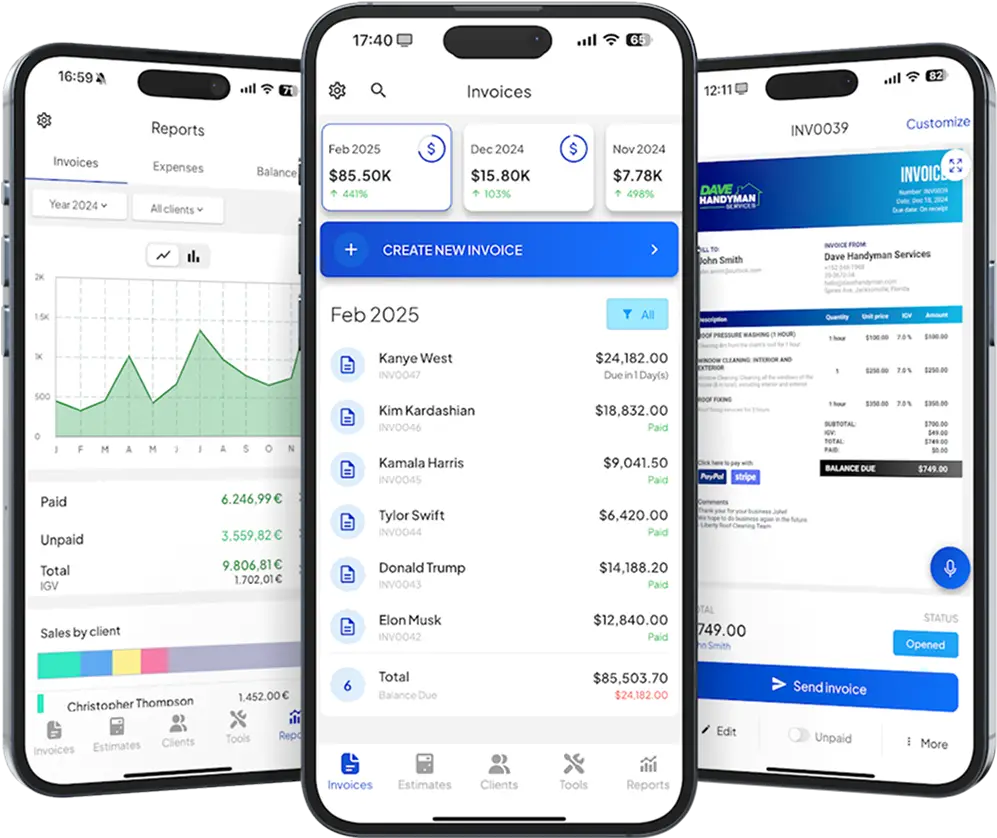
Invoice Fly gives independent pros a simple path from quote to payment. You send an estimate, collect approval or a deposit, and turn it into an invoice without retyping the job. Hours, receipts, recurring invoices, reminders, and reports sit right next to your billing, and status labels show whether each invoice is sent, viewed, paid, or overdue.
Paid access costs $8.99 a week or $98.99 a year, and both options include unlimited estimates and invoices. If you only need the occasional document, Invoice Fly also offers seven free browser-based tools, no subscription required.
What Is Contractor Plus?
Contractor Plus is web and mobile software for general contractors, remodelers, handymen, HVAC companies, and other trades.It brings leads, estimates, invoices, scheduling, contracts, payments, team chat, and job costing into one platform, with live cost data and an AI estimating tool called Estimatic on paid plans.
There are four plans: Freedom (free), Pro for one user, Pro Team for growing crews, and Max for large companies. For a wider look at Contractor Plus features and common use cases, see this Capterra overview.

Invoice Fly vs Contractor Plus: Key Differences
Invoicing and Estimates
Both apps build itemized estimates and invoices you can send digitally. Invoice Fly adds signatures, deposits, and unlimited documents on either billing option.Contractor+ leans into construction estimating. Pro adds optional line items, add-ons, live local cost data, and Estimatic AI to help you price jobs faster.
Cost data is a starting point, though. Supplier prices, delivery, and site conditions can change the real number, so double-check before you lock in a fixed quote.
Tip: Whichever app you use, use invoice automation with care and make sure to set up.clear invoice line items to help customers see how labor, materials, and other charges add up.
Estimate-to-Invoice Workflow
Both apps carry estimate details straight into the invoice, so there’s no retyping and no mismatched totals. Invoice Fly keeps the path short: estimate, approval, invoice, payment. Contractor+ places the estimate inside a longer journey, from lead to contract, scheduled job, invoice, and cost report. That suits a remodel but may be overkill for a one-visit repair.
Scheduling and Job Management
Contractor+ Pro includes scheduling and calendar sync, so appointments, notes, and costs live together in each job record.Invoice Fly doesn’t offer a scheduling calendar, which may not matter if yours already works.Contractor+ earns its keep when double bookings keep causing problems.
As the SBA’s guide to managing your business suggests, the goal is clearer operations, not one more place to copy information.
CRM and Customer Management
Invoice Fly saves each client with their estimates, invoices, payments, and expenses, which is usually enough for solo repeat work. Contractor+ has a fuller CRM. You can track leads before they become clients, follow each estimate, and keep a full job history. The free plan caps you at 250 leads and clients. If most of your work comes from referrals and you reply quickly anyway, a lead pipeline might feel like extra overhead.
Time, Mileage, and Expense Tracking
Invoice Fly tracks your hours by client or project, scans receipts, sorts spending into categories, and creates expense reports. Contractor+ also logs hours and expenses, and Pro Team ties them to each job’s profit. Mileage tracking isn’t listed on its current pricing page, so confirm it during a trial.
If you do log miles, the IRS publishes the current standard mileage rates, though what you can claim depends on your situation.

Online Payments
Invoice Fly accepts online payments through providers like Stripe and PayPal, and each payment is tied to its invoice. Contractor+ supports card and ACH payments on Pro, works with processors like Stripe, PayPal, and Authorize.net, and offers client financing to help you win bigger jobs.
Compare subscription costs and transaction fees separately, including card, ACH, and refund rates.
Tip: Clear invoice payment terms should spell out due dates, accepted payment methods, deposits, and any invoice late fees before the work starts.
Contracts and E-Signatures
Invoice Fly lets customers sign estimates and pay deposits, giving you a record of approval. Contractor+ Pro goes further with automated contracts and e-signatures, so scope, payment terms, and approval sit next to your estimates and invoices.
A template won’t cover every state’s rules, since home-improvement contracts may need license details, notices, or cancellation language. The FTC’s Cooling-Off Rule explains a federal rule for some sales made at a customer’s home, and your state may have its own requirements.
Team and Employee Management
Invoice Fly is built mainly for individuals and doesn’t offer team management tools. Contractor+ Pro Team includes two users, with more at $20 a month each on annual billing. It adds team and client chats, a client portal, and a business phone system.
Set access thoughtfully: a field worker may need the job address but not your financial details.
Job Costing and Profitability Tracking
Contractor+ has the edge here. Pro Team includes automated job costing and profit tracking, so you can compare what a job earned with what it cost. Invoice Fly reports invoices and expenses but isn’t a full job-costing system, so detailed margins may need a spreadsheet.
Callbacks and rising material prices can quietly eat into a big invoice. The IRS explains in Publication 583 that your records should support the income and expenses you report.
Integrations and Business Tools
Contractor+ Pro Team connects with QuickBooks Online and Zapier and includes developer API access, so Contractor+ can run your operations while QuickBooks handles the books. After setup, check that taxes, refunds, and deposits sync correctly. Invoice Fly is more self-contained, which suits anyone who doesn’t want to manage several integrations.
Ease of Use and Mobile Access
Both platforms work on mobile and the web. Invoice Fly has fewer settings, so once your business details and clients are saved, you can start quoting and invoicing right away. Contractor+ does more, so setup takes longer. That pays off for a growing company but can overwhelm someone who just wants to invoice faster.
For real user experiences, compare recent reviews on G2, Capterra, and Software Advice. Focus on reviewers with a similar trade and team size.

Invoice Fly vs Contractor Plus Pricing
| Pricing detail | Invoice Fly | Contractor+ Freedom | Contractor+ Pro | Contractor+ Pro Team |
|---|---|---|---|---|
| Monthly billing | Not offered | Free | $49/month | $98/month |
| Annual billing | $98.99/year | Free | $348/year | $696/year |
| Weekly billing | $8.99/week | Not offered | Not offered | Not offered |
| Users | 1 | 1 | 1 | 2 included, extra users available |
| Estimates and invoices | Unlimited | 5 per month | Unlimited | Unlimited |
Contractor+ also offers a Max plan at $500 a month with unlimited users, aimed at companies doing over $1 million a year. For another reference point, see the Capterra pricing page.
For a solo contractor paying yearly, Invoice Fly costs $98.99 compared with $348 for Contractor+ Pro. Contractor+ justifies the higher price if you’ll use its CRM, scheduling, or team tools, and its free plan works if you send only a few documents a month.
Invoice Fly vs Contractor+ for Contractors and Tradespeople
Invoice Fly usually suits independent contractors who need solid billing, time tracking, and expense reports and already have a calendar that works. It’s a strong Contractor Plus alternative if you want a lower yearly cost and less setup. Contractor+ usually suits businesses juggling leads, longer projects, contracts, crews, or detailed job costing.

The best test is a real one: run a recent job from inquiry to payment in each app and count the workarounds. And make sure the final document follows the basics of how to write an invoice.
Invoice Fly vs Contractor+: Which Should You Choose?
The right choice depends on how much of your business you want the app to manage. Invoice Fly is the stronger fit if you need an affordable, focused way to create estimates, send invoices, collect payments, track time, and record expenses. Contractor+ makes more sense if billing is part of a larger workflow involving leads, schedules, contracts, job costing, and crews.
In the end, Invoice Fly keeps the financial side of each job simple, while Contractor+ helps coordinate the wider operation. Choose the platform that solves your biggest daily challenge without adding tools, setup, or costs you do not need.