A Guide To Finding Healthy Profit Margins For Your Business

Table of Contents
Profit margin shows how much money your business actually keeps after paying expenses. It’s one of the most important numbers for understanding how profitable your company really is.
In this guide, we’ll explain what profit margin means, how to calculate it (with examples and formulas), and how to track it easily so you can make smarter business decisions and grow your profits faster.
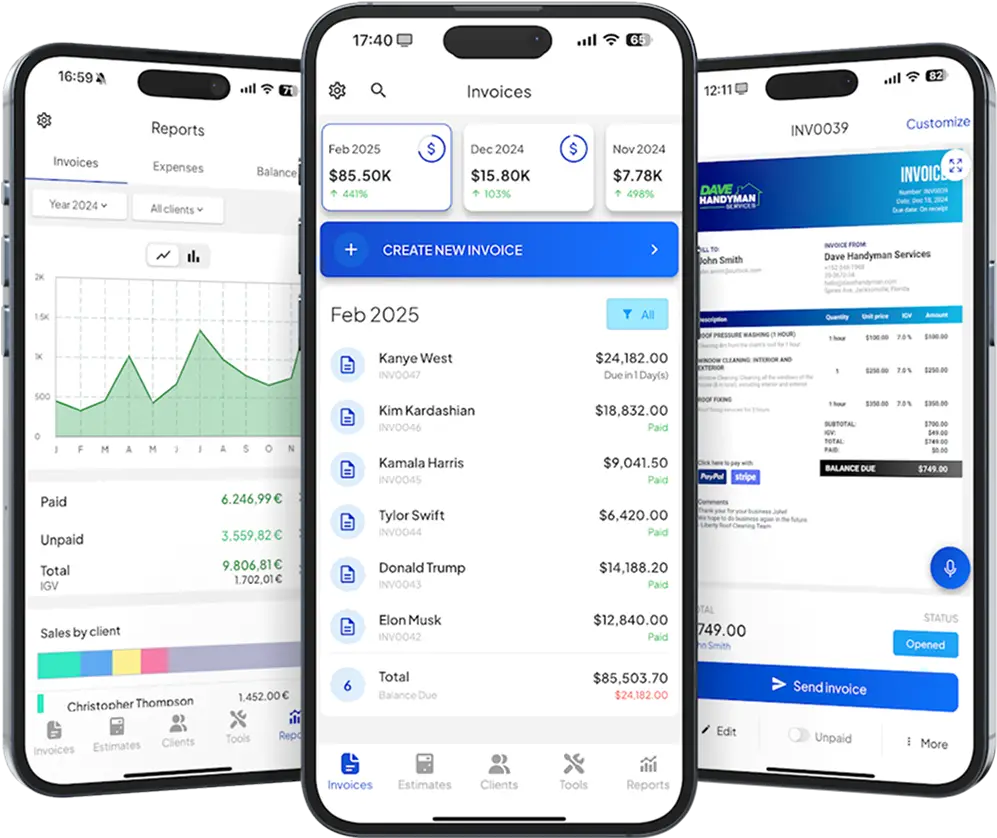
Need tools to run your business better? Try Invoice Fly’s Business Reports to track performance and make smarter decisions! If you are in the process of starting your business, read our guide to writing a business plan to get a head start.

What Is Profit Margin?
Profit margin is the percentage of revenue that becomes profit after expenses. If you make $100 in sales and have a 20% profit margin, you keep $20 as profit. The remaining $80 goes to expenses like labor, materials, and rent.
Knowing your profit margin helps you:
- Understand your financial health
- Make informed pricing decisions
- Compare your business to others
- Plan for sustainable growth
The higher your profit margin, the more money you keep from each sale. However, “good” margins vary significantly by industry, business model, and company size.
Main Types of Profit Margin
There are several types of profit margins, each showing profitability at different stages of your business operations. Understanding the difference helps you identify where money is being made or lost.
Gross Profit Margin
Gross profit margin measures how efficiently you produce or deliver your product or service. It’s calculated before operating expenses.
Formula: (Revenue – Cost of Goods Sold) / Revenue × 100

Operating Profit Margin
Operating profit margin considers both direct costs and operating expenses but excludes interest and taxes. It shows how efficiently you manage day-to-day operations.
Formula: Operating Income / Revenue × 100
Net Profit Margin
Net profit margin includes all expenses. It shows the actual percentage of revenue you keep.
Formula: Net Income / Revenue × 100
Marginal Profit
Marginal profit is the extra profit earned by producing one more unit. If the marginal profit is positive, it makes financial sense to expand.
Tip: Make sure you also understand the difference between margin vs markup, equally essential for avoiding costly pricing mistakes.
How To Find Profit Margin (Step by Step)
Calculating profit margin is easier than most business owners think. At its core, you’re simply figuring out how much money you keep from every dollar you earn.
Think of it this way: if you sell something for $100 and your profit margin is 25%, you’re keeping $25 and spending $75 on costs. The formula tells you that percentage.
Here’s the basic profit margin formula that works every time:
Profit Margin = (Profit / Revenue) × 100
The beauty of this formula is its simplicity. You just need two numbers: your total revenue (money coming in) and your profit (money left over after expenses). The type of profit margin you’re calculating just depends on which expenses you include.
Basic Profit Margin Formula
Step 1: Identify your total revenue (all sales income)
Step 2: Calculate your profit (revenue minus relevant expenses)
Step 3: Divide profit by revenue
Step 4: Multiply by 100 to get a percentage
The type of expenses you subtract determines which margin you’re calculating.
How To Calculate Gross Profit Margin
Gross profit margin shows how much you make after paying for the direct costs of producing your product or service. It doesn’t include things like rent or marketing yet.
Step 1: Find your total revenue
Step 2: Calculate your cost of goods sold (COGS) – direct costs like materials and labor
Step 3: Subtract COGS from revenue to get gross profit
Step 4: Divide gross profit by revenue and multiply by 100
Example: Revenue of $100,000 minus COGS of $50,000 = $50,000 gross profit
($50,000 ÷ $100,000) × 100 = 50% gross profit margin
Profit Margin Calculator
Number of workers needed for the job
Total hours required to complete the job
Average hourly rate per worker
Total monthly business expenses (rent, utilities, insurance)
Total working hours per month
Total hours needed to complete this specific job
Total cost of all supplies used for the job
The final price you will charge your client

Total Summary
How To Calculate Net Profit Margin
Net profit margin is your bottom line. It shows what you actually keep after paying everything: materials, labor, rent, utilities, taxes, and all other costs.
Step 1: Get your net income from your profit and loss statement
Step 2: Net income = revenue minus ALL expenses (COGS, operating expenses, interest, and taxes)
Step 3: Divide net income by revenue and multiply by 100
Example: Revenue of $100,000 minus all expenses of $85,000 = $15,000 net income
($15,000 ÷ $100,000) × 100 = 15% net profit margin
Example: Step-by-Step Profit Margin Calculation
Let’s follow a landscaping business through all three margin calculations to see how they work together:
Starting Point: Annual Revenue = $100,000
| Step | What You’re Calculating | Expenses Deducted | Profit Remaining | Formula | Margin |
|---|---|---|---|---|---|
| 1 | Gross Profit Margin | Direct costs: $50,000 (materials, labor, equipment) | $50,000 | (50,000 ÷ 100,000) × 100 | 50% |
| 2 | Operating Profit Margin | Operating expenses: $30,000 (rent, utilities, marketing) | $20,000 | (20,000 ÷ 100,000) × 100 | 20% |
| 3 | Net Profit Margin | Taxes & interest: $5,000 | $15,000 | (15,000 ÷ 100,000) × 100 | 15% |
Notice how the margins get smaller and smaller as you account for more expenses. This is normal and helps you understand profitability at different levels of your business.
Understanding gross profit vs net profit helps you see where your money goes at each stage of operations.
How To Find Profit Margin in Excel
Excel makes it easy to calculate margins using a simple spreadsheet or Microsoft excel template:
- Input revenue and expenses in separate cells
- Subtract expenses from revenue to get profit
- Divide profit by revenue and format as a percentage
Excel Spreadsheet Tips:
- Format margin cells as percentages with one decimal place
- Use dollar signs ($) for currency values
- Bold your header row for easy scanning
- Color-code margins: Green for good (>15%), yellow for concerning (5-15%), red for poor (<5%)
- Search for “profit margin calculator” in Excel’s template gallery for pre-built formulas

Tip: For contractors and service businesses, combining Excel tracking with good bookkeeping for contractors practices ensures you always know your financial position. Understanding accrual basis accounting also helps you track margins more accurately.
What’s a Good Profit Margin?
Good margins vary by industry. In general:
- 5% or less: Low
- 10%: Average
- 20% or more: High
Service businesses often have higher margins than retail or manufacturing.
Average Margins by Industry
Check benchmarks for your industry using public databases like NYU Stern. For more detailed industry comparisons, FullRatio’s profit margin data breaks down margins across hundreds of specific business categories.

How To Improve Your Profit Margin Over Time
- Raise prices strategically. Even a small increase can boost profits without changing costs. Use a service price calculator to ensure you’re pricing above your costs.
- Improve efficiency by reducing direct costs like materials or labor. Review expenses regularly to identify savings.
- Focus on high-margin offerings. Upsell premium options and bundle services to increase average transaction size. Eliminate low-margin offerings that don’t add value.
- Retain customers through excellent service and loyalty programs. It’s cheaper to keep existing clients than find new ones.
Use tools like profit margin calculators and invoice software to stay organized and make informed financial decisions. Understanding hourly vs flat rate pricing can also help maximize your margins.
Final Thoughts
Understanding how to find and improve profit margins helps you grow a stronger business. Start by tracking your margins regularly, comparing them to industry norms, and making small but smart changes to pricing and costs.
Remember that profit margins represent the financial health and long-term viability of your business. Higher margins give you more breathing room for slow periods, more resources for growth investments, and better odds of long-term success.
A 1% improvement in your margin can increase your profits by 10-20%. Even small changes compound over time. Focus on consistent improvement rather than dramatic overnight changes.
Need tools to run your business better? Try Invoice Fly’s Business Reports to track performance and make smarter decisions! Use an invoice maker to ensure you actually collect the revenue your margins are based on.
What users love about Invoice Fly:
“How easy is to create invoices at the job
sites”— Jose C. · Capterra · ★★★★★