Invoice Fly vs Harvest: Which To Choose For Your Business?
Table of Contents
Invoice Fly and Harvest both combine invoicing with time tracking, making them useful for freelancers and businesses that bill clients for their work.
The difference is in how those tools are organized. Invoice Fly keeps estimates, time, expenses, invoices and payments within a service-business billing workflow. Harvest puts more emphasis on tracked hours, projects and team reporting, with invoices often created from the time and expenses recorded against a project.
In this guide, we’ll compare Invoice Fly vs Harvest based on invoicing, time tracking, projects, payments, reporting, pricing and everyday use.
Invoice Fly vs Harvest at a glance
| Feature | Invoice Fly | Harvest |
|---|---|---|
| Best suited to | Freelancers, contractors and service businesses | Freelancers, consultants, agencies and teams |
| Starting price | $8.99/week or $98.99/year | Free |
| Free plan | No | Yes, 1 person and 2 projects |
| Invoices | Unlimited | Yes; usage charges can apply on paid plans |
| Estimates | Unlimited | Yes |
| Time tracking | Yes | Yes |
| Tracked time to invoice | Yes | Yes |
| Recurring invoices | Yes | Yes |
| Expenses | Yes | Yes |
| Project budgets | Basic client/project workflow | Yes |
| Team reporting | Business reports | Yes |
| Profitability reporting | Business reports | Enterprise |
| Online payments | Stripe and PayPal | Stripe and PayPal |
| QuickBooks/Xero integrations | No | Paid plans |
| Mobile access | Yes | Yes |
| Desktop apps | Browser/mobile workflow | macOS and Windows |
The biggest difference is what happens around the invoice. Invoice Fly focuses on managing the steps from estimate and billable work through to payment. Harvest puts tracked time and project data at the center, with more tools for teams that need to monitor hours, budgets and performance.
What is Invoice Fly?
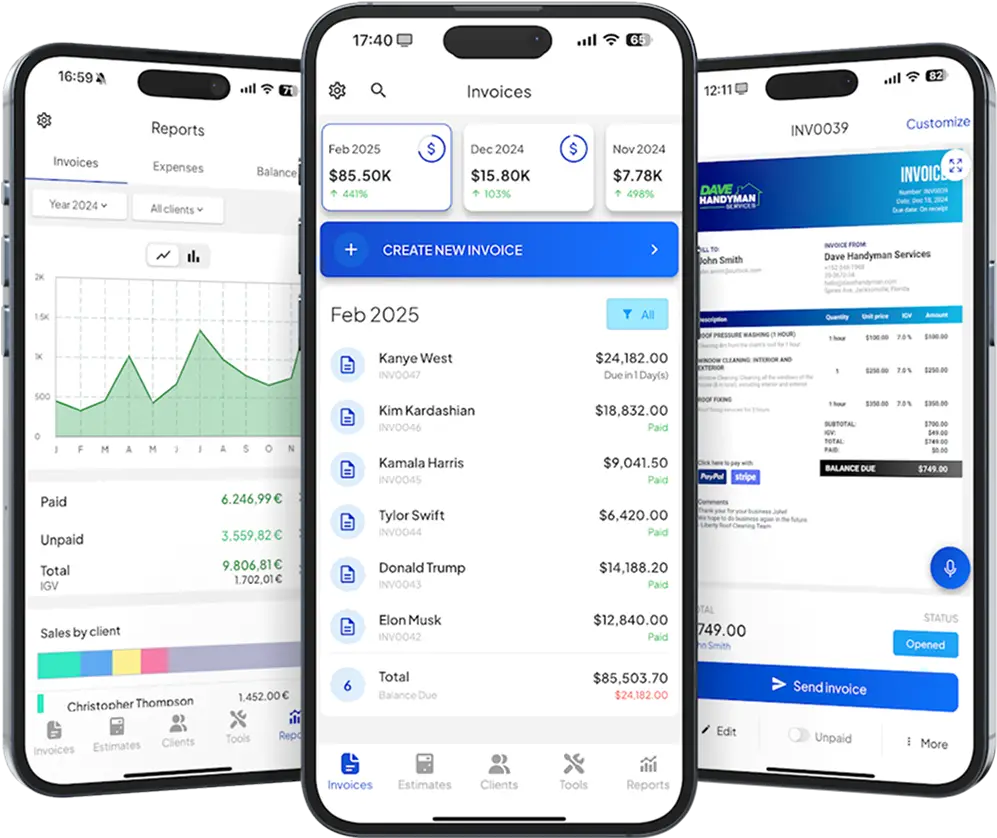
Invoice Fly is invoicing software for freelancers, contractors and small service businesses.
It combines estimates, invoices, recurring billing, time and expense tracking, payment reminders and online payments. Both subscription options include unlimited invoices and estimates, so you don’t need to choose a plan based on how many clients you bill.
For independent user feedback, you can also see Invoice Fly reviews on Capterra.
What is Harvest?
Harvest is time-tracking and invoicing software for freelancers and professional teams. Time can be recorded against clients, projects and tasks, then used for invoicing, project monitoring and reporting.
You can bill by tracked time and expenses or use fixed project fees. Harvest also supports project budgets, estimates, recurring invoices, online payments and integrations with other business tools.
There is a permanent Free plan for one person and two active projects, alongside paid plans for teams and businesses that need more capacity and reporting. Independent Harvest reviews on G2 provide additional user feedback.
Invoice Fly vs Harvest: Key differences
Both apps can take you from tracking work to getting paid. The differences become clearer when you look at how each handles time, projects and teams.
Invoicing and invoice usage
Both platforms support invoicing, but the workflow differs.
- Invoice Fly: Includes unlimited invoices and estimates. You can convert approved estimates into invoices, set up recurring billing and track invoice status.
- Harvest: Supports free-form invoices or invoices based on tracked time, expenses and project fees.
Harvest’s paid plans also use a combination of per-seat and usage-based pricing. Additional invoices, projects, clients and tasks may incur charges, so total cost can depend on how you use the platform.
If you’re deciding how to structure client billing, our guide to the different types of invoices explains some of the common options.
Time tracking and billable hours
Time tracking is a core feature of both apps, but Harvest goes deeper into how that time is analyzed.
- Invoice Fly: Its time-tracking software records billable hours against clients and projects so they can be added to invoices.
- Harvest: Tracks time by client, project and task, with timers and timesheets available across web, desktop and mobile apps. Tracked hours can then flow into invoices and project reports.
Harvest also supports different billing rates and project budgets, making those time records useful beyond creating an invoice.
For an individual freelancer or contractor, the priority may simply be capturing billable hours accurately. Agencies and teams may also want to see where everyone’s time is going and compare it against project budgets.
Projects, budgets and team workflows

The platforms handle project work differently.
- Invoice Fly: Connects time, expenses, estimates and invoices to client work, keeping project admin close to the billing process.
- Harvest: Supports Time & Materials and Fixed Fee projects, with budgets, billing rates and tools for monitoring time and team capacity.
- Harvest Enterprise: Adds timesheet approvals and more detailed profitability reporting across clients, projects, tasks and teams.
Harvest’s additional project tools are more relevant if you manage budgets or billable hours across a team. For individual client work, Invoice Fly keeps the focus on tracking the job and getting it billed.
Estimates and recurring invoices
Both platforms support estimates and recurring billing.
- Invoice Fly: Create estimates with its estimate and quote software, turn approved estimates into invoices and schedule recurring billing.
- Harvest: Supports estimates and recurring invoices on yearly, monthly or custom schedules. Free-form recurring invoices can be sent automatically, while invoices based on tracked time and expenses are created as drafts for review.
For repeat billing, invoice automation can also reduce time spent creating invoices and following up manually.
Online payments and client experience
Both platforms connect invoicing with online payments.
- Invoice Fly: Supports online payments through providers including Stripe and PayPal, with payment status connected to the invoice.
- Harvest: Integrates with Stripe and PayPal so clients can pay online from an invoice. It also provides a client dashboard for viewing outstanding invoices, recent payments and supporting recurring payment details.
Both also support payment reminders and invoice-status tracking. Harvest can record when a client views a web invoice, while Invoice Fly tracks statuses including sent, viewed, paid and overdue.
With either platform, clear invoice payment terms and a defined invoice due date can make payment expectations easier for clients to understand.
Expenses and receipt tracking
Both apps can connect business expenses to client work.
- Invoice Fly: Tracks expenses and captures receipts alongside invoices and other billing records.
- Harvest: Records expenses against projects and tasks, with receipt attachments and the option to add billable expenses to invoices.
Harvest ties expenses more closely to its project workflow, while Invoice Fly keeps them within the wider client-billing process.
Reports and profitability
The reporting you need will depend on whether you’re mainly monitoring your own billing or managing projects and a team.
- Invoice Fly: Provides business reports around invoices, payments and expenses.
- Harvest Free and Teams: Include time and project reporting, budget tracking and team reporting on Teams.
- Harvest Enterprise: Adds unlimited custom reports and profitability reporting across clients, projects, tasks and teams.
Harvest’s reporting is particularly tied to the time and project information recorded in the platform. This can be useful when billable hours, project budgets or team utilization are important measures for your business.
Invoice Fly’s reports stay closer to the financial activity around your client work.
Integrations and accounting

Harvest offers a wider integration ecosystem.
Paid Harvest plans connect with accounting and payment platforms including QuickBooks Online, Xero and Stripe, alongside project and communication tools. Harvest currently advertises more than 40 core integrations.
Invoice Fly’s workflow is more self-contained around invoicing, time, expenses, clients and payments.
If you already use several tools to manage projects or accounting, integrations may play a bigger role in your choice. If most of your day-to-day admin happens within your invoicing workflow, they may matter less.
Mobile, desktop and browser access
Harvest offers several ways to track time across devices. It has iOS and Android apps, dedicated macOS and Windows apps, browser access and extensions that can track time from other tools.
Invoice Fly supports mobile and browser access, so you can track time, manage clients and send invoices wherever you’re working.
For either platform, you can send an invoice without needing to wait until you’re back at your desk.
Ease of use and setup
Both apps connect time tracking with invoicing, but the setup reflects their different workflows.
- Invoice Fly: Brings estimates, clients, time, expenses, invoices, reminders and payments into one billing workflow.
- Harvest: Organizes work around clients, projects, tasks and tracked hours, with additional options for budgets, rates, team reporting and integrations.
For an individual user, either can cover everyday time tracking and invoicing. The difference becomes more noticeable when you need to manage project budgets, multiple team members or detailed reporting.
Invoice Fly vs Harvest pricing

The two platforms use very different pricing models.
Invoice Fly currently offers:
- Weekly: $8.99 per week
- Yearly: $98.99 per year
Both Invoice Fly pricing plans include unlimited invoices and estimates.
Harvest currently offers:
| Harvest plan | Annual billing | Monthly billing |
|---|---|---|
| Free | $0 | $0 |
| Teams | $9/person/month | $11/person/month |
| Enterprise | $14/person/month | $17.50/person/month |
| Enterprise Plus | Custom | Custom |
Annual Teams and Enterprise plans are paid upfront and currently offer a 20% discount. Harvest also charges for additional invoices, projects, clients and tasks based on usage, so the per-seat price may not be your total cost.
Harvest’s Free plan covers one person and two active projects, with some restrictions on invoicing. There’s also a fully featured 30-day trial with no credit card required.
Pricing checked September 2026.
Where each app works best
The most useful question is often how time fits into the way you bill clients.
| If you… | Consider |
|---|---|
| Want unlimited invoices and estimates | Invoice Fly |
| Want a permanent free option for one person and up to two active projects | Harvest Free |
| Mainly track your own billable hours and client expenses | Either |
| Manage project budgets and team hours | Harvest |
| Need detailed profitability reporting | Harvest Enterprise |
| Want QuickBooks Online or Xero integrations | Harvest paid plans |
| Want estimates, time, expenses and payments centred around client billing | Invoice Fly |
| Bill clients directly from detailed timesheets and project data | Harvest |
A solo freelancer may find that either platform covers the basics. The distinction becomes more important as project and team reporting grows: Harvest provides more tools around hours, budgets and utilization, while Invoice Fly keeps more of the workflow centred on completing client work and getting it billed.
The IRS recommends keeping records that clearly show business income and expenses, while the SBA provides broader guidance on managing business finances.
Invoice Fly vs Harvest: Which should you choose?
Invoice Fly may suit freelancers, contractors and service businesses that want estimates, billable time, expenses, unlimited invoices, recurring billing and payments connected in one client-billing workflow.
Harvest may suit freelancers and teams that build their billing around tracked hours and projects, particularly when project budgets, team reporting or integrations are important.
Both can track time and turn completed work into invoices. The choice comes down to what you need around that process: a focused client-billing workflow or more detailed project and team time management.