Comparing Invoice Fly vs Square for Your Business
Table of Contents
Choosing between Invoice Fly and Square, starts by answering the question: how do your clients pay? Invoice Fly suits businesses that quote and invoice for completed work. Square is built for companies that also take card payments online, at a counter, or on the go.
Both platforms can make billing easier, but they fit different routines. In this guide, we’ll compare their pricing, payment options, contracts, customer tools, and everyday usability to help you decide which is better for your business.
Invoice Fly vs Square at a Glance
| Category | Invoice Fly | Square |
|---|---|---|
| Best for | Contractors and service professionals with estimate-to-invoice work | Businesses taking online, invoiced, and in-person payments |
| Invoices and estimates | Unlimited on both paid plans | Unlimited on Square Free |
| Recurring invoices | Included | Included |
| Expense tracking | Expenses, receipt capture, and reports | Sales reporting, but not a dedicated expense tracker |
| Time tracking | Included | Requires another tool or workflow |
| Online payments | Stripe and PayPal, supporting cards, digital wallets, ACH, and SEPA | Built-in Square processing |
| In-person payments | No POS | POS software and optional hardware |
| Contracts and signatures | Estimate approvals and signatures | Reusable contracts and e-signatures |
| Free option | Free browser document generators | Square Free has no monthly fee; processing fees apply |
| Paid software | $8.99/week or $98.99/year | Plus: $49/location/month; Premium: $149/location/month |
| Mobile access | Mobile apps and browser | Square POS, Square Invoices, and web dashboard |
Quick verdict: Invoice Fly makes sense when the sale usually starts with a quote and ends with an invoice. Square has the advantage when the same business also takes cards in person, sells online, or relies on a point-of-sale system.

What Is Square?
Square is a commerce platform built around payments. You may also see it called “Squareup” because its website is squareup.com, but Squareup is not a separate product.
Its tools extend to invoices, point-of-sale software, online selling, appointments, customer programs, staff management, payroll, and hardware. Square Invoices supports unlimited invoices, estimates, and recurring bills, plus deposits, reminders, online payments, contracts, notes, and attachments.
Its main attraction is connecting remote invoices, appointment payments, counter sales, and online transactions.
The Square Invoices overview on Capterra provides a third-party summary of these Square features. Keep in mind that some tools and lower processing rates require a paid plan.
Invoice Fly vs Square: Key Differences
Invoicing and Estimates
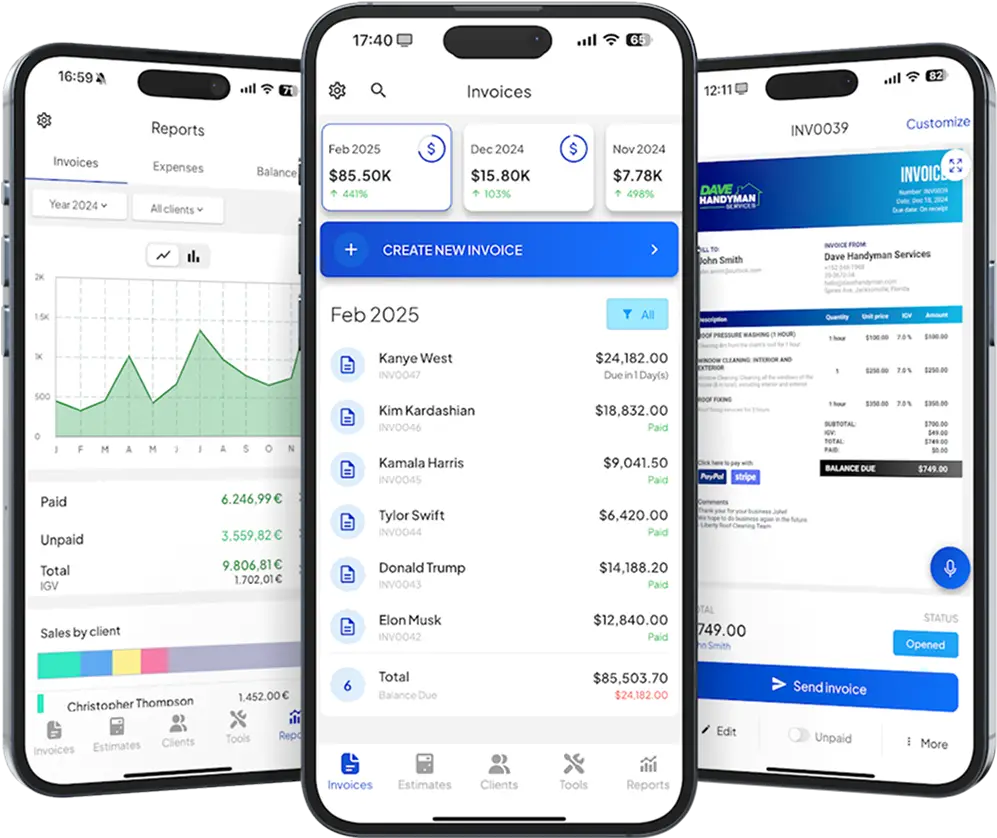
With Invoice Fly, an approved estimate does not become another piece of paperwork to rebuild. You can price the job, add taxes or discounts, collect approval, track the work, and convert the estimate into an invoice when the job is done. If you are new to billing, these guides explain how to write an invoice and how to send an invoice clearly.
Square Free also gives you unlimited invoices and estimates. Its paid plans are built for more complex sales, adding multi-package estimates, batch invoicing, custom fields, and milestone payments. That extra structure can be useful when invoices need to work alongside inventory, counter sales, and online orders.
Recurring Invoices and Payment Reminders
Invoice Fly advertises scheduled recurring invoices and automatic payment reminders alongside its invoice status tools. This invoice automation can help repeat-service businesses identify overdue accounts and spend less time on manual follow-up.
Square lets you choose the frequency, start and end dates, and due date for a recurring invoice series. Customers can also authorize automatic charges to an eligible card or bank account on file. Whichever platform you use, review recurring bills whenever prices, taxes, customer details, or services change.
Online and In-Person Payments
Payment collection is one of the clearest differences between Invoice Fly and Square. Invoice Fly lets customers pay online through supported providers such as Stripe and PayPal, making it a natural fit for businesses that usually collect payment after sending an estimate or invoice.
Square also accepts online invoice payments, but extends further into in-person sales with card readers, countertop hardware, a virtual terminal, QR codes, payment links, and Tap to Pay on compatible phones. A contractor could collect a deposit online, then accept the remaining balance by contactless card at the job site. That flexibility is useful if you take payments in several ways, but an invoice-focused business may not need the extra tools.
Payment Processing Fees
Square Free has no monthly software fee, but you still pay when a customer pays electronically. At the review date, online and invoice card payments cost 3.3% plus $0.30 on Free and 2.9% plus $0.30 on Plus or Premium. In-person tap, dip, or swipe payments cost 2.6% plus $0.15 on Free, 2.5% plus $0.15 on Plus, and 2.4% plus $0.15 on Premium.
ACH invoice payments cost 1%, with a $1 minimum. Plus and Premium cap the fee at $10, while Square does not publish the same cap for Free. The Square Invoices pricing overview on Capterra provides an additional third-party summary of plan prices and processing rates.
Invoice Fly does not set the transaction fee. Charges depend on the connected Stripe or PayPal account. To compare the real cost of each platform, estimate your fees using your typical invoice amount, monthly payment volume, and the ways customers usually pay.
Contracts, Deposits, and E-Signatures
Invoice Fly keeps approval simple. You can request a client’s signature and acceptance on an estimate, collect a deposit, and convert the approved work into an invoice. This works well when a signed estimate and upfront payment are all you need before adding a job to the schedule.
Square offers more structure for complex agreements, including reusable contract templates, editable clauses, e-signatures, attachments, deposits, and milestone-based payment schedules. It is better equipped for projects with detailed terms or several payment stages.
Tip! Whichever platform you use, clearly state the amount, due date, accepted payment methods, and late-payment rules. Invoice Fly’s guide to invoice payment terms covers common options.
Invoice Templates and Customization
Invoice Fly keeps customization simple enough to handle from a phone. You can add company and customer details, a logo, brand colors, job images, itemized charges, taxes, notes, and payment instructions without spending too much time on design.
Square Free covers standard invoice branding, while paid plans add custom templates, fields, content, and multi-package estimates. These extra controls offer more flexibility, but good invoice design is ultimately about clarity. Dates, charges, totals, and payment instructions should always be easy for the customer to find.
Customer and Business Management
Invoice Fly keeps customer details, estimates, invoices, payments, expenses, time entries, and reports centered on the billing process. A painter who mainly needs to price projects, track costs, and collect payment may prefer this more focused workspace.
Square connects customer records with invoices and a wider range of sales tools, including optional loyalty, marketing, appointments, orders, inventory, and staff management. That broader ecosystem may suit a salon that books appointments, sells products, accepts walk-ins, and rewards regular customers.
Tip! The IRS explains income and expense recordkeeping in Publication 583, while the US Small Business Administration covers broader financial and operational responsibilities.
Point-of-Sale (POS) and Additional Business Tools
Square is the clear choice when customers pay at a counter or checkout area. Its point-of-sale software works with optional card readers, terminals, registers, printers, and cash drawers. Businesses can also add tools for appointments, online stores, payroll, marketing, banking, gift cards, loyalty programs, and financing.
Invoice Fly takes a more focused approach, keeping estimates, time, expenses, receipts, customer records, and reports close to the billing process. It is a strong Square alternative when you invoice for services and do not need retail hardware, inventory, or multiple sales channels. If those features are central to your business, Square offers more room to expand.
Ease of Use and Mobile Access
Invoice Fly lets you save customer details, prepare estimates, record job costs, and send invoices without setting up a larger sales system. Square also works well on mobile, but its wider range of payment, item, project, staff, online sales, and point-of-sale settings can take more time to configure.
Square’s added depth is useful when you need those tools, but it may feel excessive if your main goal is straightforward invoicing. For additional insight, compare recent Square reviews on Capterra or Trustpilot. Look for patterns that match your priorities rather than relying on a single rating.

Invoice Fly vs Square Pricing
| Pricing detail | Invoice Fly | Square Free | Square Plus | Square Premium |
|---|---|---|---|---|
| Software price | $8.99/week or $98.99/year | $0/location/month | $49/location/month | $149/location/month |
| Online or invoice card fee | Set by the connected payment provider | 3.3% + $0.30 | 2.9% + $0.30 | 2.9% + $0.30 |
| In-person card fee | Not a central feature; provider terms may apply | 2.6% + $0.15 | 2.5% + $0.15 | 2.4% + $0.15 |
Square Free has no monthly software fee, but transaction charges, hardware, and optional services can increase the total cost, while its paid plans exchange a monthly fee for lower processing rates. Invoice Fly charges for the software, with Stripe or PayPal setting separate payment fees, and its yearly subscription offers better value than paying weekly for ongoing use. The most economical option depends on invoice frequency, payment amounts, card volume, and how customers prefer to pay.

Invoice Fly vs Square for Freelancers and Small Businesses
Invoice Fly fits the rhythm of project-based service work. If you visit a property, prepare a quote, track labor and materials, and collect payment after the job, the app keeps those steps together. That makes it a natural choice for freelancers, contractors, tradespeople, and other mobile service providers.
Square is built for businesses that take payments in more places. Retailers, restaurants, salons, and studios can connect invoices with appointments, online orders, and counter sales. It can also work for service businesses that want contracts, bookings, invoicing, and card acceptance within one larger system.
Think about how a typical sale begins. A site visit and written estimate point toward Invoice Fly, while a register, booking page, or online store points toward Square.
Invoice Fly vs Square: Which Should You Choose?
The best choice is not the platform with the longest feature list. It is the one that matches the work you do every day. Invoice Fly is built around service jobs, keeping estimates, tracked time, expenses, receipts, invoices, and payment follow-up in one focused workspace. Its annual plan is a practical fit for independent professionals who invoice regularly and do not need a checkout system.
Square earns its place when payment processing reaches beyond invoices. Its free plan includes capable billing tools, while the broader platform supports counter sales, appointments, contracts, online stores, customer programs, and payment hardware.
Square gives businesses more ways to sell, but those extra layers are not necessary for everyone. If most of your revenue starts with a quote and ends with an invoice, Invoice Fly is likely to provide the simpler and more natural fit.