Payment Reminder Email Templates (Before and After the Due Date)
Table of Contents
A payment reminder email is a message sent to a customer about an invoice that’s due soon or hasn’t been paid on time. It gives them the invoice details, confirms the amount owed, and makes it easy to complete the payment.
Not every reminder needs to sound urgent. A quick email before the due date can be enough to prevent an invoice from being overlooked. But if payment is still outstanding weeks later, you’ll need to be more direct.
Below, you’ll find ready-to-use payment reminder emails and text messages for six stages, from three days before payment is due to 30 days overdue. There are also templates for payment plans, resending invoices, and confirming a payment.
When to send a payment reminder
You don’t need to wait until an invoice is overdue to send a reminder. Contacting customers a few days before payment is due gives them time to check the invoice and arrange payment.
If the deadline passes, follow up in stages rather than sending the same message repeatedly.
Timing | Goal | Recommended tone |
|---|---|---|
3 days before the due date | Remind the customer about an upcoming payment | Friendly and helpful |
On the due date | Confirm that payment is due today | Polite and direct |
1 day overdue | Check whether the payment was missed | Friendly and understanding |
7 days overdue | Request payment or an update | Professional and firmer |
14 days overdue | Ask for prompt payment or a confirmed payment date | Firm and direct |
30 days overdue | Confirm the outstanding balance and discuss next steps | Formal and serious |
This is a suggested schedule, not a set of legal deadlines. You might send fewer reminders to a long-standing customer who usually pays on time, or follow up sooner on a large invoice that’s affecting your cash flow.
Whatever schedule you choose, check the invoice status before sending another message. A customer may have already paid, even if the payment hasn’t appeared in your records yet.
Payment reminder email templates by stage
These six templates cover the most common points in the payment process. Copy the email or text message you need, replace the details in brackets, and adjust the wording to suit your relationship with the customer.
Each includes a payment link so the customer can settle the invoice without searching through previous emails.
1. Payment reminder: 3 days before the due date
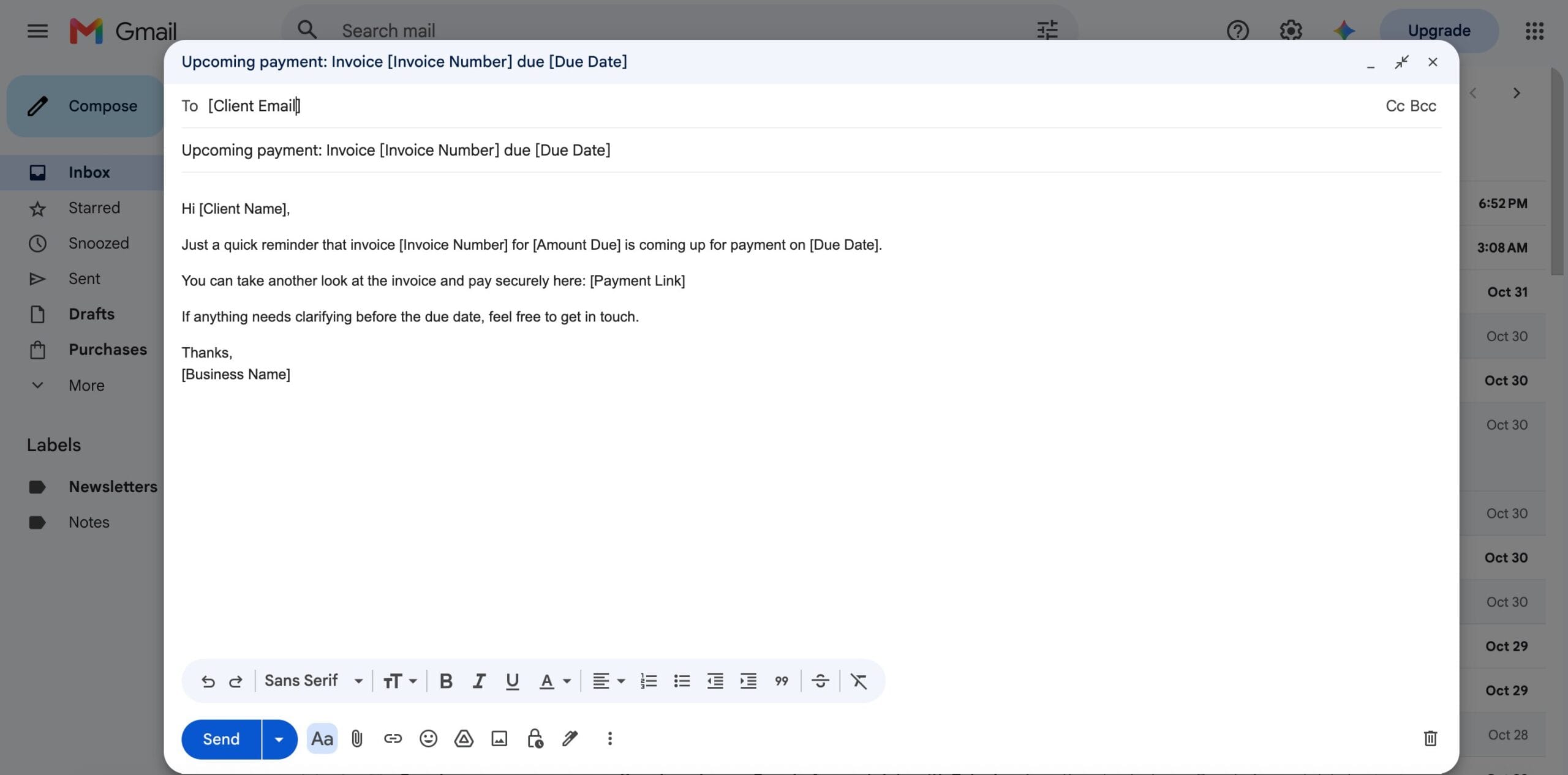
At this stage, nothing is late. Keep the message light and give the customer a chance to ask questions before payment is due.
Subject: Upcoming payment: Invoice [Invoice Number] due [Due Date]
Hi [Client Name],
Just a quick reminder that invoice [Invoice Number] for [Amount Due] is coming up for payment on [Due Date].
You can take another look at the invoice and pay securely here: [Payment Link]
If anything needs clarifying before the due date, feel free to get in touch.
Thanks,
[Business Name]
Text message
Hi [Client Name], just a heads-up that invoice [Invoice Number] for [Amount Due] is due on [Due Date]. You can pay here: [Payment Link]. Thanks, [Business Name].
2. Payment reminder: On the due date
The payment is due today, so there’s no need to suggest the customer has missed anything. State the deadline and provide the link.
Subject: Invoice [Invoice Number] is due today
Hi [Client Name],
A quick note to let you know that invoice [Invoice Number] for [Amount Due] is due today, [Due Date].
You can make your payment here: [Payment Link]
If you’ve already taken care of it, thank you! No further action is needed.
Best,
[Business Name]
Text message
Hi [Client Name], payment for invoice [Invoice Number] ([Amount Due]) is due today, [Due Date]. Here’s your payment link: [Payment Link]. Thanks, [Business Name].
3. Payment reminder: 1 day overdue
A payment that’s one day late could simply have been forgotten or delayed in processing. Start by checking in rather than assuming the customer is avoiding payment.
Subject: Checking in on invoice [Invoice Number]
Hi [Client Name],
I’m getting in touch about invoice [Invoice Number] for [Amount Due], which was due yesterday, [Due Date].
It’s still showing as unpaid on our end, so I wanted to check whether the payment has been arranged.
You can find the invoice and payment details here: [Payment Link]
If you’ve already sent the payment, please let us know so we can check our records.
Thanks for your help,
[Business Name]
Text message
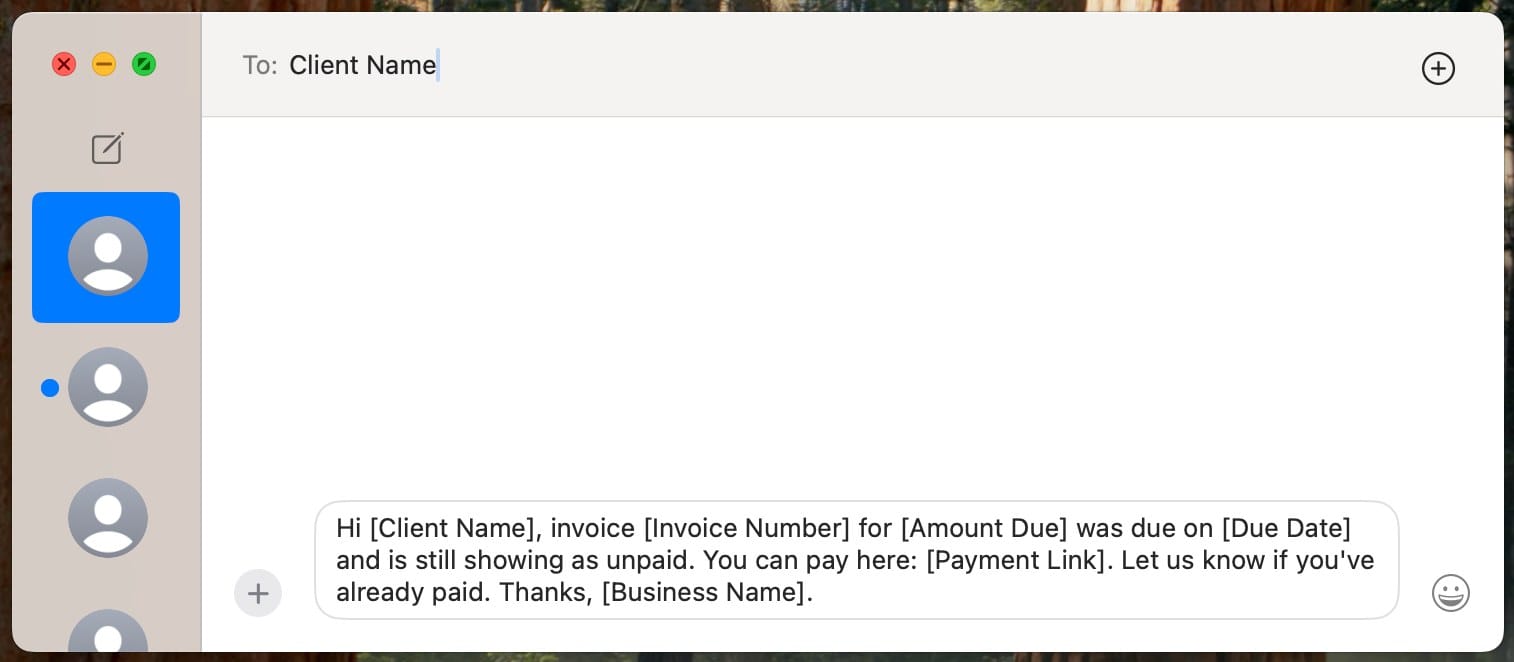
Hi [Client Name], invoice [Invoice Number] for [Amount Due] was due on [Due Date] and is still showing as unpaid. You can pay here: [Payment Link]. Let us know if you’ve already paid. Thanks, [Business Name].
4. Payment reminder: 7 days overdue
After a week, it’s reasonable to ask for a clear update. Keep the message professional, but make the request more direct.
Subject: Payment follow-up: Invoice [Invoice Number] is 7 days overdue
Hi [Client Name],
We’re following up on invoice [Invoice Number] for [Amount Due], which was due on [Due Date] and remains outstanding.
Could you please arrange payment or let us know when we can expect it?
You can access the invoice and make your payment here: [Payment Link]
If there’s an issue with the invoice or payment details, please get in touch so we can sort it out.
Regards,
[Business Name]
Text message
Hi [Client Name], invoice [Invoice Number] for [Amount Due] is now 7 days overdue. Please arrange payment here: [Payment Link], or reply with an update. [Business Name].
5. Payment reminder: 14 days overdue
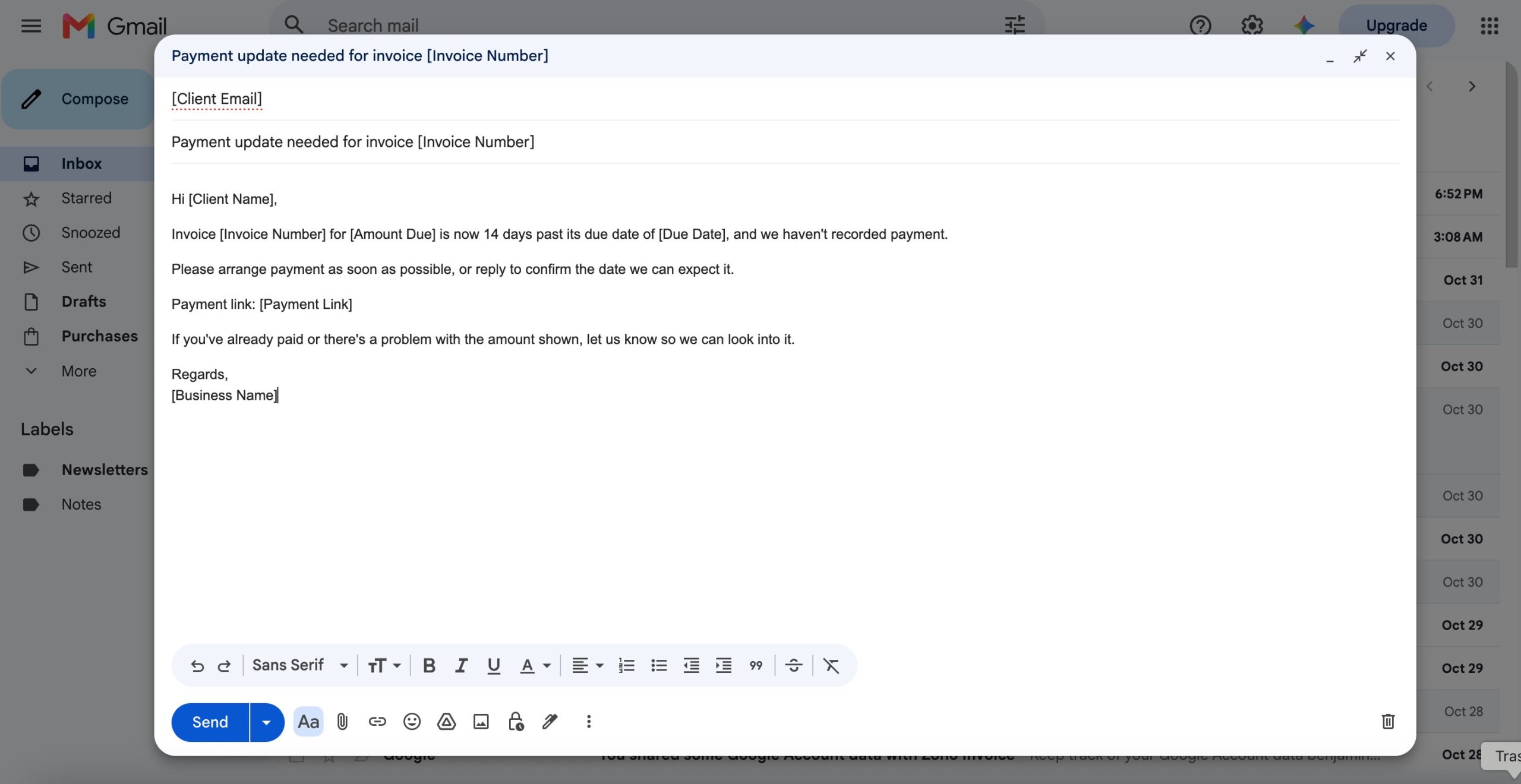
Two weeks after the deadline, you need more than a general acknowledgement. Ask the customer to pay or commit to a specific date.
Subject: Payment update needed for invoice [Invoice Number]
Hi [Client Name],
Invoice [Invoice Number] for [Amount Due] is now 14 days past its due date of [Due Date], and we haven’t recorded payment.
Please arrange payment as soon as possible, or reply to confirm the date we can expect it.
Payment link: [Payment Link]
If you’ve already paid or there’s a problem with the amount shown, let us know so we can look into it.
Regards,
[Business Name]
Text message
Hi [Client Name], we’re still awaiting [Amount Due] for invoice [Invoice Number], due [Due Date]. Please pay here: [Payment Link], or confirm when payment will be made. [Business Name].
If you’re still waiting for a response, our guide on how to follow up on unpaid invoices covers other ways to contact customers and keep track of outstanding balances.
6. Payment reminder: 30 days overdue
At 30 days overdue, the message should clearly establish what’s outstanding and ask the customer to take action. You can be firm without making threats or referring to legal consequences that haven’t been established.
Subject: Outstanding balance: Invoice [Invoice Number] is 30 days overdue
Dear [Client Name],
We’re contacting you regarding invoice [Invoice Number] for [Amount Due], originally due on [Due Date].
The balance remains outstanding 30 days after the payment deadline.
Please arrange payment using the link below, or contact us to explain any issue preventing payment.
Payment link: [Payment Link]
Please reply to confirm when we can expect payment. We’d appreciate the opportunity to resolve this directly.
Regards,
[Business Name]
Text message
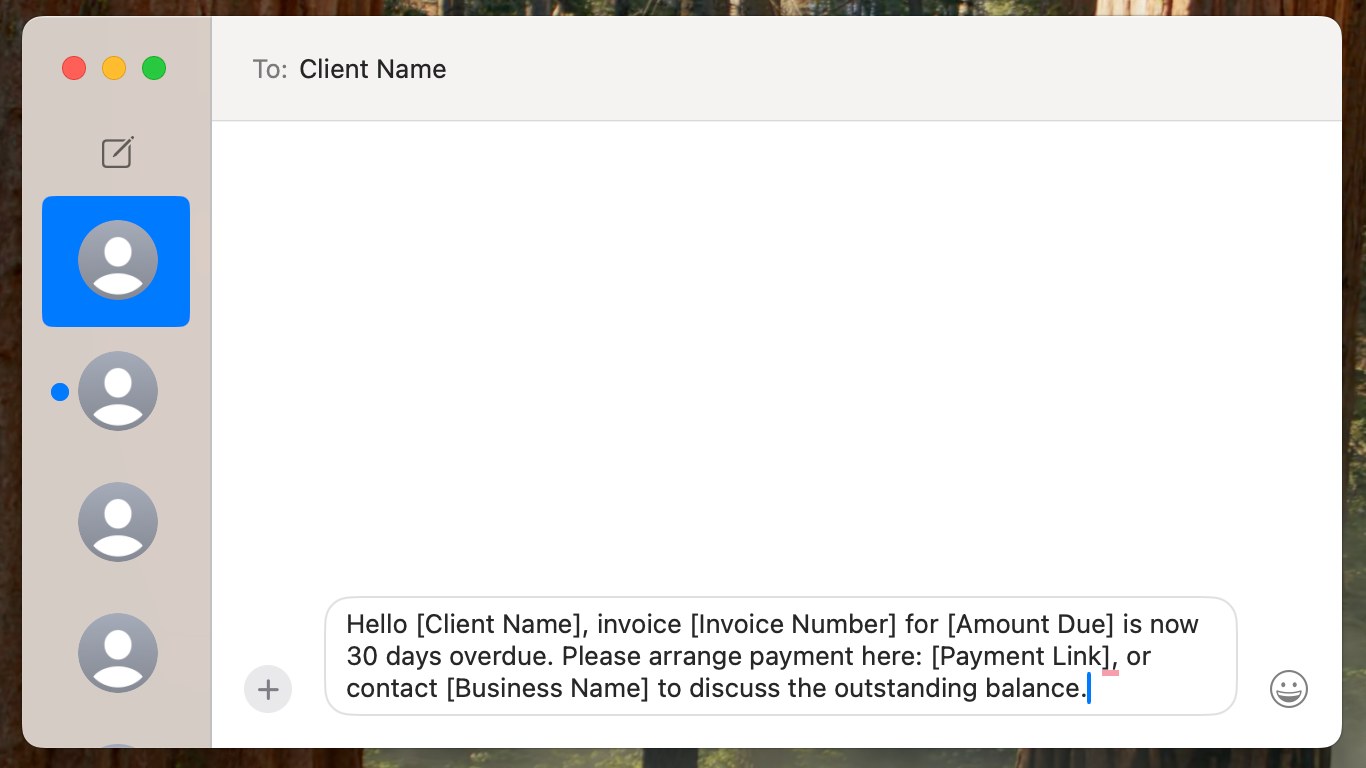
Hello [Client Name], invoice [Invoice Number] for [Amount Due] is now 30 days overdue. Please arrange payment here: [Payment Link], or contact [Business Name] to discuss the outstanding balance.
If payment remains unresolved, you may need to review the account and decide whether further formal communication is appropriate. A collection letter is different from a routine reminder and should reflect the circumstances and any applicable requirements.
For invoices that may ultimately remain unpaid, see our guide to uncollectible accounts.
Additional payment reminder templates
Not every payment issue follows the same timeline. Sometimes a customer needs more time, can’t find the invoice, or has already paid.
These three messages cover those situations without restarting the standard reminder sequence.
7. Payment plan request
Use this when a customer has explained that they can’t pay the full balance at once, or you want to offer an opportunity to discuss an alternative arrangement.
Subject: Let’s discuss payment for invoice [Invoice Number]
Hi [Client Name],
I’m following up about the outstanding balance of [Amount Due] on invoice [Invoice Number].
If paying the full amount right now isn’t possible, please get in touch. We can discuss whether a payment arrangement would work for both sides.
Any agreed payment dates and amounts will be confirmed in writing, so we’re both clear on the next steps.
You can also review the outstanding invoice here: [Payment Link]
Thanks,
[Business Name]
8. Resending an invoice
If the customer can’t find the original invoice, don’t turn it into another overdue warning. Simply resend the information they need.
Subject: Your copy of invoice [Invoice Number]
Hi [Client Name],
Of course, here’s another copy of invoice [Invoice Number] for [Amount Due], due on [Due Date].
You can view the invoice and make payment here: [Payment Link]
Let us know if you have any trouble opening it or need anything else.
Thanks,
[Business Name]
9. Payment received: Thank-you message
Once payment has been confirmed, a short acknowledgment closes the loop and reassures the customer that their records are up to date.
Subject: Payment received for invoice [Invoice Number]
Hi [Client Name],
Thanks for your payment of [Amount Paid] toward invoice [Invoice Number].
We’ve received it and updated our records accordingly.
We appreciate your business and look forward to working with you again.
Best,
[Business Name]
For a reusable document rather than an email script, you can also use Invoice Fly’s free payment reminder template.
What not to write in a payment reminder
Chasing an unpaid invoice can be frustrating, especially when you’ve already followed up several times. But the wording matters. An aggressive message can damage a customer relationship and make it harder to resolve a straightforward billing problem.
Here’s what to avoid and what to say instead.
Avoid | Instead, write |
|---|---|
“Pay immediately or we’ll take legal action.” | “Please contact us to confirm when payment can be made or discuss any issue with the invoice.” |
“You’ve deliberately ignored our invoices.” | “We haven’t received a response to our previous reminders. Could you provide an update?” |
“You legally have 24 hours to pay.” | “Please let us know your expected payment date.” |
“We’ve added a late fee because you didn’t pay.” | “Please review the outstanding balance and contact us if you have any questions about the agreed payment terms.” |
“This is your last chance.” | “We’d appreciate a response so we can agree on the next steps.” |
A few things are worth checking before you press send.
Don’t assume the customer is refusing to pay. An invoice might have gone to the wrong email address, be waiting for approval, or have been paid without the transaction appearing in your records.
Don’t invent legal deadlines or consequences. If you haven’t established the basis for a particular demand, don’t include it to make the message sound more urgent.
Don’t add unsupported late fees. Any additional charges should be consistent with the agreement and applicable law.
The aim is to get a clear response and resolve the outstanding payment, not make the email sound as severe as possible.
How to automate payment reminders with Invoice Fly
If you’re managing several jobs or customers at once, remembering which invoice needs another reminder can become a job in itself.
Invoice Fly supports automatic payment reminders, allowing businesses to schedule follow-ups around invoice due dates rather than writing every email manually.
You can use Invoice Fly to:
- Set up automatic reminders: Arrange for payment reminders to be sent based on invoice due dates.
- Choose reminder timing: Use the reminder scheduling options available in your account to plan when customers receive follow-ups.
- Send reminders to customers: Keep payment communication consistent without having to draft every message from scratch.
- Check invoice statuses: See which invoices have been sent, viewed, paid, or become overdue before deciding whether further follow-up is needed.
Invoice Fly also offers payment status notifications, including alerts when an invoice is viewed, paid, or becomes overdue. These can help you keep track of customer activity and respond when a payment needs attention.
Automatic reminders are especially useful for contractors managing multiple jobs, freelancers working with several clients, and small businesses without a dedicated accounts receivable team.
You can explore Invoice Fly’s automatic payment reminders to spend less time checking outstanding invoices and more time on your actual work.
Keep payment follow-ups clear and consistent
You don’t need a different strategy every time a customer misses a payment. Start with a friendly reminder, make each follow-up a little more direct, and always give the customer the details they need to pay or explain a delay.
If you’re regularly dealing with late client payments or trying to manage an outstanding invoice, having a consistent process makes it easier to stay on top of what you’re owed.
And if you’re still setting up your billing process, our guide on how to send an invoice covers the basics.