EDI Invoice Guide For Contractors And Service Businesses
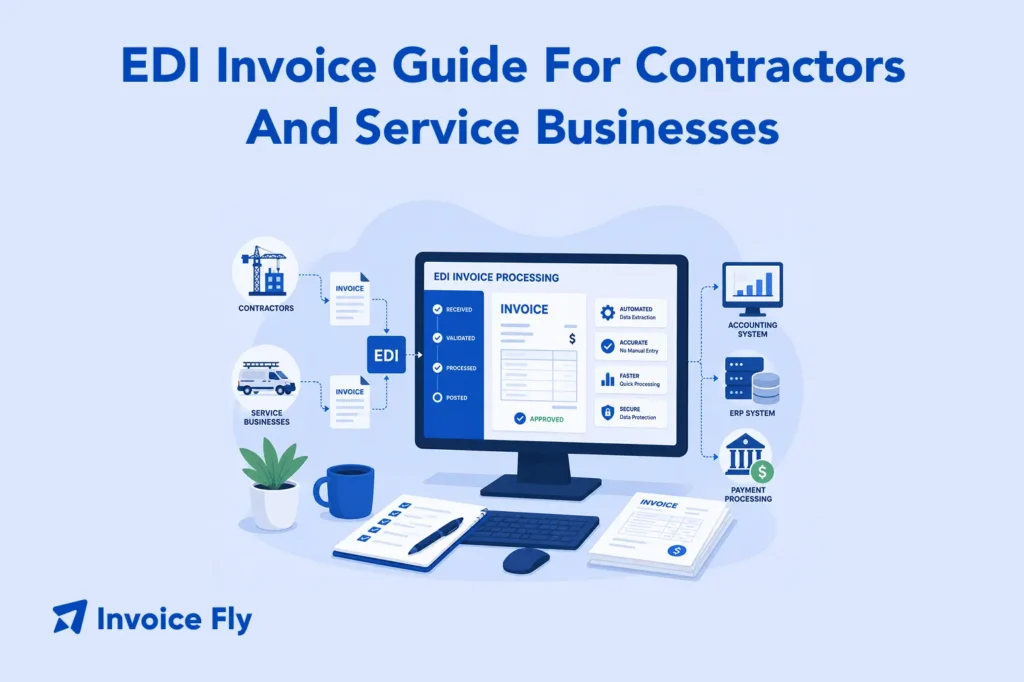
Table of Contents
An EDI invoice is a way for businesses to send invoice information directly from one computer system to another without relying on PDFs, emails, or paper bills. Instead of someone manually opening and entering the invoice, the data flows automatically into the buyer’s accounting or ERP system using a standardized format, most commonly EDI 810. That file includes information like invoice numbers, purchase orders, line items, totals, taxes, and payment terms.
In this guide, you’ll learn how EDI invoicing works, what information an EDI invoice includes, and how it compares to regular e-invoices.
What Is EDI Invoicing?
EDI stands for Electronic Data Interchange. EDI invoicing is the process of exchanging invoice data between two businesses using a standardized, machine-readable format rather than a human-readable document like a PDF or a printed bill.
In plain terms, EDI replaces the usual email-and-manual-entry process. The invoice moves directly from the supplier’s system into the buyer’s system. The receiving system reads the data automatically, matches it against purchase orders, and posts it for payment without someone manually entering the information.
EDI invoicing is common in large-scale B2B industries: retail, manufacturing, logistics, healthcare, and government contracting. If you work with major retailers, freight clients, or government agencies, chances are they require EDI compliance from their vendors.
To understand where EDI invoicing fits within the broader invoicing landscape, our guide on what is an invoice covers the foundational concepts.
EDI Invoice Example
Don’t worry if this looks technical. Most contractors never touch this directly because their EDI provider or invoicing software generates the file automatically.
A basic EDI 810 invoice looks nothing like a formatted PDF. It’s a structured data string of segments and elements:
ST*810*0001
BIG*20260513*INV-4421**PO-8872
N1*SE*Acme Plumbing Co.*92*ACME01
N1*BY*Metro Building Group*92*METRO77
IT1*1*5*EA*120.00**VP*PIPE-3/4IN
TDS*60000
DTM*011*20260527
SE*8*0001
Each segment (ST, BIG, N1, IT1) maps to a defined field in the invoice: transaction type, invoice date, seller ID, buyer ID, line items, total amount due, and payment terms. The receiving system reads these segments automatically using a data map configured by both trading partners.
How Does EDI Invoicing Work?

The EDI invoicing process follows a defined flow:
- The seller completes the job or ships goods and generates an invoice in their system.
- The seller’s system translates the invoice into the agreed EDI format, such as X12 810 or EDIFACT INVOIC.
- The invoice is transmitted to the buyer via a Value-Added Network (VAN), AS2 connection, or API.
- The buyer’s system receives the file and runs automated validation checks: does the invoice match the purchase order? Are the quantities and prices correct?
- If validated, the invoice is posted to the buyer’s accounts payable system and queued for payment.
- If there’s a discrepancy, the invoice is flagged for manual review or an error acknowledgment is sent back to the supplier.
The entire process can happen in minutes, compared to days or weeks with paper-based billing. Businesses moving toward EDI often also explore broader invoice automation workflows to streamline the full billing cycle from estimate to payment.
Invoice EDI Format
The two dominant EDI standards are:
- ANSI X12 — The most common EDI standard in North America. In this format, the EDI 810 is the standard invoice transaction.
- EDIFACT — Commonly used internationally, especially in Europe. Its invoice message, called INVOIC, serves the same purpose as the EDI 810.
Both standards organize invoice information into structured segments and fields so computer systems can process the data automatically. The main difference is the formatting rules and coding structure each standard uses. When businesses onboard a new EDI trading partner, they usually exchange a Trading Partner Agreement (TPA) and mapping specifications so both systems know how to send, receive, and interpret the invoice data correctly.
Elements of an EDI Invoice
A complete EDI 810 invoice includes these core data elements:
- Transaction header — Identifies the document type and transmission number
- Invoice number and date — Unique identifier and invoice issue date
- Purchase order reference — Links the invoice back to the original PO
- Seller and buyer identification — Business names, EDI IDs, and addresses
- Line items — Each product or service with quantity, unit of measure, unit price, and item codes
- Allowances and charges — Discounts, freight charges, or other adjustments
- Invoice total — Sum of all line items after allowances
- Tax information — Applicable tax amounts and types
- Payment terms — Due date and early payment discount terms
- Transaction trailer — Closes the segment count and confirms transmission integrity
Missing or mismatched elements, especially PO references or item codes, are the most common cause of EDI invoice rejections. For a deeper look at what makes invoices effective in general, see our guides on professional invoice elements and invoice payment terms.
Types of EDI Invoices

Several EDI transaction types relate to invoicing, depending on the industry and relationship:
- EDI 810 (Invoice) — The standard invoice from seller to buyer in North America; the most commonly used EDI invoice type
- EDI 210 (Motor Carrier Freight Invoice) — Used in transportation and logistics for freight billing between carriers and shippers
- EDI 811 (Consolidated Service Invoice) — Used for billing across multiple service transactions in a single document
- EDI 812 (Credit/Debit Adjustment) — Used to issue credits or billing corrections against previously submitted invoices
- EDIFACT INVOIC — The international equivalent of the X12 810, used in European and global trade relationships
The type your trading partner requires will be specified in your EDI onboarding documentation or Trading Partner Agreement.
EDI Invoicing Advantages
For businesses that qualify for EDI, primarily those working with larger clients, retailers, or government agencies, the benefits are significant:
- Faster processing — Invoices that used to take days to reach accounts payable arrive and post in minutes
- Fewer errors — Automated validation catches mismatches before they become disputes
- Lower processing costs — Eliminating manual data entry and paper handling reduces administrative overhead on both sides
- Improved cash flow — Faster invoice delivery and automated matching speeds up the payment cycle
- Compliance and auditability — EDI creates a full digital audit trail of every transaction exchanged
- Required for large clients — Many retailers, distributors, and government agencies mandate EDI compliance from vendors. Per the GSA, EDI is a standard requirement for federal supply chain transactions. The U.S. Treasury also supports electronic invoicing as part of broader federal financial modernization initiatives.
EDI Invoices vs. E-Invoices

These terms are often confused, but they refer to fundamentally different things.
| Feature | EDI Invoice | E-Invoice |
|---|---|---|
| Format | Structured data such as X12 or EDIFACT | Human-readable document such as PDF or XML |
| Processing | Machine-to-machine automation | Manual review or OCR |
| Best for | Large B2B, retail, logistics, government | Small business and service billing |
| Setup | EDI mapping and trading partner agreements | Minimal setup |
| Error handling | Automated validation and rejection | Manual review |
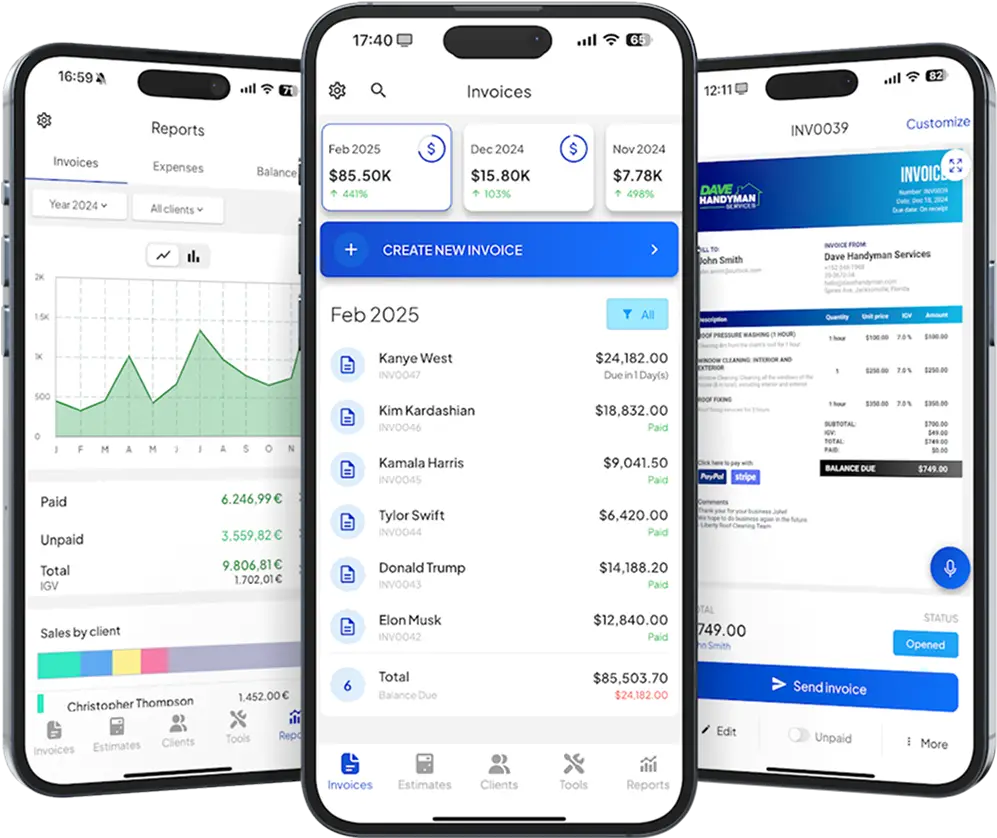
For contractors and service businesses working with smaller clients, a standard e-invoicing approach is far more practical than EDI. EDI becomes relevant when a major client or retailer mandates it as part of onboarding. If a client requires EDI, they will usually provide an implementation guide, test requirements, and approved transmission methods.
For an overview of how invoice processing works in general, see our guides on invoice processing and automated invoice processing.
Conclusion
EDI invoicing plays a major role in billing for large-scale B2B trade, automating the entire invoice-to-payment cycle between trading partners with standardized, machine-readable data. For contractors or service businesses that work with major retailers, logistics companies, or government agencies, understanding how EDI 810 invoices work is essential for getting paid accurately and on time.
For most small and mid-sized service businesses, a clean and professional standard invoicing process handles the job just as well. Our invoice maker and free invoice generator make it easy to create and send professional invoices for any client type. And if you’re building out your invoicing knowledge from the ground up, revisit our complete guide to what is an invoice for the full picture.