QuickBooks vs Wave: Which Accounting Software Is Better?
Table of Contents
QuickBooks and Wave both offer accounting software for small businesses, but they take different approaches to pricing and features. Wave keeps things simple with a permanent free Starter plan and one paid plan, while QuickBooks offers a free option alongside a wider range of paid accounting tools.
This QuickBooks vs Wave comparison covers pricing, bookkeeping, invoicing and key features to help you understand the differences between them.
QuickBooks vs Wave: overview

Wave has two main accounting plans, Starter and Pro, while QuickBooks offers a free option plus four paid QuickBooks Online plans.
The table below shows how their pricing and core features compare.
QuickBooks vs Wave at a glance
| Feature | QuickBooks | Wave |
|---|---|---|
| Permanent free plan | QuickBooks Free | Wave Starter |
| Free-plan price | $0/month | $0/month |
| Free-plan invoices | 2/month* | Unlimited |
| Free-plan estimates | 1/month | Unlimited |
| Regular paid starting price | $38/month | $19/month or $190/year |
| Bookkeeping | Yes | Yes |
| Bank reconciliation | Yes | Yes |
| Automatic bank imports | Paid plans | Pro |
| Receipt capture | Yes; 2/month on Free | Unlimited on Pro |
| Time tracking | Essentials+ | No comparable built-in time tracking |
| Projects | Plus+ | No comparable project accounting |
| Project profitability | Plus+ | No comparable built-in profitability tracking |
| Inventory | Plus+ | Manual accounting workflow |
| Payroll | Separate QuickBooks Payroll product | Separate Wave Payroll product |
| Paid-plan users | 1 / 3 / 5 / 25 by plan | Unlimited account users on Pro |
| Financial reports | Yes | Yes |
| Integrations | 800+ marketed | Smaller ecosystem |
| Mobile app | Yes | Yes |
*QuickBooks Free normally allows two invoices per month. Intuit states that eligible users who enable QuickBooks Payments may be able to send unlimited invoices.
Prices checked September 2026. Regular U.S. subscription prices shown.
QuickBooks vs Wave comparison chart
Price alone doesn’t show how different these platforms become once a business needs more than basic bookkeeping.
Pricing and key features compared
| Plan | Regular price | Users | What it adds |
|---|---|---|---|
| QuickBooks Free | $0 | 1 | Basic bookkeeping, 2 invoices/month, 1 estimate/month, 1 bank connection, limited receipts and mileage |
| QuickBooks Simple Start | $38/month | 1 | Unlimited invoicing, automated bookkeeping and broader accounting tools |
| QuickBooks Essentials | $85/month | 3 | Bills, accounts payable and time tracking |
| QuickBooks Plus | $140/month | 5 | Projects, project profitability and inventory |
| QuickBooks Advanced | $340/month | 25 | Advanced reporting, dashboards, roles and workflow tools |
| Wave Starter | $0 | Plan-dependent | Unlimited estimates, invoices, bills and bookkeeping records |
| Wave Pro | $19/month or $190/year | Unlimited account users | Automatic bank imports, receipt capture, expenses, categorization and reminders |
Compare the plans that match the features you need. For free accounting, that means QuickBooks Free vs Wave Starter. For inventory or project profitability, QuickBooks Plus is the more relevant QuickBooks plan.
QuickBooks
QuickBooks Online is Intuit’s cloud accounting platform. It starts with a limited permanent free option and extends through four paid plans for businesses that need more accounting automation, users and operational tools.
Features
QuickBooks covers the core tasks expected from small-business accounting software, including:
- Income and expense tracking
- Bank connections and reconciliation
- Estimates and invoices
- Online payments
- Receipt capture
- Financial reporting
- Sales tax
- Customer and vendor records
The paid plans build on those basics.
Essentials adds bills and accounts payable, built-in time tracking and up to three standard users.
Plus increases the limit to five standard users and adds projects, project profitability and inventory.
Advanced supports up to 25 standard users and adds more detailed dashboards, reporting, KPIs, user controls and workflow automation.
QuickBooks also markets integrations with more than 800 business apps, giving it a much larger connected-software ecosystem than Wave.
Pricing
QuickBooks Free costs $0/month, requires no credit card and isn’t a temporary trial. However, its monthly limits are important:
- 2 invoices
- 1 estimate
- 1 connected bank account
- 2 receipt uploads
- 5 mileage trips
It also includes three core reports: profit and loss, balance sheet and Account QuickReport. Accountant access isn’t included.
This is separate from the 30-day trial of the paid QuickBooks Online plans.
Regular paid prices are:
- Simple Start: $38/month
- Essentials: $85/month
- Plus: $140/month
- Advanced: $340/month
Standard-user limits are one, three, five and 25 respectively, with accountant access handled separately.
QuickBooks Payroll and QuickBooks Payments are separately priced services.
Pros and cons
Pros
- Permanent free plan available
- Full double-entry bookkeeping
- Bank feeds and reconciliation
- Bills and accounts payable from Essentials
- Built-in time tracking from Essentials
- Projects and profitability tracking on Plus+
- Inventory on Plus+
- Advanced reporting and workflows available
- Broad integration ecosystem
- Clear upgrade path as accounting needs become more complex
Cons
- QuickBooks Free has tight monthly limits
- Standard users are limited by paid plan
- Bills and time tracking require Essentials+
- Projects and inventory require Plus+
- Payroll costs extra
- Paid plans cost considerably more than Wave Pro
Independent QuickBooks Online reviews are available through G2 and Capterra.
Wave

Wave Financial combines bookkeeping, accounting, invoicing, payments and payroll tools for freelancers and small businesses.
Unlike a free trial, Wave Starter is a permanent $0 plan. It provides unlimited basic invoicing and bookkeeping rather than restricting users to a small number of transactions each month.
Features
Wave Starter includes unlimited:
- Estimates
- Invoices
- Bills
- Bookkeeping records
Wave also provides mobile invoicing and tools for managing customers and cash flow. Online payments can be added separately.
Its accounting tools include double-entry bookkeeping, a chart of accounts, general ledger, bank reconciliation and financial statements such as profit and loss, balance sheet and cash flow.
Wave Pro adds:
- Automatic bank-transaction imports
- Automatic transaction merging and categorization
- Unlimited digital receipt capture
- Expense tracking
- Automated late-payment reminders
- Unlimited account users
Wave also supports recurring billing through qualifying Pro or online-payment workflows.
Pricing
Wave Starter costs $0.
Wave Pro costs:
- $19/month, or
- $190/year
Those are the regular U.S. subscription prices.
Online payment processing is optional and separately charged.
Wave Payroll is also separate. Its current U.S. price is:
- $40/month base fee
- $6 per active employee
- $6 per independent contractor paid
Pros and cons
Pros
- Permanent $0 Starter plan
- Unlimited estimates and invoices on Starter
- Unlimited bills and bookkeeping records on Starter
- Double-entry bookkeeping
- Bank reconciliation
- Core financial statements
- Low-cost Pro plan
- Unlimited account users on Pro
- Automatic bank imports on Pro
- Unlimited digital receipt capture on Pro
- Separate payroll option
Cons
- Automatic bank imports require Pro
- Smaller integration ecosystem than QuickBooks
- No comparable QuickBooks Plus-style inventory system
- Wave doesn’t offer comparable built-in project time tracking
- Less depth for businesses that need advanced reporting and operational accounting tools
Independent Wave reviews are available through G2 and Capterra.
QuickBooks vs Wave: Detailed comparison

The differences become easier to see when you compare the jobs each platform needs to handle.
Free plans and pricing
Both companies offer permanent free plans, but the limits are very different.
Wave Starter includes:
- Unlimited invoices and estimates
- Unlimited bills
- Unlimited bookkeeping records
QuickBooks Free includes each month:
- 2 invoices and 1 estimate
- 1 connected bank account
- 2 receipt uploads
- 5 mileage trips
- 1 user, with no accountant access
Paid pricing also starts at different points. Wave Pro costs $19/month or $190/year, while QuickBooks Online starts at $38/month and reaches $340/month for Advanced.
QuickBooks’ higher plans add more accounting and business tools, so price needs to be compared alongside the features you actually need.
Accounting and bookkeeping
Both are genuine accounting platforms.
- Wave provides double-entry bookkeeping, a chart of accounts, general ledger, reconciliation and core financial statements. Starter users can work with manually entered or imported data, while automatic bank imports require Pro.
- QuickBooks also provides double-entry accounting, reconciliation, bank connections and reporting. Its paid plans extend further into accounts payable, automation, project accounting, inventory and advanced reporting.
The IRS explains the types of records businesses may need to keep to support income, expenses and other tax information.
Invoicing and payments
The free plans have very different invoicing limits.
- Wave Starter: Unlimited invoices and estimates.
- QuickBooks Free: Two invoices and one estimate per month under its standard limits.
- Paid QuickBooks Online: Broader invoicing tools without the Free plan’s monthly invoice limit.
Both platforms can connect invoices with online payments.
Wave also supports recurring billing through qualifying workflows, while QuickBooks provides recurring transaction and invoicing functionality within its paid accounting ecosystem.
If invoicing is central to your workflow, our guide to how to send an invoice covers the information to include before billing a customer. It’s also worth setting clear invoice payment terms from the start.
Bank reconciliation
Both platforms support bank reconciliation.
Wave Starter can reconcile accounts using manually entered or imported data, while automatic bank-transaction imports require Pro. QuickBooks can connect bank and credit-card accounts and bring transactions into the accounting workflow for categorization and reconciliation.
In other words, Wave doesn’t require Pro simply to reconcile an account.
Expense tracking and receipts
QuickBooks combines expense tracking with its wider accounting system, while receipt capture is available across its product range. QuickBooks Free limits receipt uploads to two per month.
Wave Pro includes expense tracking and unlimited digital receipt capture. Starter users don’t receive that same automated Pro workflow.
For businesses dealing with a large number of paper or emailed receipts, a dedicated receipt scanner app is another way to digitize expense records.
Payroll
Neither accounting subscription includes payroll as standard.
Wave Payroll costs $40/month plus $6 per active employee and $6 per independent contractor paid. It connects with Wave’s accounting system and includes payroll tax and direct-deposit functionality.
QuickBooks Payroll is also a separate product that integrates with QuickBooks accounting.
Payroll requirements can vary considerably by state and business setup, so compare the current payroll product details separately from the accounting subscription.
Time tracking, projects and inventory
QuickBooks includes more built-in tools for managing time, project finances and stock.
QuickBooks
- Built-in time tracking starts with Essentials.
- Projects and project profitability are available on Plus and Advanced.
- Inventory is available on Plus and Advanced.
- Inventory tools track quantities, costs, cost of goods sold and restock information.
Wave
- Wave doesn’t offer comparable built-in project time tracking.
- Project functionality is more limited.
- Inventory uses a manual accounting workflow rather than a unit-level inventory-management system.
- Wave doesn’t automatically calculate or track inventory unit value.
A business that simply sells services may never need these features. A company tracking stock, labor and profitability across multiple jobs is more likely to notice the difference.
Financial reporting
Both products provide core financial reports.
Wave includes profit and loss, balance sheet, cash flow, trial balance, aged receivables and payables, plus customer and vendor reporting.
QuickBooks also provides core financial reporting, with more options on its higher paid plans. Advanced adds custom reporting, dashboards and KPI tools.
Integrations and compatibility
QuickBooks has the larger integration ecosystem, currently marketing connections with more than 800 business apps.
Wave supports integrations, API functionality, Wave Connect and third-party automation tools, but the ecosystem is smaller and access to some integration functionality can depend on the Wave plan or service used.
You can import QuickBooks-format (.QBO) bank and credit-card transactions into Wave, but the two platforms don’t automatically sync with each other.
Ease of use and customer support
Ease of use depends on how much you need the software to handle:
- Wave: Has two core plans, Starter and Pro. The smaller feature set can be easier to navigate for freelancers focused on bookkeeping, invoices, expenses and payments.
- QuickBooks: Has more plans and accounting features, with options for users, projects, inventory, payroll and connected apps. That gives growing businesses more flexibility but also more to set up and manage.
Support varies by product and plan. Check the channels included before subscribing, particularly if phone support, onboarding or accountant access is important to you.
Choosing between QuickBooks and Wave

The SBA recommends considering your business needs when choosing tools and systems. For this comparison, the main question is how much accounting functionality you need beyond everyday bookkeeping and billing.
When Wave makes sense
Wave Starter covers a lot of the basics without a subscription. It may suit businesses that mainly need:
- Bookkeeping and financial reports
- Unlimited invoices and estimates
- Bills
- Customer payments
- A simple setup for a freelancer or small team
Moving to Pro adds bank automation, expense tracking, receipt capture and unlimited account users.
When QuickBooks makes sense
QuickBooks may be a better fit when the accounting workflow includes:
- Accounts payable
- Employee or billable time tracking
- Project profitability
- Inventory
- More users and permissions
- Advanced reports and workflows
- A wider range of app integrations
You don’t necessarily need those tools because your business is getting bigger. What matters is whether the way you manage the business is becoming more complex.
Switching from QuickBooks to Wave
Wave provides an official process for businesses moving from QuickBooks, but it isn’t presented as a universal one-click transfer.
Depending on your records, switching can involve:
- Setting up the chart of accounts in Wave
- Adding customers, vendors and products
- Recreating outstanding invoices and bills
- Entering opening balances
- Importing historical transactions
Wave also provides data-export tools and Wave Connect for supported uploads and downloads.
Before cancelling QuickBooks, export and retain the financial records and reports you may need later. Don’t assume every historical record, attachment or custom setup will transfer automatically.
A simpler alternative for invoicing and client work
QuickBooks and Wave are both accounting platforms. If you mainly need to manage the admin around client jobs, a more focused tool may be enough.
Invoice Fly
Invoice Fly brings together:
- Estimates and quotes
- Unlimited invoices
- Recurring billing
- Online payments
- Time tracking
- Expenses and receipt capture
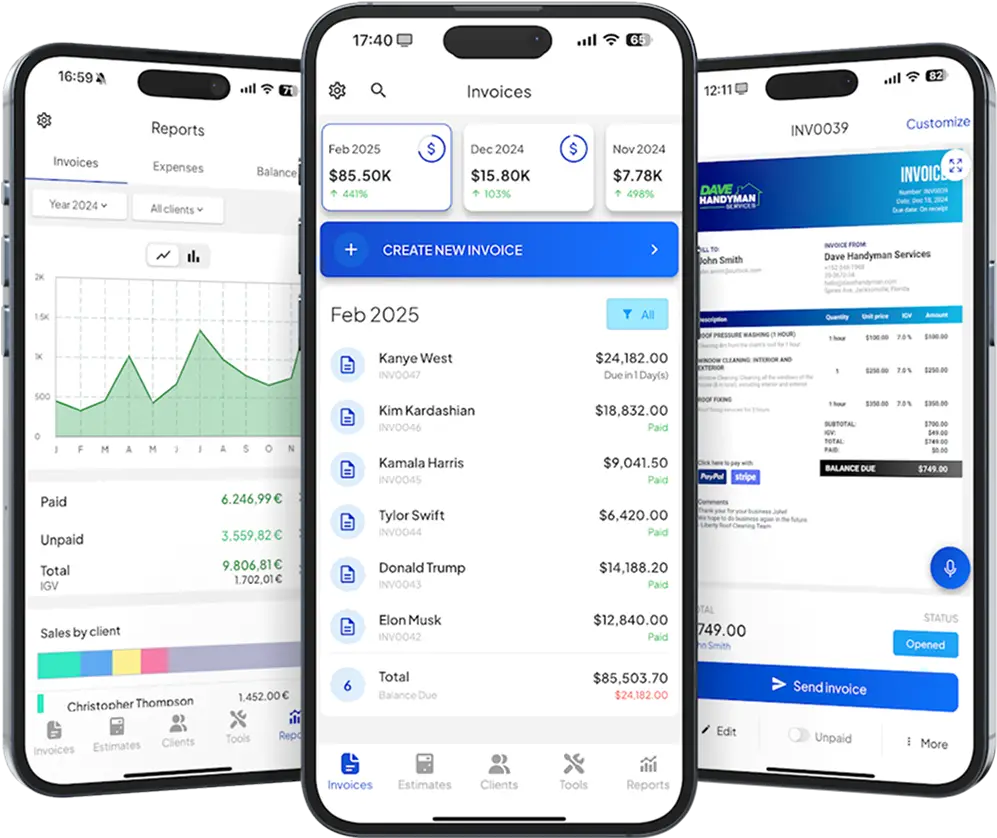
Its invoicing software covers customer billing, while estimate and quote software handles the work before an invoice is sent. Built-in time-tracking software can also record billable hours.
Current Invoice Fly pricing is $8.99/week or $98.99/year. Independent reviews are available through Capterra.
Invoice Fly isn’t designed to replace the full bookkeeping and financial reporting available through QuickBooks or Wave.
QuickBooks or Wave: what to take away
The main differences come down to cost and accounting depth.
Wave Starter covers everyday bookkeeping and unlimited basic invoicing without a subscription. QuickBooks has tighter limits on its free plan but provides a wider range of accounting tools through its paid plans, including time tracking, projects and inventory.
If you don’t need a full bookkeeping platform, Invoice Fly offers a more focused workflow for estimating work, tracking time and expenses, invoicing customers and collecting payments.