Xero vs QuickBooks: Which Accounting Software Is Better?
Table of Contents
Xero vs QuickBooks is a close comparison because both are full cloud-accounting platforms built for small businesses, accountants and bookkeepers. Both cover everyday bookkeeping, invoicing, bank reconciliation, expenses and financial reporting.
The differences become clearer when you look at how their plans work. Xero includes unlimited users across its plans and offers core inventory from Early, while QuickBooks Online increases user limits and adds features such as projects and inventory as you move through its plans.
Xero vs QuickBooks: overview

Xero has three U.S. plans: Early, Growing and Established. All three include unlimited users, bank reconciliation, invoicing, purchase orders, inventory and financial reporting. Early has tighter transaction limits, while Established adds features such as projects, multi-currency accounting and employee expense claims.
QuickBooks Online has four main plans: Simple Start, Essentials, Plus and Advanced. Its standard-user limits increase from one on Simple Start to 25 on Advanced, with features such as time tracking, projects and inventory becoming available on higher plans.
Xero vs QuickBooks at a glance
| Feature | Xero | QuickBooks Online |
|---|---|---|
| Regular starting price | $27/month | $38/month |
| Plans | Early, Growing, Established | Simple Start, Essentials, Plus, Advanced |
| Free trial | 30 days | 30 days |
| Standard users | Unlimited | 1 / 3 / 5 / 25 by plan |
| Invoicing | Yes; Early limited to 20 approved/sent invoices | Yes |
| Bills | Early limited to 5 | Accounts payable from Essentials |
| Bank reconciliation | Yes | Yes |
| Receipt capture | Yes | Yes |
| Time tracking | Established via Projects | Essentials+ |
| Projects | Established | Plus+ |
| Project profitability | Established | Plus+ |
| Inventory | Core inventory across plans | Plus+ |
| Multi-currency | Established | Essentials+ |
| Payroll | Xero Payroll, powered by Gusto | QuickBooks Payroll |
| Financial reports | Yes | Yes |
| Mobile app | Yes | Yes |
Prices checked September 2026. Xero prices shown are the announced U.S. rates effective October 1, 2026.
The clearest differences are user access and where more advanced features sit within the plans. Xero doesn’t charge additional per-user license fees on its standard plans, while QuickBooks increases the number of standard users by plan. QuickBooks puts projects and inventory on Plus and Advanced, while Xero includes core inventory across its plans but reserves Projects for Established.
Xero
Xero is cloud-based accounting software for small businesses, accountants and bookkeepers. Its three-plan structure starts with core bookkeeping and accounting tools, then adds more automation, analytics and project features at higher levels.
Features
All three Xero plans include tools for:
- Bank connections and reconciliation
- Quotes and invoicing
- Online payments
- Smart document capture
- Financial reporting
- W-9 and 1099 management
- Sales tax
- Purchase orders
- Core inventory
- Contacts and file storage
- Unlimited users
The main limitation on Early is volume. It allows up to 20 approved or sent invoices and five bills, and transactions initiated through connected apps can count toward the invoice limit. Growing and Established don’t have those advertised limits.
Growing adds automatic bank reconciliation through JAX, alongside other automation and forecasting features.
Established goes further with:
- 180-day cash-flow forecasting
- KPI and ratio analysis
- Multi-currency accounting
- Projects
- Project time and cost tracking
- Employee expense and mileage claims
- Industry benchmarking
Xero Projects can track time, costs, budgets and profitability, with support for fixed-price and time-and-materials invoicing.
Pricing
From October 1, 2026, Xero’s regular U.S. prices are:
- Early: $27/month
- Growing: $59/month
- Established: $97/month
There are no additional per-user license fees on Xero’s standard plans.
Optional costs can include Xero Payroll powered by Gusto, Inventory Plus, payment processing and some international payment services. Xero Payroll is priced separately at $36/month plus $6 per employee or contractor.
Pros and cons
Pros
- Unlimited users across all plans
- Three-plan structure
- Bank reconciliation across plans
- Core inventory included across plans
- Purchase orders included
- Projects and project profitability on Established
- Multi-currency on Established
- More than 1,000 integrations marketed by Xero
Cons
- Early is limited to 20 approved/sent invoices and five bills
- Projects and built-in project time tracking require Established
- Employee expense and mileage claims require Established
- Payroll costs extra
- Inventory Plus is a separate add-on
Independent Xero reviews are available through G2 and Capterra.
QuickBooks

QuickBooks Online is Intuit’s cloud-accounting platform. It covers core bookkeeping from Simple Start and adds more users, bills, time tracking, projects, inventory and advanced reporting as you move through the plans.
Features
Every QuickBooks Online plan covers core accounting tasks such as:
- Double-entry accounting
- Bank feeds and reconciliation
- Income and expense tracking
- Estimates and invoices
- Online payments
- Receipt capture
- Financial reporting
- Customer and vendor records
- Sales tax
Essentials adds bills and accounts payable, built-in time tracking and up to three standard users.
Plus supports up to five standard users and adds projects, project profitability and inventory. Its inventory tools cover quantity on hand, inventory costs, reorder information, cost of goods sold and related purchase information.
Advanced supports up to 25 standard users and adds features including advanced dashboards, custom reporting, KPIs, more custom fields and workflow automation.
Pricing
Regular U.S. QuickBooks Online prices are:
- Simple Start: $38/month
- Essentials: $85/month
- Plus: $140/month
- Advanced: $340/month
The standard-user limits are one, three, five and 25 respectively. Accountant users are handled separately from those limits.
QuickBooks Payroll is a separate product, while payment processing and some connected services also carry separate costs.
Pros and cons
Pros
- Full double-entry accounting
- Bank reconciliation
- Built-in time tracking from Essentials
- Projects and project profitability on Plus+
- Inventory on Plus+
- Up to 25 standard users on Advanced
- Advanced reporting and workflow tools
- Separate payroll option
- Broad third-party app ecosystem
- Established accountant and bookkeeper workflows
Cons
- Standard users are limited by plan
- Bills and accounts payable require Essentials+
- Projects and inventory require Plus+
- Payroll is separately priced
- Advanced is considerably more expensive than the entry plans
Independent QuickBooks Online reviews are available through G2 and Capterra.
Xero vs QuickBooks: detailed comparison

Here’s how Xero and QuickBooks compare across the features businesses use day to day.
Accounting and bookkeeping
Both Xero and QuickBooks Online are full accounting platforms.
- Xero includes core bookkeeping across all three plans, including bank feeds, reconciliation, financial reporting, purchase orders and inventory. The Early plan is functional accounting software, but its invoice and bill limits can make it restrictive for businesses processing higher volumes.
- QuickBooks Online also starts with double-entry bookkeeping, reconciliation and financial reporting. Its plan structure places some everyday business-accounting features higher up: bills and accounts payable begin with Essentials, for example.
The IRS provides guidance on the records businesses may need to retain to support income, expenses and other tax information.
Invoicing and payments
Both platforms cover the main steps from billing a customer to recording payment:
- Xero: Supports quotes, invoices, recurring invoices, automatic reminders and online payments. Early is limited to 20 approved or sent invoices, while Growing and Established don’t carry that advertised restriction.
- QuickBooks: Supports estimates, invoices, recurring transactions and online payments, with customer billing connected to the wider accounting record.
Xero can connect online invoices with payment providers including Stripe and GoCardless. Supported payment methods can include cards, ACH, direct debit, Apple Pay and Google Pay, depending on the provider. Payment-provider fees are separate from the Xero subscription.
QuickBooks Payments is also separate from the accounting subscription.
For more on billing customers, see our guides to how to send an invoice and setting invoice payment terms.
Bank reconciliation
Bank reconciliation is available with both platforms.
- Xero includes reconciliation across its plans. Growing adds automatic bank reconciliation through its current JAX functionality, alongside other automation and forecasting features.
- QuickBooks connects bank and credit-card accounts so transactions can be matched or categorized and reconciled against statements. More advanced AI-assisted reconciliation functionality is currently associated with Plus and Advanced.
For either platform, reconciliation still depends on accurate records and reviewing discrepancies rather than simply connecting a bank account.
Expense tracking
Both platforms can record and categorize business expenses and capture supporting documents.
The main Xero plan distinction concerns employee expenses:
- Core accounting handles business expense transactions and document capture.
- Established adds employee expense claims and mileage claims.
- Project costs can also be tracked through Xero Projects on Established.
QuickBooks includes income and expense tracking and receipt capture across its standard accounting workflow. Expenses can also feed into project profitability on Plus and Advanced.
A receipt scanner app can be useful when receipt capture is one of the main administrative tasks you’re trying to simplify.
Time tracking and projects
This is one area where the plans differ noticeably:
- Xero: Projects and its associated time tracking are included with Established. Projects can track time, costs, budgets and profitability and support fixed-price or time-and-materials invoicing.
- QuickBooks: Basic built-in time tracking starts with Essentials. Projects and project profitability are available on Plus and Advanced.
QuickBooks Time is also available separately for businesses that need deeper workforce time-management functionality.
Our guide to invoice automation explains how recurring billing and other automated steps can reduce repetitive invoice admin.
Inventory
Both platforms offer inventory tools, but they package them differently.
- Xero: Core inventory functionality is included across its current plans. Inventory Plus is a separate optional add-on available with Growing and Established.
- QuickBooks: Inventory is included with Plus and Advanced, covering quantity on hand, inventory costs, reorder information, products and services, and cost of goods sold.
Payroll
Payroll is separately priced with both platforms in the U.S.
Xero Payroll is powered by Gusto and costs $36/month plus $6 per employee or contractor.
QuickBooks Payroll integrates with the wider QuickBooks accounting ecosystem and is priced separately.
If payroll is an important part of your comparison, include those separate costs when working out the monthly total rather than comparing accounting subscriptions alone.
Financial reporting
Both provide the financial statements expected from full accounting software.
- Xero includes financial reporting across its plans. Growing adds performance dashboards and financial-health tools, while Established extends the analytics with KPI and ratio analysis, longer cash-flow forecasting and industry benchmarking.
- QuickBooks also includes financial reporting throughout its plans. Advanced provides its strongest reporting set, with custom reports, dashboards, KPIs and additional controls.
The specific reports you use regularly are more useful to compare than the total number advertised by either platform.
Integrations
Both platforms connect with third-party business software.
- Xero: Markets more than 1,000 app integrations and supports connections across areas such as payments, ecommerce, inventory and business operations.
- QuickBooks: Has a broad App Store ecosystem and connects with many accounting, payroll, CRM, ecommerce and operational tools.
If you already depend on specific software, check the exact integration and the features it supports before changing accounting platforms.
Ease of use and customer support
Ease of use depends partly on the accounting work you’re doing and how many people need access.
- Xero: Unlimited users can make collaboration simpler when several employees, accountants or bookkeepers need access without increasing the number of paid seats.
- QuickBooks: Its tiered user permissions and accountant workflows can suit businesses that need tighter controls as their accounting setup becomes more complex.
Both companies provide support resources. Check the support channels included with the specific plan you’re considering, particularly if phone support or onboarding help is important.
Choosing between Xero and QuickBooks
Rather than starting with business size alone, look at the accounting tasks, people and systems the software needs to support.
When Xero fits the workflow
Xero’s plan structure may be relevant when you need:
- Several employees or advisers to access the books
- Core inventory without moving to a higher plan
- Purchase orders
- Bank reconciliation
- A three-plan structure
- Multi-currency, projects and more advanced analytics on Established
The unlimited-user model is particularly notable for businesses where multiple team members, accountants or bookkeepers need access.
Early’s invoice and bill limits still matter, though. A business sending more than 20 invoices or entering more than five bills may need Growing even if it doesn’t need Growing’s additional automation.
The SBA’s business-management resources also cover broader areas of running and managing a business.
When QuickBooks fits the workflow
QuickBooks Online provides a different progression through its plans. It may fit businesses that need:
- Accounts payable
- Built-in time tracking
- Project profitability
- Inventory
- More detailed user controls
- Advanced reporting and workflow automation
- Integration with other Intuit products
The plan required depends heavily on the feature. Time tracking begins with Essentials, while projects and inventory require Plus or Advanced.
For accountants, bookkeepers and larger teams
User access deserves particular attention here.
Xero includes unlimited users on every plan, without separate per-user license fees on its standard subscriptions.
QuickBooks limits standard users by plan:
- Simple Start: 1
- Essentials: 3
- Plus: 5
- Advanced: 25
Accountant users are treated separately from these QuickBooks standard-user limits.
That doesn’t determine which accounting system a firm should use, but it can materially affect plan selection when several people need access.
If you’re planning to switch from QuickBooks to Xero
Xero provides migration routes for businesses moving from QuickBooks, including a documented free conversion option through its migration partner.
Supported information can include:
- Chart of accounts
- Contacts
- Bills
- Invoices
- Historical transactions
The standard conversion doesn’t migrate payroll data, so payroll needs to be set up separately. Businesses requiring additional historical periods may also face migration costs.
Before switching, reconcile and clean up the existing QuickBooks books and keep exports or archives of historical records. Don’t assume every attachment, payroll record or custom configuration will transfer automatically.
A simpler alternative to Xero and QuickBooks

Full accounting software isn’t necessary for every freelancer, contractor or service business.
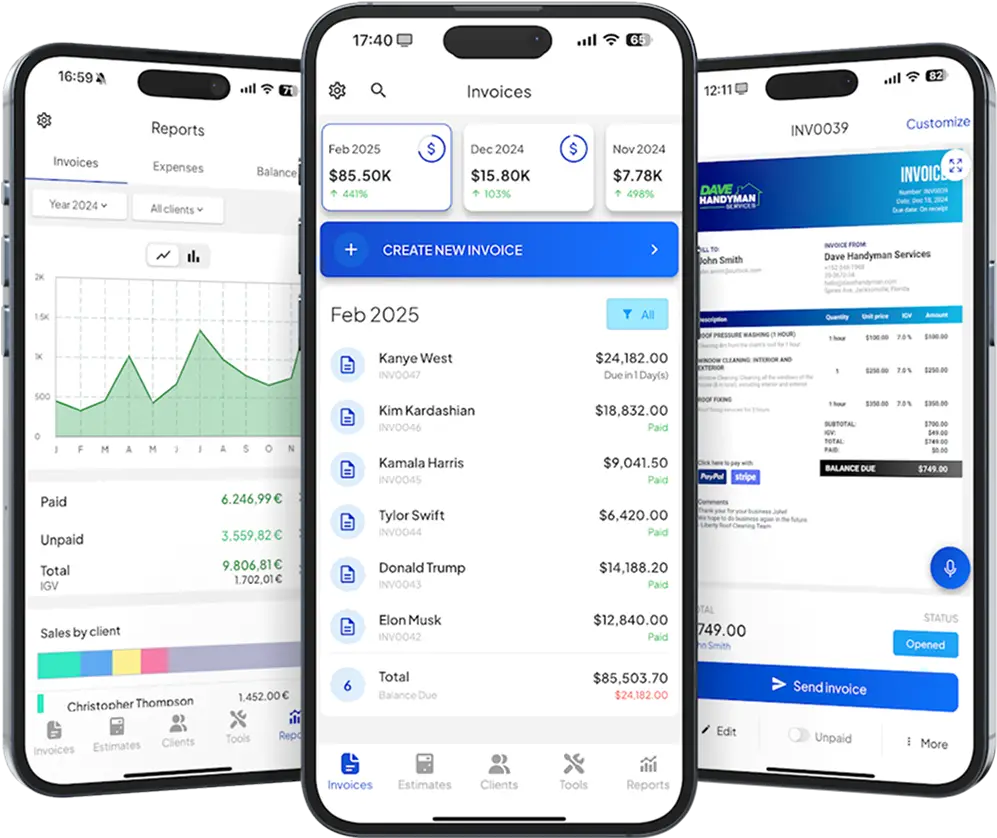
Invoice Fly focuses on the admin around client work, including estimates, unlimited invoices, recurring billing, payments, expenses, receipts and client management.
Its invoicing software covers customer billing, while estimate and quote software handles the earlier stage of pricing work. Time-tracking software is also available for recording billable work.
Current Invoice Fly pricing is $8.99/week or $98.99/year, with unlimited invoices and estimates.
Invoice Fly isn’t designed to replace the full bookkeeping, reconciliation, inventory and financial-reporting functionality available in Xero or QuickBooks. It provides a narrower option when those accounting features aren’t required.
Xero and QuickBooks: What to take away
Xero and QuickBooks Online both cover core business accounting, but their plan structures differ.
Xero combines unlimited users, core inventory and bank reconciliation across its plans, with projects, multi-currency and more advanced analytics on Established.
QuickBooks uses plan-based user limits and adds time tracking with Essentials, followed by projects and inventory with Plus. Advanced extends the platform with more reporting, permissions and workflow controls.
For businesses mainly focused on estimating jobs, tracking work and expenses, invoicing customers and collecting payments, Invoice Fly offers a more focused alternative without the wider accounting scope.