Invoice Fly vs Housecall Pro: How To Choose
Table of Contents
Invoice Fly and Housecall Pro aren’t really built for the same size of problem. Invoice Fly keeps estimates, invoices, expenses, and payment follow-up simple enough for one person to run. Housecall Pro goes further, adding scheduling, dispatching, and customer communication for a whole home-service team.
This Invoice Fly vs Housecall Pro comparison looks at what each platform actually does, where the extra tools earn their keep, and when the simpler option is the smarter cachoice for your business.
Invoice Fly vs Housecall Pro at a Glance
| Invoice Fly | Housecall Pro | |
|---|---|---|
| Best for | Independent contractors and small service businesses | Home-service companies managing appointments and technicians |
| Estimates and invoices | Unlimited with paid access | Included, with advanced proposals on selected plans |
| Scheduling and dispatch | No full dispatch board | Calendar, dispatching, booking, and assignments |
| Recurring work | Recurring invoices | Recurring service plans, jobs, visits, invoices, and payments |
| Time and expenses | Built in | Employee time tracking and business reporting tools |
| Customer records | Client and billing details | Property, equipment, job, payment, and communication history |
| Payments | Through Stripe and PayPal, supporting cards, digital wallets, ACH, and SEPA | Cards, ACH, wallets, Tap to Pay, and financing options |
| Team controls | Suited to individuals and simple small-business routines | Roles, schedules, permissions, notifications, and technician tools |
| Starting price | $8.99 weekly or $98.99 yearly | $79 monthly or $59 per month with annual billing |
| Free option | No-account document generators | 14-day trial, with no permanent free plan |
The Housecall Pro vs Invoice Fly decision depends on the problem being solved. Invoice Fly is easier to justify when paperwork and collections are the main concerns. Housecall Pro becomes more valuable when booking, scheduling, technicians, and customer communication also need attention.
What Is Invoice Fly?
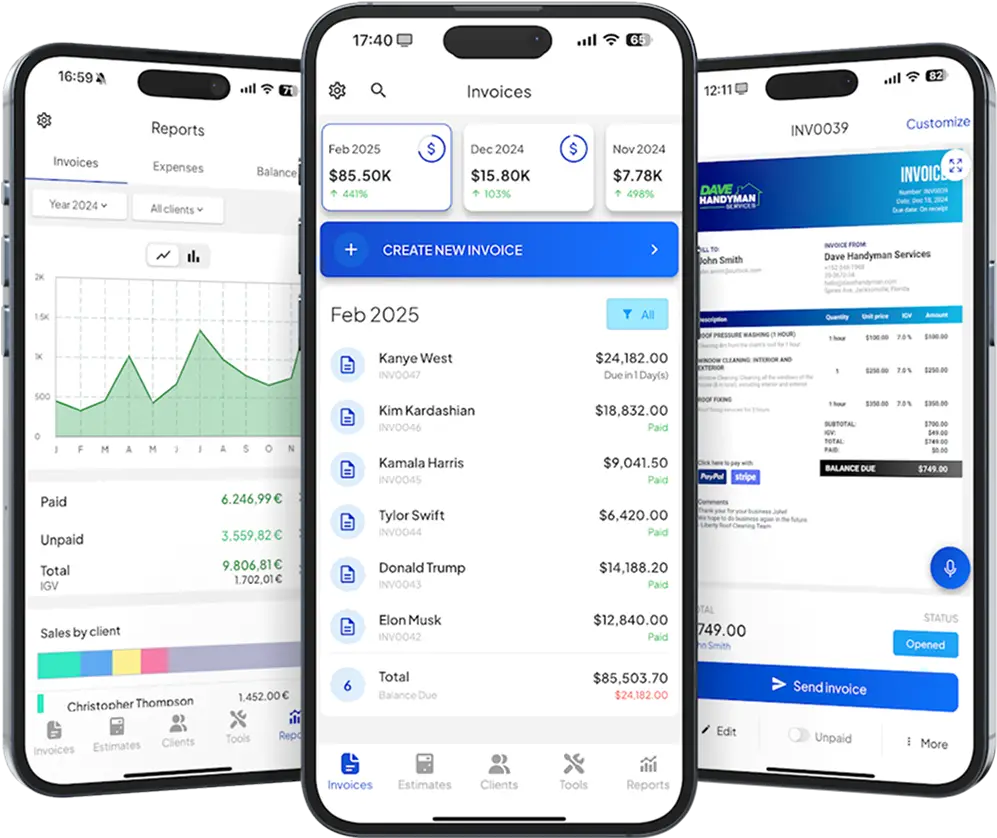
Invoice Fly gives contractors and service professionals a practical route from quote to payment. A user can prepare an estimate, request a signature or deposit, create the final invoice, and check its sent, viewed, overdue, or paid status.
Around that core, it also features: logging hours, tracking expenses, saving photos of receipts, sending recurring bills and reminders on autopilot, and turning it all into reports when you want the full picture. Whether you pay $8.99 a week or $98.99 a year, unlimited estimates and invoices come with either plan.
And if all you need is a single document rather than the whole system, Invoice Fly’s seven free browser generators (invoices, estimates, quotes, bills, receipts, proformas, work orders) handle that too, no account required. Try the free invoice generator here.
What Is Housecall Pro?
Housecall Pro is field-service management software for HVAC, plumbing, electrical, cleaning, landscaping, appliance repair, handyman, and other home-service businesses.
It connects incoming requests with online booking, scheduling, dispatching, job records, customer messages, invoicing, and payment. Field technicians can open job details and update progress through the mobile app, while office staff see the wider calendar.
Additional Housecall Pro features include recurring service plans, review requests, employee tools, QuickBooks integration, reporting, and optional sales or price-book products. This Capterra overview provides a third-party summary of its broader operational scope.

Invoice Fly vs Housecall Pro: Key Differences
And now for the main differences between Invoice Fly vs Housecall Pro.
Invoicing and Estimates
Estimates and invoices are table stakes for both, taxes, discounts, payments, and a way to see what’s still owed all show up either way. The real question is how much else gets pulled into that process.
With Invoice Fly, the whole thing stays close to one person: build the estimate, get it approved, do the work, send the invoice, all from the same screen. That’s exactly what you want when the person swinging the hammer is also the one sending the bill.
Housecall Pro ties the estimate to a specific customer and a job on the calendar instead. Depending on the plan, that can mean sending proposals with multiple pricing options, photos, and upgrade choices, then rolling anything accepted straight into the schedule.
However you build the number, it still has to make sense to the person paying it. How to write an invoice is a good refresher on itemizing labor, materials, quantities, and totals clearly.
Scheduling and Dispatching
This is where the size gap really shows. Housecall Pro runs on a dispatch calendar: office staff book appointments, assign technicians, shuffle jobs around, and see who’s free, with every update pushed straight to the crew’s phones.
Invoice Fly doesn’t try to compete here. It’ll organize your billing by client and project just fine, but it won’t tell you who’s driving where or when, and for a solo operator whose calendar already does that job, that’s not really a gap at all. It only starts to matter once there’s a crew that needs to see the same schedule at the same time.
However the day gets planned, it shouldn’t get planned in a way that pressures anyone to rush between jobs. OSHA’s recommended safety practices are built around planning the work, involving employees, and spotting hazards before they become a problem.
Online Booking and Customer Management
Housecall Pro lets customers request or book work online, within whatever rules the business sets, and builds out a real profile behind each one: address, equipment, job history, quotes, invoices, payments, and messages, all in one place.
That kind of detail earns its keep with repeat-service work. An HVAC company needs to know which unit it repaired last summer and what the technician found when they were out there, not just what was billed. Invoice Fly keeps the client and billing information an estimate or invoice actually needs, but it was never meant to double as a property or equipment record.
Jobs, Workflows, and Field-Service Management
Housecall Pro tracks a job from the first phone call all the way through scheduling, service, billing, payment, and the review that comes after. Statuses tell the office what’s booked, in progress, done, or still waiting on something, and technicians get their instructions without anyone digging through a group text to find them.
Invoice Fly isn’t trying to run the whole operation, just the paperwork end of it, and for a one-person business, that’s often the point in its favor rather than against it.
A useful gut check: count the handoffs and review this guide on when to send invoices. A job that passes from receptionist to estimator to dispatcher to technician to billing has a lot of places for information to get lost, and that’s exactly where Housecall Pro earns its complexity. A job that only ever passes through one person doesn’t have that problem to solve, and a full workflow system there is more setup than it’s worth.
Online Payments and Payment Reminders
Invoice Fly takes payments online through providers like Stripe and PayPal, and pairs that with statuses and reminders so nothing unpaid quietly falls off your radar.
Housecall Pro casts a wider net: cards, ACH transfers, digital wallets, Tap to Pay, and financing for customers who qualify. What that actually costs you depends on the payment type and your account terms, so check the rate that applies to your business rather than trusting whatever number shows up first in the marketing.
Either way, convenience only goes so far without clear expectations behind it. Set invoice payment terms and an invoice due date that actually match the cash flow you need.

Recurring Jobs and Billing
Invoice Fly can put recurring invoices and reminders on a schedule, which works well when the charge repeats on its own and you’re managing the actual visits somewhere else.
Housecall Pro builds recurring service plans around the visit itself: future appointments, customer notifications, invoices, and approved payments, all tied together. That distinction matters more than it sounds, since service and billing don’t always run on the same clock. A cleaner might show up weekly but invoice monthly, while an HVAC contract might fund two visits through one recurring payment.
Whatever’s on autopilot still needs a human check-in whenever a price, frequency, or scope changes. Invoice Fly’s guide to invoice automation walks through how to save time without letting outdated details keep repeating.
Team and Technician Management
Housecall Pro is built with a team in mind: user roles, technician schedules, permissions, job notifications, and tools for tracking activity out in the field. Essentials pricing covers five users, MAX covers eight, and add-on users or specialist packages can push the final cost higher from there.
Invoice Fly doesn’t try to manage a team at all. It stays focused on the owner’s estimates, billing, time, and costs, which suits an individual or small operation that has no real use for dispatch permissions or technician oversight.
Before paying for any team feature, it’s worth asking who actually needs access, and which calendar, messaging, or management tool already in use the new platform is meant to replace.
Customer Communication and Reviews
Housecall Pro automates a lot of the back-and-forth around an appointment: confirmations, reminders, on-my-way texts, follow-ups, invoice nudges, and review requests. Customers get a clearer sense of when someone’s actually showing up, and the office fields fewer routine calls asking exactly that.
Invoice Fly keeps its messaging narrower, built around estimates, invoice status, and chasing payment, without the same string of appointment texts running alongside it.
If review requests are part of the plan, handle them carefully. The Federal Trade Commission’s endorsement guidance is clear that a business shouldn’t misrepresent feedback or tie any kind of incentive to getting a positive one.
Integrations and Business Tools
Housecall Pro connects with QuickBooks Online and a range of other business services, and depending on the plan or add-on, can also bring in proposals, pipeline tools, equipment tracking, price books, service plans, payroll functions, or more advanced reporting.
An integration cuts down on retyping, but it’s not something to set and forget. Duplicate customers, tax mappings, edited invoices, and payment mismatches are all worth a periodic look with a bookkeeper.
Invoice Fly takes the opposite approach and stays deliberately narrow: estimates, invoices, time, expenses, receipts, reports, and payment options make up the whole toolkit, which for a solo contractor can mean fewer systems to juggle in the first place.
Ease of Use and Mobile Access
Invoice Fly doesn’t ask for much configuration. Add your company information, branding, services, and clients, and you’re already creating documents, with a mobile experience that holds up well for billing from a jobsite or the front seat of a truck.
Housecall Pro has mobile apps too, but getting there can mean setting up booking rules, services, employee permissions, schedules, messaging, payments, imports, and accounting connections first. For a busy team, that setup pays off in a smoother day-to-day. For one person, it can feel like a lot just to send a bill.
Real user feedback fills in the rest. G2 reviews, Capterra reviews, and Trustpilot feedback are worth a look, with more weight given to recent reviews from businesses that look like yours.

Invoice Fly vs Housecall Pro Pricing
Invoice Fly and Housecall Pro use very different pricing models. Invoice Fly offers the complete app through a weekly or yearly subscription, while Housecall Pro has three plans based on features and team size.
| Invoice Fly | Housecall Pro | |
|---|---|---|
| Entry-level plan | $8.99 per week or $98.99 per year | Basic: $79 per month or $59 per month with annual billing |
| Mid-level plan | Not applicable | Essentials: $189 per month or $149 per month with annual billing |
| Top-level plan | Not applicable | MAX: $329 per month or $299 per month with annual billing |
| Included users | Not tiered by team size | 1 with Basic, 5 with Essentials, and 8 with MAX |
| Primary focus | Invoicing, estimates, payments, time, expenses, receipts, and reports | Field service management, including scheduling, dispatch, CRM, customer communication, invoicing, and payments |
| Free trial | Free document tools are available | 14 days with no credit card required |
Invoice Fly is considerably less expensive, especially with its annual subscription. Housecall Pro costs more because it is designed to manage field service teams and includes scheduling, dispatch, CRM, and other operational tools. Its Capterra pricing page provides another overview of the standard plans and features.
Invoice Fly vs Housecall Pro for Contractors and Home-Service Businesses
Invoice Fly tends to fit the tradesperson running their own calendar: solo operators, independent contractors, small crews who don’t need anyone else looking at their schedule. When what you actually want is estimates, signatures, invoices, time, costs, and someone chasing unpaid balances, it works as a practical Housecall alternative or Housecall Pro alternative without the extra weight.

Housecall Pro makes more sense once there’s real coordination to manage: several technicians on the road, online bookings coming in, property histories worth keeping, or maintenance plans to sell. The higher price tag stops being a hard sell the moment scheduling mix-ups and scattered job details start costing more than one person’s time.
Invoice Fly vs Housecall Pro: Which Should You Choose?
Pick Invoice Fly if you’re the one doing the job and the one sending the bill. It handles estimating, invoicing, time tracking, expenses, receipt capture, recurring bills, online payments, and reports, without making you pay for dispatch tools you’d never open. Pick Housecall Pro if you’re running more than just your own schedule, once requests, bookings, technicians, job records, customer communication, payments, and reviews all need to work together, that’s the system built to hold them.
If you’re deciding between Invoice Fly or Housecall, let your team size make the call. Someone looking for an Invoice Fly alternative usually needs to coordinate people, not just send bills, while someone looking for an Alternative to Housecall Pro usually just wants dependable invoicing without the operational system wrapped around it. Either way, the right tool is the one sized to the business you actually run, not the one you might grow into someday.