Invoice Fly vs Invoice-Generator: Which Is Better for Your Business?
Both Invoice Fly and Invoice-Generator can produce a professional invoice quickly, but speed is only part of the decision. What matters more is whether you need one document today or a repeatable process for the months ahead. Invoice-Generator is built for instant document creation, while Invoice Fly organizes the estimates, time, expenses, receipts, and payment follow-up that surround regular client work.
In this guide, we’ll compare how the two, Invoice Fly vs Invoice-Generator, stack up on features, pricing, and everyday use so you can see which one actually fits your business.
Invoice Fly vs Invoice-Generator at a Glance
| Invoice Fly | Invoice-Generator.com | |
|---|---|---|
| Best for | Freelancers and service businesses that invoice regularly | Anyone who needs a PDF invoice quickly |
| Account required | Yes for the app; no for its free generators | No for a basic invoice PDF |
| Free documents | Invoices, estimates, quotes, bills, receipts, proformas, and work orders | Invoices and several other document generators |
| Invoice history | Cloud records in the paid app | Browser history plus expanded online tools |
| Estimates and quotes | Connected to the app and available as free generators | Separate estimate and quote generators |
| Recurring invoices | Yes | Yes |
| Online payments | Stripe and PayPal, supporting cards, digital wallets, ACH, and SEPA | Card and ACH options |
| Time and expenses | Timer, expenses, receipt scanning, and reports | Timesheet generator, but no comparable expense workflow |
| Published price | $8.99 weekly or $98.99 yearly | Core PDF generator is free |
| Device access | Mobile app and browser | Responsive browser experience |
Invoice-Generator is difficult to beat when the entire task is “make a PDF now.” Invoice Fly becomes more useful when billing happens often enough that saved business records and connected tools start saving real time.
What Is Invoice Fly?
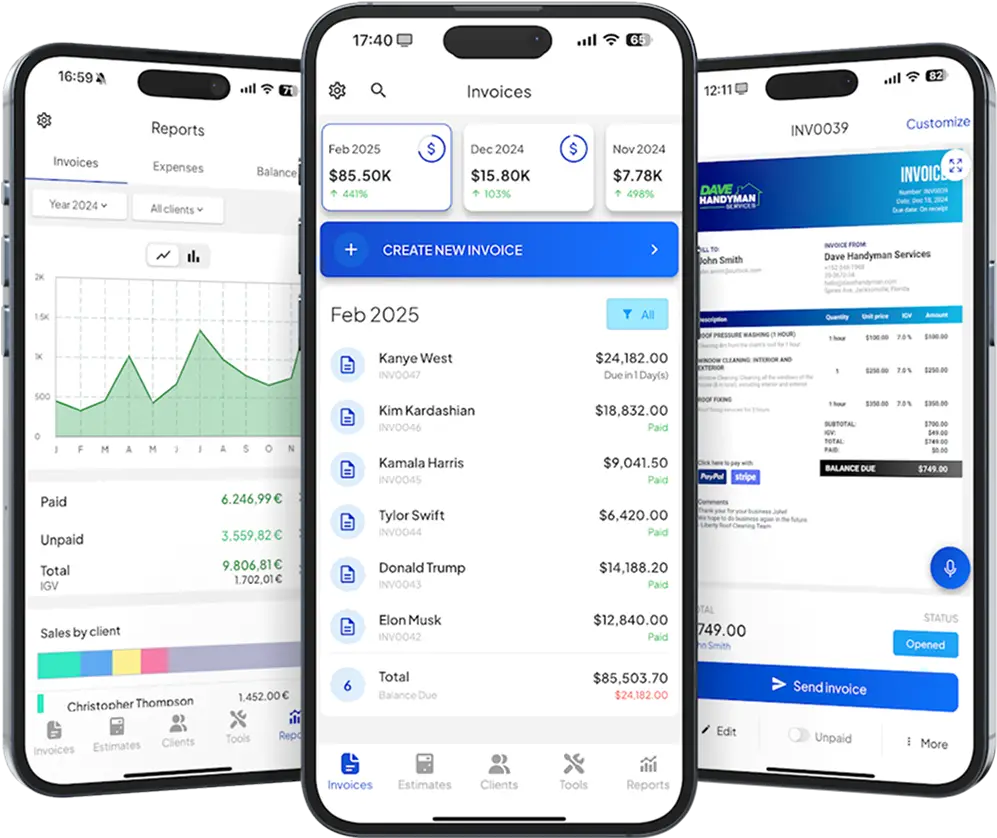
Invoice Fly brings the whole billing process into one workspace for freelancers, tradespeople, and service businesses. Send an estimate, get it approved, turn it into an invoice, collect payment, and keep an eye on its status, all without switching tools along the way.
It also handles the work around the invoice: tracking billable time and expenses, capturing receipts, scheduling recurring invoices, and pulling everything into business reports. Paid access runs $8.99 a week or $98.99 a year, and both options include unlimited estimates and invoices.
For a one-off job, Invoice Fly’s seven free browser generators cover invoices, estimates, quotes, bills, receipts, proformas, and work orders, no app subscription needed. Try the free invoice generator here.
What Is Invoice-Generator?
Invoice-Generator(.com) is a browser-based tool whose main page opens directly to an editable invoice. Visitors can enter seller and customer details, dates, line items, taxes, discounts, notes, and payment terms, then download the result as a PDF. A basic invoice requires no registration.
The service also has tools for estimates, quotes, receipts, credit notes, purchase orders, timesheets, work orders, and statements. Expanded features include saved customers, recurring invoices, reminders, view tracking, online payments, and an AI option.
That makes it more capable than a simple blank form. Even so, the defining experience remains fast, free PDF creation. The Capterra product profile lists a free version along with invoice creation, history, payments, estimates, and other Invoice-Generator features.

Invoice Fly vs Invoice-Generator: Key Differences
We will take a look at the main differences in this next section.
Creating and Sending Invoices
Invoice-Generator skips the setup and drops you straight into a ready-to-fill form. Add your business and client information, an invoice number, dates, services, quantities, rates, tax, discounts, and terms, and the page calculates the balance and hands you a downloadable PDF. That short route works well for a first invoice, an urgent replacement, or anything billed only occasionally.
Invoice Fly asks for a bit more upfront: an account and a business profile. In exchange, your branding, customers, documents, and statuses all stick around for the next time you bill someone. If this is your first time invoicing a customer, it’s worth starting with what an invoice is, then working through how to write an invoice to cover the details a customer needs before they’ll actually pay you.
PDF Invoices and Invoice Customization
Both tools turn out a professional-looking PDF. Invoice-Generator gives you editable labels, a logo field, currency settings, taxes, discounts, shipping, and notes, and it can remember your template details in the browser for next time. Invoice Fly takes a similar set of options and saves them to your profile instead, so new estimates and invoices stay consistent across customers and devices, with customization built into a broader, saved workflow.
The real difference shows up after you hit download. An Invoice-Generator PDF may be all you need if another system handles your records and payments, while Invoice Fly keeps that same document tied to the customer, estimate, status, time, and expenses behind it. Whichever route you take, run through these professional invoice elements first, so a good-looking invoice is backed up by complete information.
Estimates, Quotes, and Other Business Documents
Invoice Fly’s paid app includes estimates that flow straight into invoicing: once a customer approves one, it converts without you re-entering the job, and a signature or deposit confirms they’re on board. Its free tools cover quotes, bills, receipts, proformas, and work orders separately.
Invoice-Generator goes wider instead of deeper, with a genuinely broad lineup of stand-alone forms: estimates, quotes, credit notes, purchase orders, sales orders, timesheets, statements, packing slips, and receipts. Which approach wins out depends on how often you’re preparing documents. Separate generators suit the occasional quote, while connected documents save a contractor real time when they’re putting together several proposals a week.
Invoice Tracking and Management
A PDF proves what you charged, but it doesn’t tell you whether the customer actually saw it or paid for it, and that’s where a real invoicing system earns its keep. Invoice Fly organizes documents by customer and labels each one sent, viewed, paid, or overdue, so notifications and outstanding balances point you straight to who needs a follow-up.
Invoice-Generator can hold onto details in browser storage, and its online workflow adds statuses, customers, reminders, and view tracking on top of that. Just don’t let browser-only history be your only copy of something important, since clearing local data can take it with it. Download your final documents and back them up in a clear filing system either way; the NIST small-business cybersecurity resources are a solid place to start on access control, account protection, backups, and recovery.
Online Payments
Invoice Fly lets customers pay straight from the invoice through connected providers like Stripe and PayPal, while you track the document’s status on your end. Invoice-Generator covers similar ground with card and ACH payments, payment links, and online tracking, shrinking the gap between opening a bill and getting paid.
Just remember that free invoice creation doesn’t mean free payment processing. Check transaction charges, payout timing, refunds, verification rules, and limits before turning on a provider, and make sure the invoice itself states the deadline and accepted methods. This guide to how to send an invoice covers delivery, payment instructions, and the follow-up that keeps things moving.

Recurring Invoices and Automation
Invoice Fly’s paid app handles recurring invoices along with automatic reminders and status notifications, which suits retainers, maintenance contracts, and any billing that runs on a predictable schedule. Invoice-Generator has grown into similar territory too, adding recurring invoices, saved customers, view tracking, and reminders well beyond its original no-signup PDF form.
Automation still needs a human checking in, though. Review recurring bills whenever prices, scope, contact details, or tax treatment change, and Invoice Fly’s guide to invoice automation explains how to save time without letting an inaccurate bill repeat unnoticed.
Expense and Time Tracking
This is where the two products really part ways. Invoice Fly has a built-in timer that ties work to specific clients or projects, plus the ability to log expenses, photograph receipts, organize costs, and pull it all into reports. Invoice-Generator offers a free timesheet generator for documenting hours, which is handy on its own but isn’t the same as having an active timer, receipts, expenses, customers, and invoices living in one connected workspace.
Which one fits depends on what you’re already using. A consultant with a separate time-tracking app may not need the extra layer, while a contractor still working from paper receipts and handwritten hours stands to gain more from Invoice Fly. Either way, the IRS explains in Publication 583 that your records need to support the business income and expenses you report, and neither app guarantees complete tax records on its own, so hold onto whatever supporting material your situation requires.
Account Access and Invoice History
Invoice-Generator doesn’t ask for an account to create a basic invoice, which keeps that first visit quick and spares you one more password. The tradeoff is that browser-based information doesn’t necessarily follow you to a different device.
Invoice Fly does require an account for its full app, but that’s because customer records, documents, time entries, expenses, and status changes all need somewhere to sync. Its free generators stay available whenever saved history just isn’t necessary. In general, let the file decide: a rough draft can stay temporary, but a final invoice backing up income, tax reporting, or a customer dispute deserves a copy that’ll actually still be there later.
Ease of Use and Device Access
Invoice-Generator wins the first five minutes outright. Its homepage is already editable, works fine on a phone screen, and never puts a signup between you and a basic PDF. Invoice Fly asks for more upfront, but once your profile, services, and customers are saved, each invoice after that takes less effort than the last.
So ease of use really comes down to how often you’re billing. Invoice-Generator may be the simpler choice for invoice number one, while Invoice Fly tends to feel more efficient by invoice number 20. G2’s product profile and Trustpilot feedback offer more perspectives if you want them, though review counts and experiences vary, so weigh recent feedback from businesses with needs similar to yours a bit more heavily.

Invoice Fly vs Invoice-Generator Pricing
| Pricing detail | Invoice Fly | Invoice-Generator |
|---|---|---|
| Free option | Free document generators without an account | Free invoice creation and PDF downloads without an account or invoice-value limit |
| Weekly plan | $8.99 per week | No subscription advertised for the standard generator |
| Annual plan | $98.99 per year | No annual plan advertised |
| Included usage | Unlimited invoices and estimates | Free accounts can also save customers and invoices and access features such as recurring invoices, reminders, and view tracking |
Invoice-Generator is a straightforward option if you only need to create and download basic invoice PDFs for free (see its Capterra listing). Invoice Fly requires a subscription for its full app but provides a broader set of tools for managing estimates, payments, expenses, receipts, time, and reports.
Free Invoice Generator vs Full Invoicing Platform
A free generator makes sense when you bill rarely, need a PDF right now, and are fine keeping records elsewhere and handling delivery, follow-up, and backups on your own. A complete platform earns its keep once invoices go out every week, estimates need to become bills, customers need reminders, or time and expenses actually determine what you charge. At that point, you’re paying for continuity, not for the PDF itself.
The Small Business Administration’s financial guidance stresses keeping close track of money owed to the business, and that holds no matter which tool you pick. So whatever you choose, knowing at a glance what’s outstanding and what cash you actually have on hand is key.
Invoice Fly vs Invoice-Generator for Freelancers and Small Businesses
Invoice-Generator fits a new freelancer sending their first bill, a side business with the occasional sale, or anyone ready to retire a homemade spreadsheet template. It’s quick, approachable, and free for exactly what it’s built to do.
Invoice Fly is built for steadier client work: quoting a job, capturing approval, recording labor and costs, sending the invoice, and following up on payment. Think of it as the Invoice-Generator alternative for a business that’s outgrown handling each document on its own.
The deciding factor is where your other records already live. If time, expenses, customers, and storage are already handled elsewhere, Invoice-Generator can slot right in. If those things are scattered across notebooks and random downloads, Invoice Fly is more likely to cut down the admin.
Invoice Fly vs Invoice-Generator: Which Should You Choose?
Ask how many times this exact document will exist. A one-off invoice barely needs software, just a form that gets out of the way, and that’s what Invoice-Generator delivers: no account, no learning curve, a finished PDF before you’ve closed the tab.
Most billing isn’t a single moment, though. It’s the same client, week after week, and that’s where Invoice Fly earns its subscription: estimates that become invoices without retyping, reminders that fire on their own, and receipts and hours that don’t live in three separate apps.
So weigh Invoice Fly or Invoice-Generator by what comes after this invoice, not what this one costs to make. If you’re eyeing an Invoice Fly alternative because time, receipts, and reminders already live somewhere else, fair enough. If they still live in your head, Invoice Fly is built to hold onto them instead.