Invoice Fly vs Invoice Home: Which Is Better?
Table of Contents
Invoice Home and Invoice Fly can both get an invoice out the door fast, but they get there from different directions. Invoice Home leads with design, offering more than 100 templates so you can send a polished document in minutes. Invoice Fly leads with process, tying the invoice back to the estimate, hours, and expenses that built it.
In this Invoice Fly vs Invoice Home comparison, we break down how the two stack up on features, pricing, and daily use, so you can see which one actually fits the way you work.
Invoice Fly vs Invoice Home at a Glance
| Invoice Fly | Invoice Home | |
|---|---|---|
| Best for | Contractors and service providers who want invoicing plus work and expense tracking | Freelancers and small businesses that prioritize document design |
| Invoices and estimates | Unlimited with a paid plan | Free plan has an invoice-value limit; paid plan is unlimited |
| Templates | Customizable professional layouts | More than 100 designs |
| Recurring invoices | Yes | Yes |
| Time and expenses | Built in | No dedicated time or expense tracker |
| Online payments | Stripe and PayPal, supporting cards, digital wallets, ACH, and SEPA | Through Stripe, PayPal, and and Authorize.net |
| Reports | Invoices, payments, time, expenses, and activity | Invoice, customer, status, and tax information |
| International billing | Currency and tax settings | 150+ currencies, multiple languages, and custom taxes |
| Price | $8.99 weekly or $98.99 yearly | $9 monthly |
| Free option | Free invoice and estimate generators | Free account limited to $1,000 in invoices per 30-day period |
Invoice Home is appealing when you want to pick a design and produce a polished document quickly. Invoice Fly makes more sense when the work behind the bill also needs organizing.
What Is Invoice Fly?
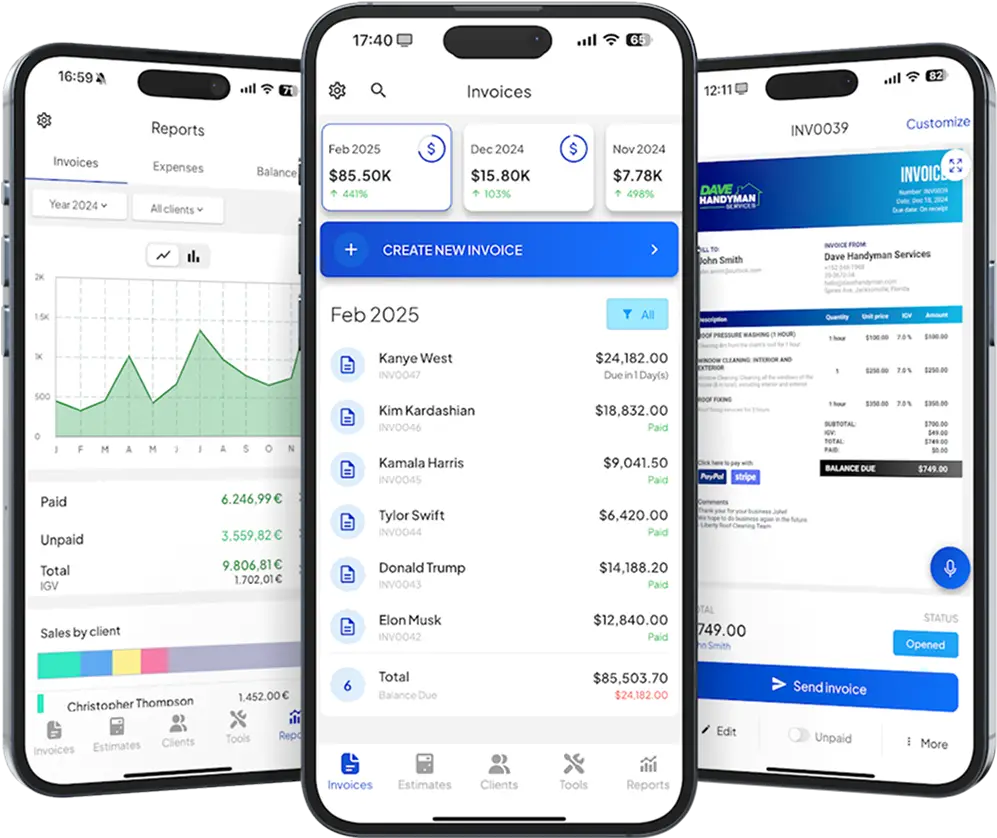
Invoice Fly is an invoicing and business management app for freelancers, contractors, and service providers. It connects each stage of the billing process, from creating an estimate and collecting approval to sending an invoice, accepting payment, and following up. Accepted estimates can be converted into invoices, which reduces duplicate data entry.
The app also includes billable time and expense tracking, receipt scanning, recurring invoices, payment tracking, and business reports. Paid access costs $8.99 per week or $98.99 per year, with unlimited invoices and estimates included in both plans.
For occasional needs, Invoice Fly offers free browser-based generators that do not require an account. These tools can create invoices, estimates, quotes, receipts, bills, proformas, and work orders. The paid app is better suited to businesses that need to manage documents, customer records, payments, expenses, and reporting as part of an ongoing workflow.
What Is Invoice Home?
Invoice Home is a web and mobile invoicing service for freelancers and small businesses. Its best-known feature is a library of more than 100 professionally designed templates. Users can create invoices, estimates, quotes, purchase orders, credit memos, and receipts, then email, download, print, or save them.
Other Invoice Home features include recurring invoices, customer histories, online payment links, automatic numbering, tax options, cloud storage, multiple languages, and support for more than 150 currencies. This Capterra overview confirms its focus on fast, customizable document creation.

Invoice Fly vs Invoice Home: Key Differences
Invoicing and Estimates
Both apps keep the basics approachable, even without an accounting background. Save your business and customer details, add services or products, run the totals, apply taxes or discounts, and send the finished document.
The difference is what the document is for. Invoice Fly builds billing around the job itself: send an estimate, collect approval, convert it into an invoice, and track what happens next, a flow suited to contractors who quote before they start. Invoice Home leans toward variety instead, adding purchase orders, credit memos, receipts, and quotes alongside invoices, with saved customers and items to speed up repeat billing.
Either way, this guide on how to write an invoice is worth checking first, since it covers what a customer needs to see before approving a bill.
Invoice Templates and Customization
Templates are the headline feature here. Invoice Home offers more than 100 designs, from restrained business layouts to brighter styles, plus a logo, color, currency format, and field options. Invoice Fly lets you customize templates and save your branding too, but design is a smaller part of a bigger workflow.
More choice doesn’t guarantee clarity, though. A professional invoice still needs seller and customer details, a unique number, dates, itemized charges, the amount due, and payment instructions.
Recurring Invoices and Billing Automation
Both apps can automate recurring billing. Invoice Fly ties it to reminders, status notifications, time records, and expenses, keeping everything connected rather than running on its own.
Invoice Home schedules documents weekly, monthly, quarterly, or yearly, with start and end dates and a prepared email, and extends that automation to other document types too. Either way, review a series whenever prices, scope, taxes, or details change. This intro to invoice automation covers where it helps and where a human check still matters.
Online Payments and Payment Tracking
Invoice Fly accepts payments through providers like Stripe and PayPal, with status labels (sent, viewed, paid, overdue) showing who needs a follow-up. Invoice Home connects to the same two providers, letting customers pay via a link while you mark documents paid or filter by status.
Processing fees sit outside the subscription either way, so compare card rates, payout times, refunds, and account requirements before choosing a provider. Clear invoice payment terms help too: state the due date, accepted methods, and any deposit or late-fee terms.

Customers, Items, and Invoice Management
Invoice Home keeps customer details and document history organized: filter by date, type, currency, or status, download statements, and save products or services you bill often.
Invoice Fly connects more of the actual work to that record, linking client and project files to estimates, invoices, time, expenses, receipts, and payments. Invoice Home answers what you billed; Invoice Fly adds how the charge came together. Once a document’s ready, how to send an invoice covers the best way to deliver it and keep a record.
Reports and Business Records
Invoice Home summarizes invoiced amounts, taxes, document status, and customer activity, with statements showing past and outstanding bills at a glance.
Invoice Fly’s reports add time and expenses for a fuller operational picture, though it’s not a full double-entry accounting system. The IRS notes in Publication 583 that your records need to support what you report at tax time, which usually means keeping receipts and bank records beyond what either app stores.
Multi-Currency and Tax Options
Invoice Home has the stronger international setup: more than 150 currencies, several languages, custom tax names and rates, and settings you can adjust per document or customer.
Invoice Fly supports currency and tax settings too, just without making them the focus. Neither guarantees compliance on its own. Sales tax, VAT, and reporting rules vary, so check the IRS small-business tax center for federal basics and a qualified adviser for anything state-level or international.
Ease of Use and Mobile Access
Neither app requires the setup of full accounting software. Invoice Home runs through a browser or mobile app with everything stored in the cloud, and feels quickest when the goal is just picking a template and sending a PDF.
Invoice Fly is mobile-friendly too, but its workspace covers more ground, letting a service pro issue an estimate, log time, photograph a receipt, and check payment status from the field. Since experiences vary, G2 reviews, Capterra reviews, and Trustpilot feedback are worth checking for patterns among similar businesses.
Invoice Fly vs Invoice Home Pricing
| Pricing detail | Invoice Fly | Invoice Home |
|---|---|---|
| Free option | No paid-app free plan; free document generators are available without an account | $0, with up to $1,000 invoiced per 30-day period |
| Monthly or weekly plan | $8.99 per week | $9 per month |
| Annual plan | $98.99 per year | None |
| Paid-plan allowance | Unlimited estimates and invoices | Unlimited documents, customers, and emails |
Invoice Fly’s yearly plan costs slightly less than 12 months of Invoice Home’s paid plan, although the billing options differ. Invoice Home offers extensive design options and unlimited cloud documents for $9 per month. Invoice Fly’s $98.99 yearly plan includes time and expense tracking, receipt scanning, estimates, and reporting tools that some businesses might otherwise need to manage separately.
Invoice Fly vs Invoice Home for Freelancers and Small Businesses
Invoice Fly tends to suit contractors who quote before starting work, freelancers who bill by the hour, and service providers who want expenses and receipts sitting right alongside their invoices. If you care more about the whole billing routine than a big design library, it’s the Invoice Home alternative worth a look.

Invoice Home fits better if you’re juggling several document types, billing in multiple currencies, or just want more layouts to choose from. Its free account can even cover a low-volume side business, as long as your rolling invoice total stays under the limit.
The real question is where your numbers already live. If hours, job costs, and receipts are scattered across different apps, Invoice Fly probably saves you more steps. If everything’s already organized and all you need is a polished document to send, Invoice Home keeps things simple.
Invoice Fly vs Invoice Home: Which Should You Choose?
It really comes down to when your invoicing work starts. Choose Invoice Fly if billing begins well before the final invoice, with estimates, approvals, time records, expense tracking, receipt capture, recurring invoices, and reminders carrying the wider job along with it. Choose Invoice Home if what matters most is how the document looks.
If you’re still deciding between Invoice Fly or Invoice Home, match the software to the work you actually want it to take off your plate: someone looking for an Invoice Fly alternative is probably drawn to Invoice Home’s template-first approach, while someone searching for an alternative to Invoice Home likely wants the deeper tracking that comes with Invoice Fly. Either way, the right pick is the one that quietly handles the part of the job you’d rather not think about.