Invoice Fly vs FreshBooks: Which To Choose
Table of Contents
At first glance, Invoice Fly and FreshBooks cover much of the same ground. Both help you bill clients and collect payments, but the experience is different. Invoice Fly centers the workflow on estimates, invoices, time, expenses, and follow-ups. FreshBooks branches into accounting reports, proposals, retainers, and project work.
In this Invoice Fly vs FreshBooks comparison, we look at each platform’s prices and deep dive into the features to help you decide which is best for your business.
Invoice Fly vs FreshBooks at a Glance
| Feature | Invoice Fly | FreshBooks |
|---|---|---|
| Best for | Solo contractors and service businesses that want simple billing tools | Freelancers, consultants, and agencies that manage clients and projects |
| Starting regular price | $8.99/week or $98.99/year | $23/month for Lite |
| Invoices and estimates | Unlimited on both paid plans | Unlimited, with limits on billable clients |
| Billable-client limits | Unlimited on both paid plans | 5 on Lite, 50 on Plus, unlimited on Premium |
| Proposals and retainers | Quotes and estimates available; no dedicated retainer feature | Included from Plus |
| Time and expense tracking | Included | Included |
| Receipt scanning | Included | Included from Plus |
| Accounting reports | Basic business reports | Double-entry accounting reports from Plus |
| Project profitability | No | Included with Premium |
| Online payments | Through Stripe and PayPal, supporting cards, digital wallets, ACH, and SEPA | Through FreshBooks Payments |
| Extra team members | 1 user per account | $11/month per person |
| Mobile and browser access | Yes | Yes |
Quick verdict: Invoice Fly gives independent service providers a direct route from estimate to payment, without client-based pricing. FreshBooks earns its higher price when proposals, retainers, shared projects, and accounting reports are part of the daily workflow.

What Is Invoice Fly?
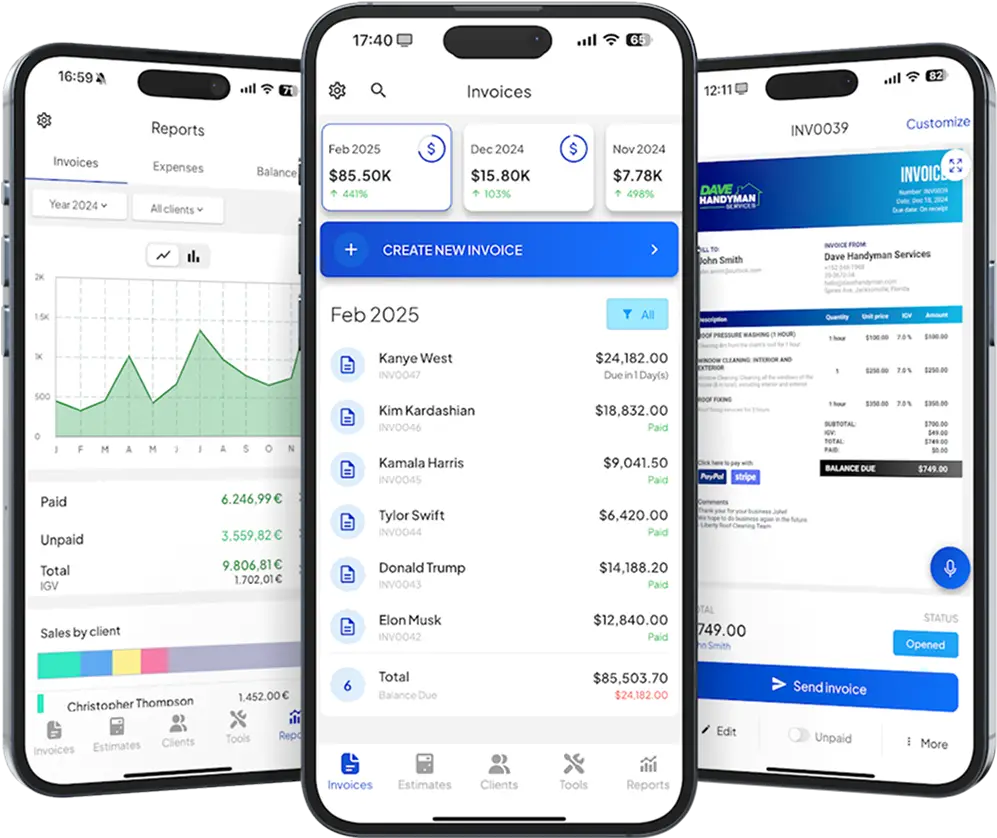
Invoice Fly is a billing app designed around the day-to-day workflow of independent tradespeople and service providers. It brings estimates, invoices, expenses, client information, and payment tracking together without requiring users to learn a full accounting system.
A typical workflow starts with creating an estimate for the job. Once the customer approves it, you can convert the estimate into an invoice, send it, and track its status through payment. Weekly and yearly subscribers receive the same core tools, including unlimited invoices and estimates, time tracking, receipt capture, expense records, client management, online payments, and business reports. Invoice Fly’s invoice software is available through its mobile apps and a web browser.
However, Invoice Fly is not a full double-entry accounting platform. You may still need a bookkeeper or another system for tasks such as bank reconciliation, accounts payable, balance sheets, and detailed financial statements.
If you are new to billing, this guide to what an invoice is explains how invoices document the products or services a customer needs to pay for.
What Is FreshBooks?
FreshBooks is invoicing and accounting software for freelancers, consultants, agencies, and small businesses. It combines billing with time tracking, expenses, projects, online payments, and financial reports.
Its plans are based partly on how many clients you can bill. Lite allows five billable clients, Plus allows 50, and Premium has no client limit. All three include unlimited customized invoices and estimates, recurring invoices, time tracking, expenses, and online payments. Plus adds proposals, retainers, receipt scanning, accountant access, and double-entry accounting reports. Premium adds project-profitability tools, accounts payable, and more detailed bill receipt scanning. Select is a custom plan for larger businesses and includes two team-member accounts and Advanced Payments.
You can compare this list with FreshBooks features on Capterra and FreshBooks reviews on G2 for an outside view of the platform. Review sites reflect individual user experiences, so we recommend using them alongside current product information.
Invoice Fly vs FreshBooks: Key Differences
In this section we will take a look at the biggest differences between Invoice Fly and FreshBooks.
Invoicing and Estimates
Both platforms handle estimates, invoices, online payments, and payment reminders, but their plan structures differ. Invoice Fly keeps billing at the center of the experience, with unlimited estimates and invoices on both paid plans and no published client limit. This may suit a cleaner, landscaper, or contractor who works with many customers throughout the year.
FreshBooks also includes unlimited invoices, but each plan limits how many clients you can bill. Lite may work for a consultant with four steady clients, while a service business with dozens of customers would need Plus or Premium even if it sends relatively few invoices. FreshBooks has the advantage for more detailed billing arrangements because Plus and higher plans include proposals, retainers, and recurring billing tools.
Accounting and Bookkeeping
FreshBooks’ Plus, Premium, and Select plans include double-entry accounting reports, bank reconciliation, and accountant access, while Premium and Select also include accounts payable. These features make FreshBooks a stronger choice if you want to manage billing and formal accounting in the same platform.
Invoice Fly focuses on everyday billing tasks, including tracking invoices, income, payments, receipts, and expenses. Its reports can help you monitor business activity, but the app is not intended to replace a complete bookkeeping system.
Tip! See the US Small Business Administration advice to business owners on how to maintain accurate records and understand their core financial statements.
Expense Tracking and Receipt Management
Receipt capture is included with each Invoice Fly subscription. A contractor can photograph a materials receipt at the store, add the expense to their records, and avoid searching through a truck or toolbox later. Keeping these documents organized can also support accurate business recordkeeping (see IRS Publication 583).
FreshBooks includes expense tracking and bank imports with its standard plans, while receipt scanning starts with Plus. Premium adds bill receipt scanning with line-item entry, and Select can automatically capture multiple line items. You can also mark expenses as billable when passing travel, materials, or subcontractor costs on to a client.
Time Tracking and Project Management
Invoice Fly includes time tracking that helps you turn completed work into accurate invoices. You can record hours for a client or project, then use those entries when preparing the bill. This straightforward workflow works well for solo contractors and service providers who need to track their time without managing a larger project system.
FreshBooks also converts tracked time into billable entries and adds tools for project budgets, team collaboration, client access, and project billing. Premium and Select can compare project income with expenses and labor costs to measure profitability. Team members cost $11 per person per month on standard plans, while Select includes two team-member accounts. These broader tools may suit businesses with several contributors or projects that must stay within a set budget.

Invoice Fly’s current Help Center says it does not support recurring billing automation, so I would avoid saying it can schedule recurring invoices. Its automation article supports payment reminders, status tracking, and online collection.
Recurring Invoices and Payment Reminders
Invoice Fly reduces repeat admin by tracking invoice status, accepting online payments, and sending reminders when payment is overdue. Its guide to invoice automation explains how these tools can make follow-up more consistent, although recurring invoices still need to be created manually. Setting clear invoice payment terms, including the due date, accepted payment methods, and any late fees, can make this process smoother.
FreshBooks adds automated recurring invoices for businesses that bill the same clients on a regular schedule. It also supports late-payment reminders and scheduled late fees, while Plus and higher plans include retainers for ongoing work. These features may make FreshBooks a better fit when repeat billing is a significant part of the business.
Online Payments
Invoice Fly connects with Stripe and PayPal, allowing customers to pay directly from an invoice. The provider you choose determines the available payment methods, transaction fees, and payout times. This setup can be convenient if you already use Stripe or PayPal and want to keep that existing payment relationship.
FreshBooks offers more payment controls within the platform. FreshBooks Payments, powered by Stripe, supports cards, digital wallets, ACH transfers for US businesses, and eligible buy-now-pay-later options. Published rates start at 2.9% plus $0.30 for standard consumer cards and 1% for ACH, although other fees may apply and Select customers may qualify for lower rates. Advanced Payments adds saved-card and virtual-terminal features for $20 per month on Lite, Plus, and Premium, and is included with Select.
Ease of Use and Mobile Access
Both platforms work in a browser and on mobile devices, but Invoice Fly offers a more focused experience. You can prepare an estimate, record an expense, check whether a client has opened an invoice, and send the final bill from one streamlined system. This simplicity makes it well suited to contractors and service providers whose main priority is billing.
FreshBooks combines invoicing with accounting, projects, proposals, retainers, payments, and team access. It requires more setup but may replace several separate tools for businesses with more complex workflows.
For additional context, compare recent FreshBooks reviews on Capterra and FreshBooks customer reviews on Trustpilot, keeping in mind that ratings and individual experiences can change.

Invoice Fly vs FreshBooks Pricing
| Pricing detail | Invoice Fly | FreshBooks Lite | FreshBooks Plus | FreshBooks Premium | FreshBooks Select |
|---|---|---|---|---|---|
| Regular US price | $8.99/week or $98.99/year | $23/month | $43/month | $70/month | Custom pricing |
| Billable clients | Unlimited | 5 | 50 | Unlimited | Unlimited |
| Main features | Full paid feature set with unlimited invoices and estimates | Core invoicing, expenses, time tracking, and payments | Proposals, retainers, receipt scanning, and accounting reports | Project profitability, accounts payable, and bill scanning | Two team members, Advanced Payments, and dedicated support |
FreshBooks uses a tiered pricing model, with higher plans increasing client limits and unlocking additional features. Invoice Fly keeps pricing simple with two paid plans that include the same full feature set. The table above compares each platform’s standard published pricing rather than temporary promotional offers.

Invoice Fly vs FreshBooks for Freelancers and Small Businesses
Invoice Fly is a good choice for electricians, cleaners, landscapers, handymen, and other solo service professionals who need straightforward invoicing without client limits or unnecessary complexity.
FreshBooks is better suited to freelancers and small businesses that want invoicing combined with accounting features, with plans that scale as client numbers and reporting needs grow.
When comparing Invoice Fly and FreshBooks, consider how many clients you invoice, whether you need built-in accounting, and if multiple users or an accountant will need access. Whatever you choose, following invoicing best practices, such as setting clear invoice due dates and sending timely payment reminders, will help you stay organized and get paid faster.
Invoice Fly vs FreshBooks: Which Should You Choose?
The right choice depends on how you run your business. Invoice Fly is ideal for solo contractors and service providers who want a simple way to create estimates, send invoices, track payments, and record expenses. Its annual plan offers good value for businesses with a growing client base that do not need advanced accounting or project management features.
FreshBooks is a better fit for businesses that need built-in accounting, proposals, retainers, project collaboration, accountant access, bank reconciliation, or project profitability reports. Before choosing a plan, consider its billable client limits and the additional cost of extra team members.
Overall, choose Invoice Fly if you want a straightforward estimate-to-payment workflow. Choose FreshBooks if your business will benefit from its broader accounting and project management capabilities.