Invoice Fly vs Wave: Which Is Better?
Table of Contents
At first glance, Invoice Fly and Wave seem to solve the same problem: sending professional invoices and getting paid. Look closer, though, and an Invoice Fly vs Wave comparison reveals two different approaches. Invoice Fly follows the job from estimate to payment, with tools for billable time, receipts, deposits, and follow-ups. Wave connects invoicing to basic bookkeeping.
If you are choosing between Invoice Fly or Wave, this guide will show you how they compare.
Invoice Fly vs Wave at a Glance
| Feature | Invoice Fly | Wave |
|---|---|---|
| Best for | Contractors and service professionals who want focused billing and job-related admin tools | Freelancers and small businesses that want invoicing with bookkeeping |
| Starting price | $8.99/week or $98.99/year | $0 for Starter |
| Invoices and estimates | Unlimited on both paid plans | Unlimited on Starter and Pro |
| Recurring invoices | Included | Pro or eligible Wave Payments access |
| Payment reminders | Included | Pro or eligible Wave Payments access |
| Bookkeeping | Income, expense, invoice, and client reports | Double-entry bookkeeping and financial reports |
| Bank transaction imports | Not designed as a bank-reconciliation tool | Automatic imports with Pro |
| Receipt scanning | Included | Pro or a paid Starter add-on |
| Time tracking | Included | Not listed as a built-in feature |
| Online payments | Through connected Stripe or PayPal accounts, supporting cards, digital wallets, ACH, and SEPA | Through Wave Payments |
| Payroll | No | Paid add-on |
| Additional users | 1 user per account, separate business accounts required | Available with Pro |
| Mobile and browser access | Yes | Yes; some mobile features vary by plan |
Quick verdict: Choose Invoice Fly for focused estimate-to-payment tools, including time and receipt tracking. Choose Wave Starter for free invoicing and basic bookkeeping, or Pro for bank imports and more accounting automation.

What Is Invoice Fly?
For a service business, billing often begins well before there is an invoice to send. Invoice Fly supports that earlier stage, when you are pricing the work, confirming the details, and getting the customer’s approval.
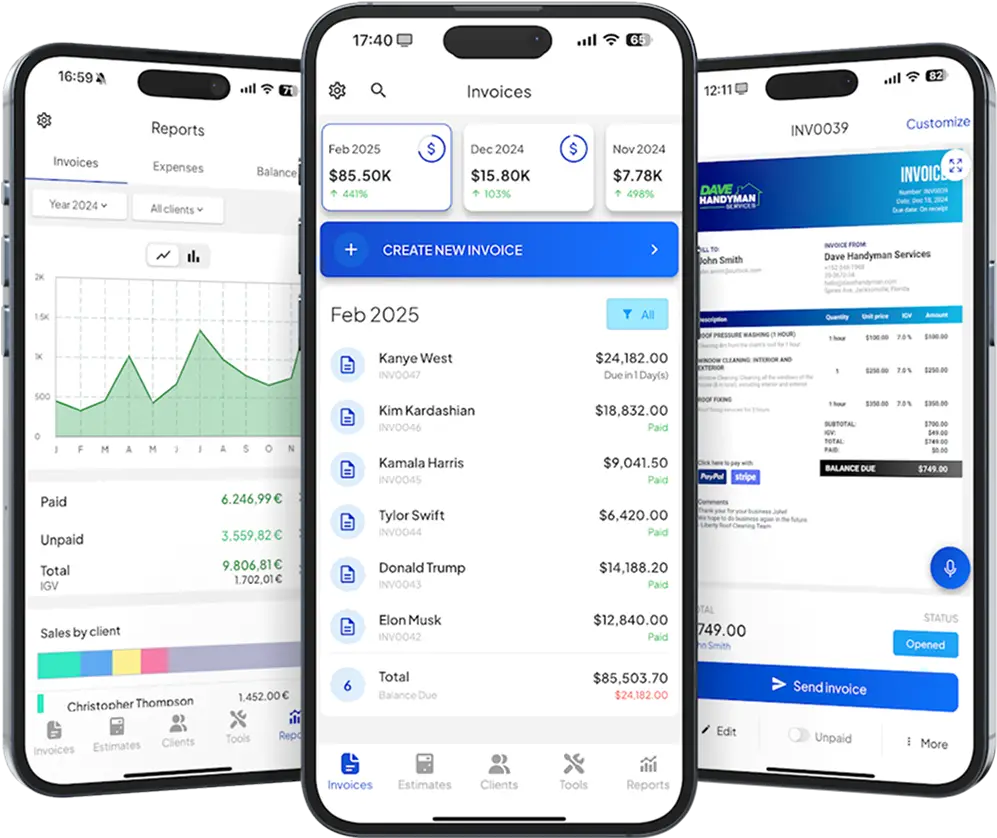
A job can begin with an estimate that includes a signature or deposit request. Once the customer agrees, you can turn it into an invoice and offer payment through a connected Stripe or PayPal account. Invoice Fly’s invoice software then shows whether the invoice was sent, viewed, paid, or overdue.
Both paid plans include unlimited invoices and estimates, along with recurring billing, reminders, time tracking, receipt scanning, expenses, client management, and reports.
Because the platform is organized around jobs and customers rather than accounting records, its everyday tools are easy to understand. The tradeoff is that it does not replace double-entry bookkeeping or payroll software.
What Is Wave?
Wave is financial software for freelancers and small businesses. Its free Starter plan includes unlimited estimates, invoices, bills, and bookkeeping records, plus basic reports and mobile invoicing.
The free Starter plan covers the essentials, but additional Wave features such as automatic bank imports, receipt scanning, additional users, wider branding, integrations, and automation require Pro or an add-on. Wave pricing starts at $0 with Starter, then moves to $19 per month or $190 per year for Pro. Payroll and bookkeeping support are sold separately.
For another perspective, read Wave reviews on Trustpilot to see what users say about setup, support, and everyday use.
Invoice Fly vs Wave: Key Differences
Invoicing and Estimates
Both platforms offer unlimited invoices and estimates, save customer details, accept payments, and turn approved estimates into invoices, so the basics look similar on paper. The real difference shows up earlier in the process. With Invoice Fly, an estimate can include a customer’s signature or deposit request, not just a price. Its estimate and quote software lets a contractor secure a clearer commitment before materials are ordered or time is reserved.
Wave Starter covers the same basic document process for free, and Pro adds branding and automation. Invoice Fly places more emphasis on the pre-job steps, making it the more focused option when signatures, deposits, billable time, and follow-ups all need to feed into the same invoice.
Whichever platform sends the invoice, the fundamentals still matter. Knowing how to write an invoice and avoiding common invoicing mistakes can prevent payment delays no matter which tool you use.
Accounting and Bookkeeping
Wave’s biggest difference from Invoice Fly is what happens after the invoice is sent. Wave keeps a full set of books. Its double-entry system records income, expenses, assets, and liabilities, with Starter users entering transactions by hand and Pro importing eligible bank activity automatically through Plaid.
Invoice Fly stays lighter. Its reports on revenue, expenses, invoices, payments, and clients are useful for tracking the business from day to day, but they do not create a general ledger or reconcile bank accounts.
That difference in depth matters at tax time. IRS Publication 583 explains that business records should show income and expenses and support the entries on your tax return. Wave builds more of that recordkeeping into the platform. Invoice Fly organizes invoices, payments, expenses, and receipts, but you may still need accounting software or a bookkeeper to maintain your full books.
Choose Wave if you want bookkeeping built into the same app you use for invoicing. Choose Invoice Fly if you would rather keep billing simple and manage the books elsewhere.
Expense Tracking and Receipt Management
Invoice Fly includes expense tracking and a dedicated receipt scanner app with both paid plans. A contractor can photograph a materials receipt at the counter and record the cost before the paper gets lost.
Wave takes a more accounting-focused route. Pro captures receipts through mobile, desktop, or email and uses optical character recognition to turn them into bookkeeping transactions. Starter users can add the same capture tool for $11 per month.
The practical difference is where the receipt ends up. Invoice Fly files it with your job expenses, keeping costs organized by client or project. Wave turns it into a bookkeeping transaction that is ready to categorize and reconcile alongside your other accounts. That connection matters more if you want to keep full books in the same platform.

Recurring Invoices and Payment Reminders
Recurring billing is useful when the same customers are charged on a regular schedule. A cleaner might invoice weekly, while a maintenance provider may bill every month under an ongoing service agreement.
Invoice Fly includes recurring invoices and automatic payment reminders in both paid plans. It also tracks whether an invoice has been viewed or is overdue, so you know when a personal follow-up is needed. Setting clear invoice payment terms upfront, including the due date, payment methods, and any deposit, can reduce the need for those follow-ups.
Wave Pro also includes recurring invoices and late-payment reminders, and some eligible Wave Payments users may receive access without upgrading. The main difference is predictability. Invoice Fly includes both tools in either paid plan, so you do not need to qualify for payment access or move to a higher tier to keep a customer on a billing schedule.
Online Payments
Both platforms let customers pay from an invoice, removing the need to arrange payment separately. The customer experience is similar, but the payment is processed and managed differently behind the scenes.
Invoice Fly connects to the business’s Stripe or PayPal account. The provider sets the payment methods, fees, requirements, and payout times, while Invoice Fly reflects the activity in the invoice status and reports. This setup suits businesses that already use Stripe or PayPal and want to keep that flexibility.
Wave uses its own payment service for approved users, keeping payments and bookkeeping in the same system rather than routing them through a separate provider. Processing costs depend on the payment method and plan, so include them alongside subscription and add-on fees when comparing the total price. This setup may appeal more if you want payments to flow directly into your bookkeeping records.
Payroll and Business Management
Wave offers payroll as a paid add-on in all 50 states, including direct deposit, employee access, payroll journal entries, and payroll-tax services. Once you have employees, keeping accurate wage and payment records becomes an important part of running the business.
The U.S. Department of Labor says covered employers must retain payroll records for at least three years and certain wage-calculation records for two years. Wave can help keep that information organized, although the employer remains responsible for making sure it is complete and accurate.
Invoice Fly does not offer payroll. It stays focused on the customer side of the business, including estimates, billable time, job expenses, receipts, invoices, and payment follow-ups. Its built-in time tracking is especially useful for freelancers and contractors because recorded hours can be assigned to a client or project and carried directly into billing.
Ease of Use and Mobile Access
Both platforms are available in a browser and on mobile devices, but they organize the work differently. Which one feels easier will depend on whether you tend to think in terms of customer jobs or financial accounts.
Invoice Fly follows the job. Its main screens deal with customers, estimates, invoices, time, expenses, and payments. A contractor can reach common tasks without learning bookkeeping categories, which makes the platform feel more direct for everyday job admin.
Wave follows the financial record. Accounts, categories, transactions, and reports require more setup, and some receipt and transaction tools need Pro or an add-on. Starter still supports mobile invoicing. The extra structure takes longer to learn, but it may save time later when invoicing is part of a larger bookkeeping process.
Invoice Fly vs Wave Pricing
| Invoice Fly | Wave Starter | Wave Pro | Wave Receipts for Starter | Wave Payroll | |
|---|---|---|---|---|---|
| Price | $8.99/week or $98.99/year | Free | $19/month or $190/year | $8/month or $72/year | From $40/month, plus $6 per active employee or contractor paid |
| Main features | Unlimited invoices and estimates with full paid access | Unlimited estimates, invoices, bills, and bookkeeping records | Bank imports, receipt scanning, automation, custom branding, integrations, and additional users | Unlimited digital receipt capture and expense tracking | Payroll processing, direct deposit, employee access, and payroll tax services |
Wave Starter may work if you only need basic invoicing and bookkeeping. However, some useful tools require a paid add-on or an upgrade to Wave Pro. Invoice Fly includes receipt scanning, time tracking, recurring invoices, and payment reminders in both billing options, making its pricing more straightforward for freelancers and service businesses that need these features.

Invoice Fly vs Wave for Freelancers and Small Businesses
For many contractors, paperwork starts to slow things down before and just after a job. You may need to prepare the estimate, log hours, save receipts, send the invoice, and follow up with the customer. Invoice Fly keeps that sequence together, and invoice automation can reduce the number of steps you repeat by hand.
That makes Invoice Fly a practical Wave alternative when you want less accounting software and more help with customer jobs. If you are a freelancer looking for an alternative to Wave, you may not need bank feeds or a general ledger at all. You may simply want a faster way to move from approved work to payment.
Wave solves a different problem. Its free Starter plan can suit a solo business willing to enter transactions manually, while Pro adds bank imports and more automation. It can be an Invoice Fly alternative when keeping invoices and bookkeeping together matters more than built-in time tracking, signatures, or deposit requests.
Invoice Fly vs Wave: Which Should You Choose?
The Wave vs Invoice Fly decision comes down to where you need the most support. Wave Starter wins on subscription price and gives new businesses a free way to begin invoicing and bookkeeping. Wave Pro is the stronger fit when bank imports, additional users, payroll, and deeper accounting tools are essential.
Invoice Fly is built for a different daily routine. It brings estimates, time, receipts, deposits, invoices, and follow-ups into one simpler workflow. For contractors and service businesses that mainly want to organize customer jobs and get paid, it is likely to be the more useful choice.