What Is Billing Software? How It Automates Payments
Table of Contents
Billing software can turn one of the most repetitive parts of running a business into a much simpler routine. Instead of manually creating bills, checking who has paid, chasing overdue balances, and updating spreadsheets, you can manage more of the process in one place and spend less time on payment admin.
In this guide, we’ll explain how billing software works, which features are most useful, the different types available, typical costs, and how to choose a platform that fits your business.

What is billing software?
Billing software is a digital tool that helps businesses manage the process of charging customers and getting paid. Depending on the platform, it can create invoices, calculate totals and taxes, accept online payments, send payment reminders, track unpaid balances, manage recurring billing, and keep customer payment records organized.
You may be wondering how billing software differs from invoicing software. The two overlap a lot, and for many small businesses, the same platform handles both. The main difference is usually the scope:
- Invoicing software focuses mainly on creating, sending, and managing invoices. You can learn more in our guide to what an invoice is.
- Billing software can cover more of the payment process, from calculating what a customer owes to collecting payment and tracking outstanding balances. Our guide to what billing is explains that wider process in more detail.
In practice, the line between the two is often blurry. What matters most is whether the software gives you the tools you need to bill customers accurately, stay on top of payments, and keep the process organized.
How does billing software work?
A typical small business billing process looks something like this:
- Add the customer and work details. Record the client, products, services, hours, or project information.
- Calculate the amount due. Add prices, quantities, taxes, discounts, deposits, or other charges.
- Create and send the invoice. The software formats the billing information into a professional document.
- Collect payment. Customers may be able to pay online using options such as credit cards or bank transfers.
- Track the invoice. The software records whether an invoice is sent, outstanding, overdue, or paid.
- Follow up. Automatic reminders can reduce the need to manually chase overdue payments.
- Record the transaction. Payment information stays connected with the customer and invoice for future reference.
For repeat customers, recurring invoices can automate even more of the process. Our guide to billing cycles explains how recurring billing periods work.
7 key features of billing software
The exact features vary between platforms, but these seven functions are particularly useful for small businesses and service providers.
1. Invoice creation and customization
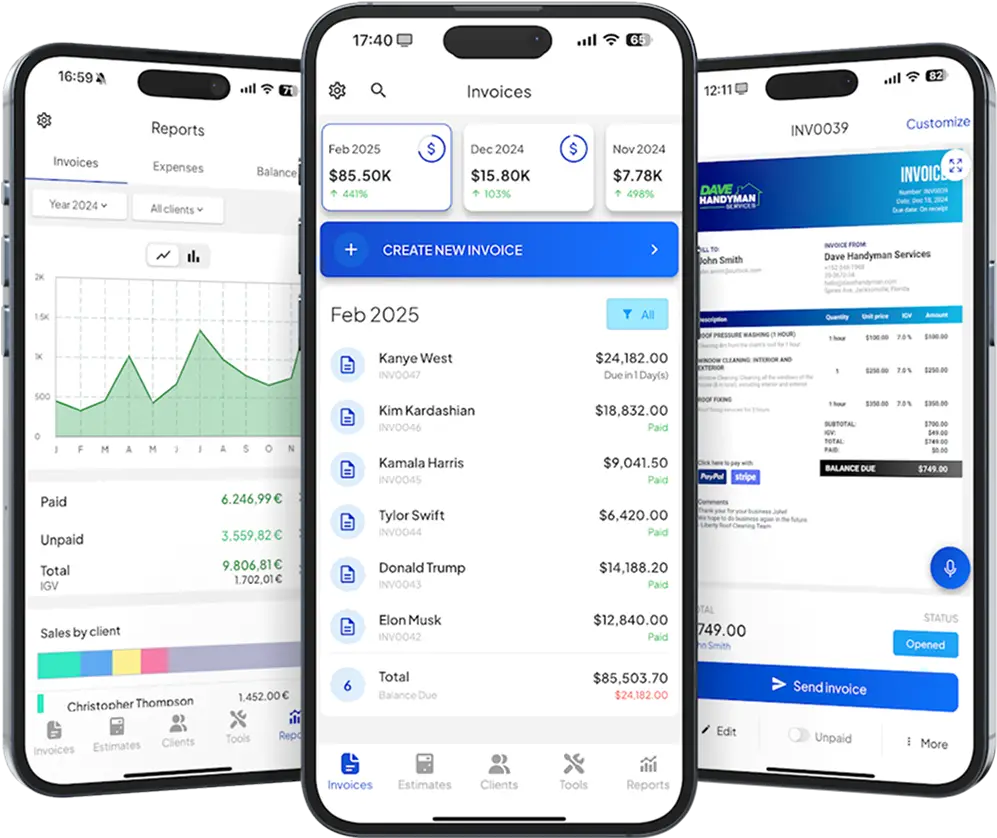
Billing software should let you create professional invoices with your business details, customer information, products or services, prices, taxes, payment terms, and due dates.
Customizable templates can also help keep your branding and billing information consistent.
2. Automatic calculations
Instead of calculating every subtotal, tax, discount, and balance manually, billing software can perform the calculations for you. This saves time and reduces simple arithmetic errors.
3. Online payment collection
Giving customers a convenient way to pay can remove unnecessary steps from the payment process. Depending on the software and payment provider, customers may be able to pay invoices online by card or bank transfer.
InvoiceFly, for example, lets businesses accept online payments alongside their invoices.
4. Payment tracking and notifications
Once invoices have been sent, billing software can help you see which customers have paid and which balances remain outstanding.
This gives you a clearer view of outstanding payments and shows which customers may need a follow-up.
5. Automatic payment reminders
Following up on unpaid invoices takes time. Automatic reminders can contact customers when a payment is approaching its due date or has become overdue.
If late payments are a recurring problem, these tips for getting invoices paid faster can also help improve your billing process.
6. Recurring billing
Recurring billing features are useful for retainers, maintenance contracts, subscriptions, and other ongoing services.
InvoiceFly supports recurring invoices for repeat customers. More advanced subscription billing platforms may also handle features such as usage-based pricing, plan changes, and complex subscription management.
7. Customer and financial records
Keeping customer, invoice, and payment information together makes it easier to review transactions and monitor outstanding balances.
The IRS recommends keeping organized business records to help track income and expenses, prepare financial statements and tax returns, and support items reported on those returns.

Types of Billing Software
Billing systems range from simple small business apps to specialized platforms built for particular industries or pricing models.
| Type | Common users | Typical needs |
| Small business billing software | Contractors, freelancers, service businesses | Invoices, payments, reminders, customer records |
| Subscription billing software | SaaS, memberships, subscription businesses | Recurring charges, renewals, plan management |
| Usage-based billing software | SaaS, utilities, telecom | Metered usage and variable charges |
| Professional services billing software | Consultants, legal and other service firms | Time, expenses, projects, client billing |
| Retail/POS billing software | Retail businesses | Transactions, payments, receipts, inventory connections |
These categories can overlap. A small business billing app may support recurring invoices, for example, without offering the more complex tools found in a dedicated subscription billing system.
Common billing methods
Billing methods describe how you charge a customer, not the type of software you use.
- Fixed or project billing: You charge an agreed price for the entire job or project.
- Hourly billing: The customer is charged based on the time spent on the work.
- Recurring billing: Customers are billed on a regular schedule, such as weekly, monthly, or annually.
- Milestone or progress billing: A larger project is divided into stages, with payment due as milestones are reached.
- Usage-based billing: The amount charged changes according to how much of a product or service the customer uses.
Many businesses use more than one method. A contractor might charge a fixed price for smaller jobs but use progress billing for a project that takes several months.
Benefits of Using Billing Software
For a small business, one of the biggest benefits of billing software is reducing repetitive admin. Instead of manually creating documents, checking calculations, recording payments, and remembering every follow-up, you can manage more of the process from one place.
Billing software can help you:
- create professional invoices faster
- reduce manual calculation errors
- make it easier for customers to pay
- track paid and unpaid invoices
- automate payment reminders
- manage recurring invoices
- keep customer and payment records organized
- reduce duplicate data entry
Good financial organization also makes it easier to understand how money moves through your business. The U.S. Small Business Administration highlights bookkeeping and financial management as important parts of running a business.
Billing is necessary admin, but time spent manually creating invoices or chasing payments is time you cannot spend on paid work. InvoiceFly’s Salary & Time Gap explores how administrative work can cut into billable time.

What to Look for in Billing Software
Start with the way you currently bill customers and identify where you lose the most time.
For a contractor or small service business, ask:
- Can I create and send invoices from my phone?
- Can customers pay online?
- Can I see which invoices are unpaid?
- Can I automate reminders and recurring invoices?
- Can estimates or completed jobs flow into invoices?
- Can I keep customer details and payment records together?
- Is the software simple enough to use regularly?
- Does the price make sense for the amount I bill?
A platform with hundreds of features is not necessarily better. A straightforward invoicing and billing app may be more useful for a small service business than an enterprise system built around complex subscriptions or accounting workflows.
How Much Does Billing Software Cost?
Billing software can range from free to several hundred dollars per month, while advanced enterprise systems may cost thousands or use custom pricing.
Free tools and templates can be enough if you only send invoices occasionally. InvoiceFly, for example, offers a free invoice generator for creating individual invoices online.
Small business billing software is usually subscription-based and may include payment tracking, reminders, recurring invoices, online payments, customer management, and mobile access.
Accounting and business management platforms generally cost more because billing is only one part of the system. You may also be paying for bookkeeping, payroll, inventory, reporting, or additional users.
Advanced subscription and enterprise billing platforms can cost hundreds or thousands of dollars per month, with pricing based on users, transaction volume, customers, usage, or a custom contract.
The best value is not necessarily the cheapest platform or the one with the longest feature list. Focus on what you will actually use and whether the software saves enough time and manual work to justify the cost.

Make Billing Easier for Your Business
Billing software should make getting paid feel simpler, not add another layer of admin. By bringing invoices, payments, reminders, recurring billing, and customer records into one place, it can help you stay organized and spend less time chasing paperwork.
The right platform depends on how your business works, but the goal is the same: fewer manual steps and a smoother path from completed work to payment. If you want to understand where the software fits into that wider process, our guide to what billing is explains the full billing cycle from calculating charges to recording payment.