Tax vs. VAT: What’s the Difference for Small Businesses?
Table of Contents
Do you need to add VAT to your invoice, or does sales tax apply? And how is either different from the tax you pay on your profits? These questions often come up when you start billing customers, especially overseas.
VAT, or value-added tax, is one of several taxes your business may need to handle. Some taxes come out of your earnings, while others are collected from customers. This guide breaks down tax vs VAT, explains how VAT differs from sales tax, and shows what that means for your invoices and records.
What Is Tax?
Tax is money that individuals and businesses must pay to a government under its tax laws. What you owe depends on factors such as your earnings, business structure, location, and activities.
Small business owners may encounter:
- Income tax: Based on taxable income or profits.
- Self-employment tax: Generally covers Social Security and Medicare for self-employed people in the US.
- Employment taxes: Include employer taxes and amounts withheld from employee wages.
- Property tax: Applies to real estate or other taxable property.
- Sales tax: Generally collected on taxable sales to the final customer.
- Excise tax: Applies to specific products, services, or activities.
The IRS explains the main federal business taxes. State and local obligations may apply separately.
VAT belongs within this broader category, too. For an overview, see our guide to different types of taxes.
What Is VAT?
VAT is a consumption tax used in countries including the UK, France, Germany, and Spain. Businesses generally collect it from customers on taxable sales and report it to the tax authority.
Unlike a tax based on your profits, VAT follows the sale of goods or services. A business can have a slow year with little profit and still have VAT to report.
VAT-registered businesses may deduct eligible VAT paid on their purchases from the VAT they collect. The European Commission explains how this allows tax to be collected throughout the supply chain, with the final consumer generally bearing the cost.
Once you know which tax applies, your invoice needs to show the charge and customer total clearly.
Tax vs. VAT: The Main Differences
The difference between tax and VAT is mainly one of scope: tax is the broad category, and VAT is one specific part of it.
| Comparison | Tax in general | VAT |
|---|---|---|
| Definition | Broad category of government charges | A specific consumption tax |
| What it applies to | Income, profits, wages, property, purchases, or activities | Taxable goods and services |
| Who bears the cost | Depends on the tax | Generally the final consumer |
| Who collects it | Tax authorities, employers, or businesses, depending on the tax | Usually VAT-registered suppliers |
| Collection stage | Varies | Multiple supply-chain stages |
| Deductions | Depend on the tax | Eligible input VAT may offset output VAT |
| Invoice treatment | Some taxes don’t appear on customer invoices | VAT commonly appears in the invoice breakdown |
Think about a contractor’s income tax and VAT. Income tax generally relates to taxable earnings or profits. VAT collected from customers is generally a tax liability, rather than money the contractor has earned.
That’s why a customer’s full payment isn’t necessarily all available to spend.
VAT vs. Sales Tax
VAT and retail sales tax both tax consumption. The main difference is when businesses collect them.
Traditional retail sales tax is generally collected when the final customer buys a taxable product or service. A retailer purchasing stock for resale may qualify to buy it without sales tax.
Under VAT, a supplier generally charges VAT to the retailer. The retailer then charges VAT to its customer and may deduct eligible VAT paid to the supplier.
The OECD explains these different collection methods. The United States has no national VAT, although state and local sales taxes commonly apply.
For US businesses, VAT questions often arise when selling internationally. You don’t automatically charge VAT just because a customer lives abroad.
How Does VAT Work?
Suppose a contractor buys materials from a supplier for $500 before VAT. At a hypothetical 20% rate, the contractor pays another $100 in VAT.
The contractor uses those materials to complete a customer project priced at $1,500 before VAT.
| Customer invoice | Amount |
|---|---|
| Project price before VAT | $1,500 |
| VAT at 20% | $300 |
| Total payable | $1,800 |
The contractor now has two VAT amounts to track:
- Input VAT: The $100 paid to the supplier.
- Output VAT: The $300 charged to the customer.
If the full input VAT qualifies for deduction, the calculation is:
$300 output VAT − $100 input VAT = $200 payable
This simplified example uses dollars for illustration. Actual rates and recovery rules depend on the country and transaction.
Keep the supplier’s invoice. A receipt can show that you paid, but proof of payment alone may not meet the requirements for claiming input VAT.
Who Needs to Register for VAT?
There’s no single registration rule that applies everywhere. Your obligations depend on where you operate, what you sell, and how much taxable business you do.
Many countries set a registration threshold based on taxable sales. Some allow businesses below that threshold to register voluntarily. For example, HMRC explains both mandatory and voluntary registration in the UK.
Cross-border sales can follow different rules. Selling digital services, storing stock abroad, or importing goods may create obligations even when your business is small.
Before charging VAT, confirm whether you must register and when your registration takes effect. Don’t assume another country’s threshold applies to your sales there.
How Does VAT Affect an Invoice?
Your invoice should make it easy for the customer to see what you charged and how much tax applies.
A full VAT invoice commonly includes:
- An issue date and unique invoice number.
- Seller and customer details.
- VAT identification numbers where required.
- Descriptions and quantities of goods or services.
- Net amounts before VAT.
- VAT rates and amounts.
- The gross total payable.
- Special wording where required, such as for reverse-charge transactions.
Before sending your invoice, check that its VAT treatment matches your original estimate. If different VAT rates apply, show the amounts for each rate separately so your customer can follow the breakdown.
The exact information required depends on the country and invoice type. The European Commission explains EU VAT invoice requirements, while our guide to what an invoice should include covers the general billing details.
Need help working out the figures? Our guide to calculating VAT on an invoice explains the formulas with examples. You can also use Invoice Fly’s free VAT calculator to add VAT or separate it from a tax-inclusive total.
Standard, Reduced, Zero, and Exempt VAT
Not every sale gets the same VAT treatment. Before choosing a rate, check how the relevant country classifies your goods or services.
- Standard-rated: The country’s standard VAT rate applies.
- Reduced-rated: A lower rate applies to specified goods or services.
- Zero-rated: The sale is taxable at 0%. The seller may still recover eligible input VAT.
- VAT-exempt: No VAT is charged, and recovery of related input VAT is generally restricted.
Some transactions are outside the scope of VAT altogether.
Zero-rated and exempt sales can look similar to customers because neither adds VAT to their bill. For the seller, however, the difference can affect how much VAT is recoverable on expenses. HMRC explains this distinction under UK rules.
What Happens With International Sales?
An overseas address alone won’t tell you how to handle VAT. You’ll need to check the customer’s status, what you’re selling, and where the transaction is treated as taking place.
These are often called place-of-supply rules. Goods, services, and digital products may follow different rules, as may sales to businesses and consumers.
International transactions can involve import VAT, export relief, overseas registration, or the reverse charge.
Under reverse-charge VAT, the customer accounts for VAT instead of the supplier collecting it. You may need to verify the customer’s VAT number and include specific invoice wording.
Check the treatment before issuing your quotation, particularly if the tax could change the final price.
How to Track Tax and VAT
Separate the money you earn from the tax you collect. Otherwise, your bank balance can make your business look better funded than it is.
Track these amounts separately:
- Sales revenue before VAT.
- Output VAT charged to customers.
- Input VAT paid on purchases and the portion recoverable.
- Zero-rated, exempt, and other sales categories.
- Gross customer payments.
- Credit notes, refunds, and tax payments.
Keep supporting documents with each transaction. If you reduce or cancel a sale after invoicing, follow the applicable credit-note process rather than simply deleting the invoice.
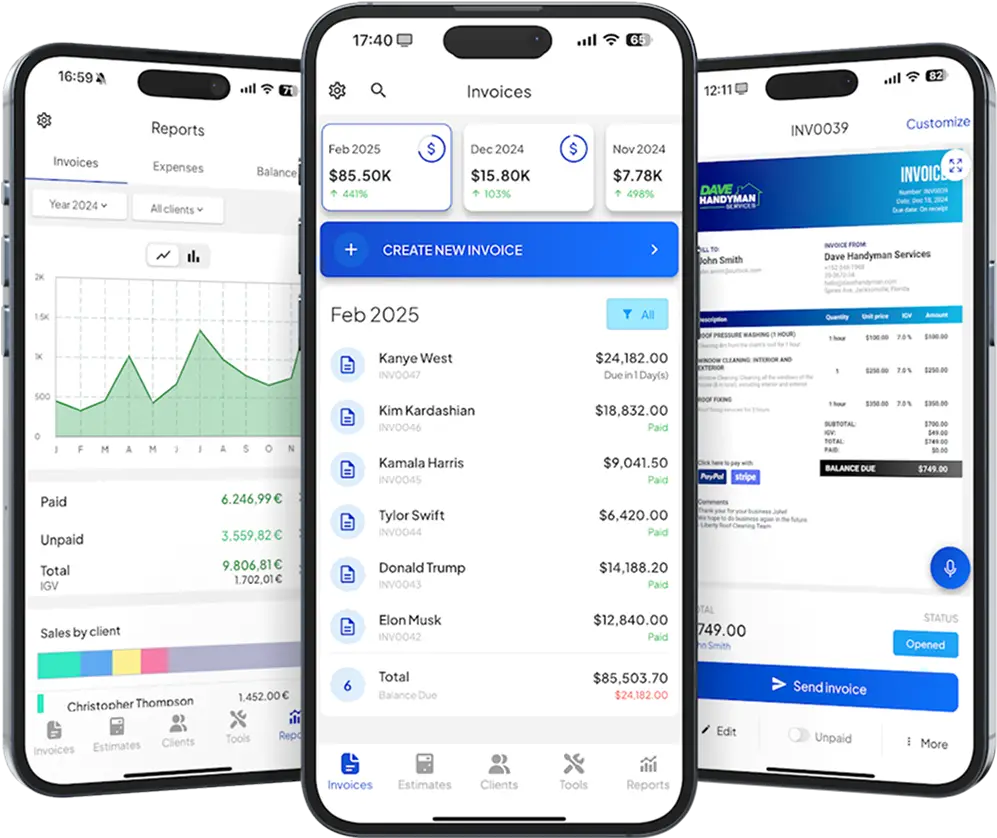
A consistent billing process helps you connect agreed prices, invoices, and payments. Invoice Fly’s invoice maker can help you create and organize customer invoices.
Common Tax and VAT Mistakes
Doing the math is often the easy part. Problems usually start when the wrong tax treatment is applied.
Watch for these mistakes:
- Charging VAT without checking registration requirements.
- Applying the standard rate to every sale.
- Confusing zero-rated sales with exempt sales.
- Adding VAT again when the agreed price already includes it.
- Treating VAT collected as sales revenue.
- Claiming input VAT without the required records.
- Leaving required information off an invoice.
- Assuming domestic rules apply to overseas sales.
Review your tax settings when you introduce new services or start selling in another country. Catching a mistake before invoicing saves you from correcting documents and explaining a changed bill later.
For a broader review, revisit our guide to common tax types.
Conclusion
VAT is one part of your business’s tax responsibilities. Knowing whether to collect it, which rate applies, and what your invoice must show matters more than memorizing tax terminology.
Keep clear records, separate VAT from revenue, and check uncertain transactions with the relevant tax authority or a qualified adviser.
When you’re ready to bill, use Invoice Fly’s free invoice generator or free invoice templates to prepare a clear customer invoice.